When Your Abuser Has Already Been Convicted of Threatening to Kill You

The threat is no longer simply an allegation. A court has already recognised it as a criminal offence. There is a profound difference between reporting a death threat and living with the knowledge that the person who threatened you has already been criminally convicted for doing so. For survivors of domestic abuse, that distinction matters.… Read More When Your Abuser Has Already Been Convicted of Threatening to Kill You

“If You Ever Find Another Partner, I Will Kill You”: The Reality of Death Threats After Domestic Abuse

By Linda C.J. Turner | Trauma Therapist | Neuroscience & Emotional Intelligence Practitioner | Advocate for Women’s Empowerment When a threat follows you long after you leave Imagine finally finding the courage to leave a relationship that has caused you years of pain. You have spent years living with criticism, intimidation, emotional abuse or physical… Read More “If You Ever Find Another Partner, I Will Kill You”: The Reality of Death Threats After Domestic Abuse

When Is It Safe to Move On Publicly After Domestic Abuse?

Leaving an abusive relationship is not always the end of the abuse. Sometimes, it is the beginning of a different kind of fear. After decades of domestic abuse, coercive control, intimidation and threats, you may finally reach a point where you can breathe again. You have left quietly. You have rebuilt your life carefully, perhaps… Read More When Is It Safe to Move On Publicly After Domestic Abuse?

Obtaining a New Protective Order in Spain: What Survivors Need to Know

If your restraining order is approaching expiry and you are concerned about your safety, you may be able to ask the court for a new protective measure. This is not an automatic renewal: the court must consider the legal requirements and the evidence of risk. Under Articles 544 bis and 544 ter of Spain’s Criminal… Read More Obtaining a New Protective Order in Spain: What Survivors Need to Know

1. How the VioGén scoring system works in English

Spain’s official VioGén system — English explanation describes a police risk-assessment process, not a simple public checklist. VioGen +1 The process is broadly: Information is gathered: the police interview the victim and consider available evidence, previous incidents, witness accounts and relevant records. Risk factors are entered: the officer completes the relevant police risk-assessment questionnaire. The system calculates a proposed risk level: its statistical model assesses the combined information. The officer reviews the result: the responsible officer can raise the proposed level when circumstances warrant greater protection. Protection and monitoring are arranged: the risk level informs the response, and reassessment can take place as new information emerges. VioGén+1 2. What is the actual score? The system uses weighted risk indicators and a statistical model, but the official public information does not provide a complete, current scoring table showing every question, its numerical points and the cut-off scores for each risk category. I therefore cannot reliably give you an official points calculator or say, for example, that a certain number of points automatically means Alto or Extremo. VioGén Research on earlier versions of VioGén describes the underlying principle: risk indicators receive different weights, the model combines them, and thresholds map the resulting score to a risk level. Those historical details should not be assumed to be the exact scoring rules in the current VioGén 2 system. journals.copmadrid.org 3. The four current risk levels Spanish English What it means in general Bajo Low Lower assessed risk, but not zero risk Medio Medium Significant risk requiring appropriate protective measures Alto High Elevated risk requiring strengthened protection Extremo Extreme Highest standard VioGén risk category, requiring the strongest applicable protective response VioGén 2 introduced these four levels in the 2025 protocol, removing the previous No Apreciado category. Ministry of the Interior

Other dangerous combinations of domestic abuse warning signs

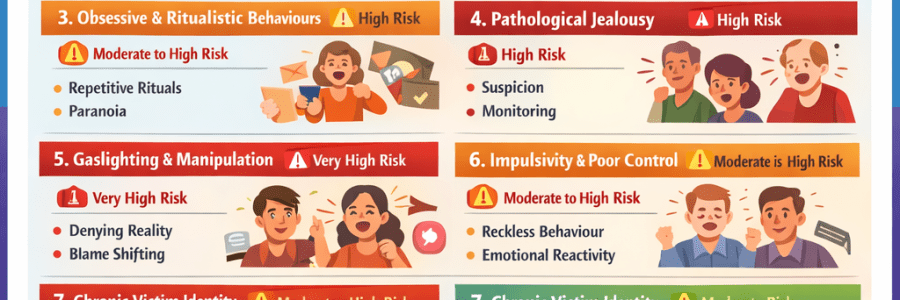
These combinations should prompt urgent specialist risk assessment, particularly when several occur together or the behaviour is escalating. Police guidance identifies these and other factors as relevant to assessing serious harm. College of Policing Urgent concern 1. Strangulation + stalking Previous strangulation or suffocation combined with persistent stalking, especially after separation. Strangulation can cause fatal or lasting injury even when there are no obvious marks. Urgent concern 2. Threats to kill + previous violence Threats against a partner, former partner, children or relatives, alongside a history of assault or escalating violence. Treat threats as serious, especially when accompanied by specific plans or access to weapons. Urgent concern 3. Separation + escalating intimidation The person leaves or announces plans to leave, and the abusive partner responds with threats, aggressive confrontations, surveillance or attempts to force contact. Separation can be a particularly dangerous period. Urgent concern 4. Stalking + physical assault Repeated following, unwanted appearances, monitoring or persistent contact combined with physical violence. The risk is especially concerning when the behaviour continues or intensifies after separation. Urgent concern 5. Threats of suicide + threats against a partner Statements suggesting “if I can’t have you, nobody can,” threats to kill both partners, or threats of suicide used alongside intimidation or coercive control. Do not assume these threats are merely emotional manipulation. Urgent concern 6. Weapons + threats or a history of violence Threatening to use a weapon, displaying one to frighten someone, or having access to weapons alongside escalating aggression. This requires immediate attention to safety. Urgent concern 7. Extreme possessiveness + stalking + separation Obsessive jealousy, claims of ownership, monitoring and refusal to accept the end of a relationship. Risk rises when these behaviours are accompanied by threats, intimidation or violence. Urgent concern 8. Coercive control + repeated breaches of protective orders A pattern of control, unwanted contact, stalking or intimidation continuing despite police intervention or court restrictions. Repeated breaches must be reported and assessed in context. Urgent concern 9. Threats against children or pets + escalating abuse Threatening to harm, take or kill children or animals to punish, frighten or control a partner, particularly when combined with possessiveness or previous violence. Urgent concern 10. Sexual violence + coercive control or physical violence Forced sex, sexual assault or threats of sexual harm alongside intimidation, isolation or other violence. This is a serious indicator that requires specialist assessment. These are not a validated ranking from most to least dangerous. A person does not need to experience several warning signs for their situation to be serious. Professional assessment considers the whole pattern, the history, recent changes and the person’s own fear. Why these combinations can be missed Someone who has lived with abuse for years may gradually come to regard frightening behaviour as normal. They may minimise what has happened, feel ashamed, fear the consequences of speaking out, or struggle to recognise the danger while managing everyday life. You do not have to prove that you are in the highest-risk category before asking for help. Speak privately to a trained domestic-abuse professional or the police and explain the full history, including any strangulation, stalking, threats, escalation and breaches of protective orders. If you believe there is immediate danger in Spain, call 112. The Spanish domestic-violence support service 016provides information and support.

When You Have Lived With Abuse for Years, You May Not Realise How Much Danger You Are In

The warning signs you may not recognise until you finally speak out By Linda CJ Turner | Trauma Therapist | Neuroscience & Emotional Intelligence Practitioner I want to talk about something I know from personal experience. When you have lived with abuse for many years, your perception of what is normal can gradually change. You… Read More When You Have Lived With Abuse for Years, You May Not Realise How Much Danger You Are In

Why Do Couples Divorce? What European Statistics Tell Us About Relationships

By Linda CJ Turner | Trauma Therapist | Neuroscience & Emotional Intelligence Practitioner Why do people who once promised to spend their lives together eventually decide to separate? Is it boredom? Financial pressure? Infidelity? A loss of sexual attraction? Emotional neglect? The desire for freedom? Or have some people been unhappy for years without their… Read More Why Do Couples Divorce? What European Statistics Tell Us About Relationships

Why Do People Leave Long-Term Relationships? 30 Reasons a Man or Woman May Walk Away After Years Together

By Linda CJ Turner | Trauma Therapist | Neuroscience & Emotional Intelligence Practitioner A relationship can last 10, 20, 30 or even 40 years, yet still come to an end. Sometimes the reasons are clear. Sometimes one partner is left wondering how the person they shared so much of their life with could walk away… Read More Why Do People Leave Long-Term Relationships? 30 Reasons a Man or Woman May Walk Away After Years Together

When a Long-Term Relationship Ends: Questions to Ask Yourself

Understanding the relationship, recognising the truth and finding your way forward By Linda CJ Turner | Trauma Therapist | Neuroscience & Emotional Intelligence Practitioner Sometimes, the hardest part of a relationship ending is not the separation itself. It is trying to understand how someone you shared years, sometimes decades, of your life with can walk… Read More When a Long-Term Relationship Ends: Questions to Ask Yourself