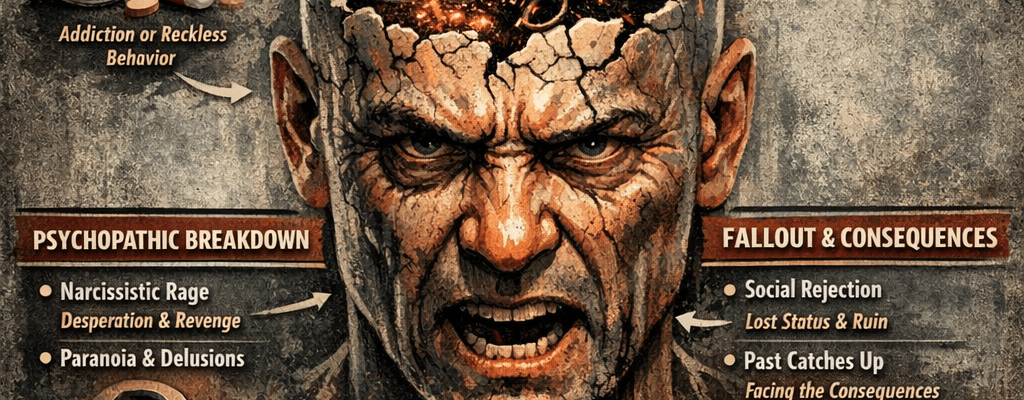
What do we leave behind when our life is over?
For some people, it is love, kindness, memories, lessons, photographs and stories that bring people together.
For others, the legacy is far more complicated.
It may be a trail of lies, distorted stories, broken relationships, unanswered questions and a version of the past carefully constructed to protect the person who lived it.
And sometimes, the most extraordinary part is that they may genuinely believe their own version of events.
A lifetime of deception does not necessarily end with one final confession. Sometimes it ends with the person still defending the story they have spent decades creating.
When the story becomes the identity
Psychologically, repeated lying can become much more than individual acts of dishonesty.
Over time, the person may begin to build an entire narrative around those lies.
One betrayal requires an explanation.
That explanation requires another.
Another lie is added to protect the previous one.
Eventually, the original truth can become buried beneath years of justification, blame, selective memory and reinterpretation.
This is where self-deception becomes particularly powerful.
The person is no longer simply deceiving other people.
They are protecting themselves from themselves.
They may tell themselves:
“It wasn’t really like that.”
“They made me do it.”
“Everyone has their own version.”
“I was the victim too.”
“It wasn’t that bad.”
“They remember it incorrectly.”
And because the human mind is remarkably capable of protecting us from psychological discomfort, the distorted version can eventually feel completely real.
Denial can become a way of life
Denial is not always a conscious decision to lie.
Sometimes it is a psychological defence against shame, guilt, fear or the unbearable recognition that the person one believes oneself to be does not match the person one has actually been.
“I am a good person” becomes difficult to reconcile with:
“I repeatedly hurt people.”
So the mind searches for another explanation.
Perhaps they deserved it.
Perhaps it wasn’t really betrayal.
Perhaps the relationship was already broken.
Perhaps someone else was responsible.
Perhaps the past should simply be forgotten.
This is one of the ways cognitive dissonance can be reduced: change the story rather than confront the behaviour.
And if that process continues for decades, the story can become deeply embedded in identity.
But other people remember
There is something denial cannot completely control.
Other people’s memories.
The people who were there may remember the conversations, the promises, the betrayals, the manipulation, the fear, the humiliation, the silence and the consequences.
Children may remember what they experienced.
Partners may remember what they endured.
Friends may remember what they witnessed.
And even when nobody challenges the story, that does not make the story true.
Silence is not confirmation.
Someone’s refusal to acknowledge what happened does not erase what happened.
The tragedy of a distorted legacy
Perhaps one of the saddest consequences of lifelong denial is that the person can reach the final chapter of their life without ever allowing themselves to know their own life honestly.
They may die believing they successfully controlled the narrative.
But control of the narrative is not the same thing as truth.
And eventually, they leave behind something they cannot control at all:
the memories of the people who knew them.
A reputation can be carefully managed.
A story can be repeated.
Evidence can be dismissed.
Responsibility can be avoided.
But other people carry their own experiences.
Compassion without removing accountability
There is also a compassionate psychological perspective here.
People do not always construct elaborate defences because they are incapable of feeling.
Sometimes they are protecting themselves from overwhelming shame.
Sometimes admitting the truth would require them to completely reconsider who they believe they are.
Sometimes the psychological cost of saying “I was wrong” feels greater than continuing to believe “I was right.”
Understanding this does not excuse the behaviour.
Explanation is not exoneration.
Compassion can help us understand why someone became trapped inside denial without asking the people they harmed to excuse them.
Accountability requires something different:
I did this.
It caused harm.
I cannot change what I did.
I cannot demand that the people I hurt forgive me.
But I can finally stop lying about it.
That is where genuine psychological growth begins.
Some people never get there
Not everyone reaches that point.
Some people become more reflective as they age.
Others become more defensive.
Some eventually look back and recognise the damage they caused.
Others become increasingly committed to protecting the version of themselves they have constructed.
And that can be especially difficult for those left behind.
Because sometimes the person who caused the damage will never provide the acknowledgement that the injured person hoped for.
There may be no confession.
No apology.
No moment of recognition.
No admission that the story was false.
Healing, therefore, sometimes requires accepting something deeply painful:
you may never receive the truth from the person who denied it.
But you can still know your own truth.
What is a legacy?
A legacy is not simply what someone says about themselves after they are gone.
It is what remains in the lives of the people they touched.
The kindness they gave.
The love they offered.
The safety they created.
The trust they earned.
Or, sometimes, the confusion, hurt and unanswered questions they left behind.
Nobody lives perfectly.
Everyone has things they regret.
Everyone has made mistakes.
The difference is what we do with the truth once we see it.
We can defend ourselves forever.
Or we can become honest enough to say:
“This was who I was. This is what I did. I hurt people. I cannot rewrite it. But I can finally stop pretending it didn’t happen.”
That is not weakness.
That is accountability.
Because ultimately, the greatest tragedy is not having made mistakes.
It is reaching the end of your life having spent so much energy protecting yourself from the truth that you never became honest enough to know yourself.
And perhaps that is the final question of any life:
When people remember you after you are gone, will they remember the person you claimed to be — or the truth of how you made them feel?

