Neuroscience and Psychology of Connection: Why We Feel the Urge to Reach Out

There are moments when life delivers difficult news in clusters — one concern followed quickly by another. In those periods, something subtle but powerful often happens in the mind and body: a heightened sense of emotional awareness and a sudden urge to reconnect with the people we care about. From the perspective of neuroscience and… Read More Neuroscience and Psychology of Connection: Why We Feel the Urge to Reach Out

Don’t Ignore the Urge to Reach Out — It Often Means Something Important

There are moments in life when information arrives in waves — one difficult message after another — and it can create a kind of emotional overload that is hard to immediately process. In those moments, something important often happens in the nervous system. The brain begins to shift into a heightened state of sensitivity. The… Read More Don’t Ignore the Urge to Reach Out — It Often Means Something Important

Cruelty, Betrayal, Recovery

Part 1: The Neuroscience of Cruelty Cruelty rarely announces itself as cruelty. It often presents itself as power, control, or superiority. But in the brain, cruelty is not abstract — it is processed through systems that evaluate threat, meaning, and emotional pain. The amygdala detects emotional danger.The anterior insula registers internal distress.The anterior cingulate cortex… Read More Cruelty, Betrayal, Recovery

The Difference Between Cruelty and Abuse (and How the Brain Learns Both)

Cruelty and abuse are often used interchangeably, but they are not the same thing. Understanding the difference matters — not only psychologically and socially, but also in terms of how the brain processes repeated harm versus isolated harm. Cruelty: the act Cruelty refers to behaviour that causes emotional or physical pain, often without empathy or… Read More The Difference Between Cruelty and Abuse (and How the Brain Learns Both)

Cruelty often appears to be about power.

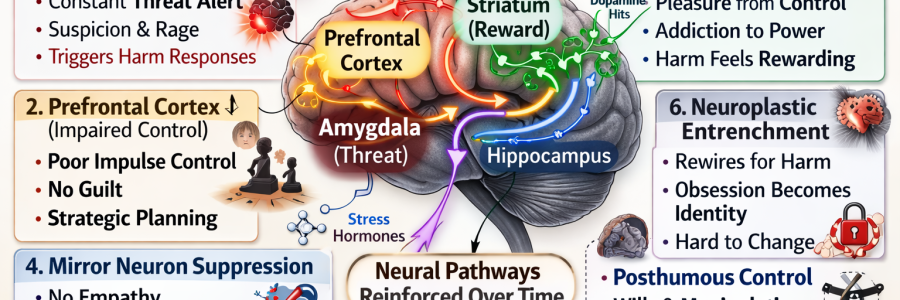
What looks like power in the momentcan quietly become limitation in the brain.Cruelty doesn’t just affect others —it reshapes the person who repeats it. Cruelty often appears to be about power.Control. Superiority.A momentary advantage over another person. But beneath that surface, neuroscience suggests something deeper is happening. The brain systems that allow us to feel… Read More Cruelty often appears to be about power.

The Cost of Cruelty

Cruelty often appears, on the surface, to be about power. Control. Superiority. A momentary advantage over another person. But beneath that surface, neuroscience suggests something more complicated is happening — not just socially, but biologically. In studies of empathy and moral cognition, researchers have identified a network of brain regions that allows humans to resonate… Read More The Cost of Cruelty

Kindness, Cruelty, and the Brain: Why Our Choices Shape Everything

There are more kind people in this world than cruel ones.But it doesn’t always feel that way. Cruelty is louder. It leaves sharper memories. It takes up more emotional space. Kindness, by contrast, is often quieter—steady, consistent, and easy to overlook unless we are paying attention. And yet, beneath every interaction—every reaction, every pause, every… Read More Kindness, Cruelty, and the Brain: Why Our Choices Shape Everything