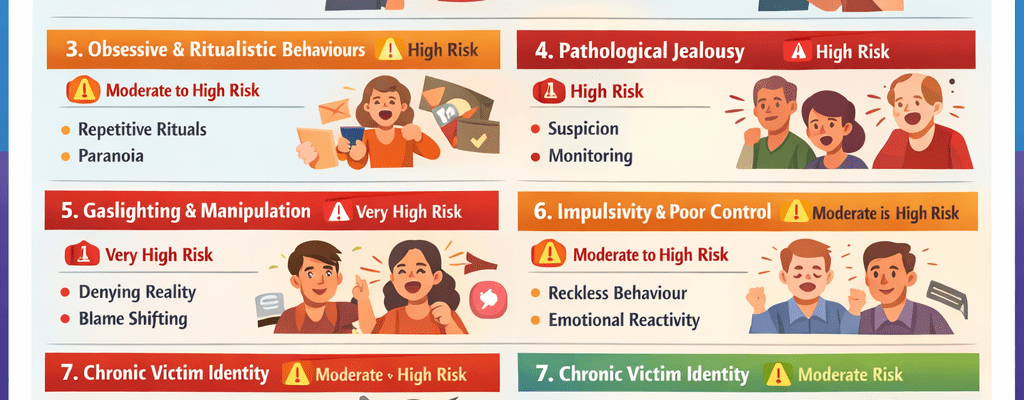
When a clinician is assessing for multidimensional abuse, they are generally looking beyond a single incident and examining the pattern, domains, severity, impact, risk and degree of control within the relationship.
It is not simply a checklist asking, “Were you hit?” A good assessment tries to understand the person’s lived environment.
What a clinical assessment may examine
1. Psychological and emotional abuse
- Humiliation, degradation or persistent criticism
- Threats, intimidation or deliberate frightening
- Gaslighting or persistent undermining of the person’s perception
- Blaming the victim for the perpetrator’s behaviour
- Withholding affection as punishment
- Deliberately creating confusion or insecurity
- Making the person feel responsible for maintaining peace
2. Verbal abuse
- Name-calling and insults
- Shouting or aggressive communication
- Threatening language
- Repeated contempt or belittling
- Attacks on appearance, intelligence, competence or character
3. Physical violence
The clinician would usually ask about the type, frequency, severity and escalation of physical behaviour, including:
- Hitting, pushing or kicking
- Restraining or preventing someone from leaving
- Throwing objects
- Blocking doorways
- Threatening with physical violence
- Choking or strangulation
- Violence that has become more frequent or severe
Importantly, the assessment would not necessarily require visible injuries for physical abuse to be taken seriously.
4. Financial or economic abuse
This is often missed in assessments. Questions might explore whether the partner:
- Controls bank accounts or income
- Withholds money
- Monitors expenditure excessively
- Prevents or interferes with employment
- Creates financial dependency
- Takes wages or benefits
- Prevents access to financial information
- Uses money as a reward or punishment
- Prevents the person from making independent financial decisions
5. Social isolation
The clinician may explore whether the individual has been prevented or discouraged from:
- Seeing family
- Maintaining friendships
- Working
- Participating in social activities
- Accessing professional support
- Maintaining independent relationships.
6. Digital and technological control
This can include:
- Monitoring phones or messages
- Demanding passwords
- Tracking location
- Checking emails or social media
- Using technology to intimidate or harass
- Accessing accounts without permission.
7. Coercive control and autonomy
This is where the assessment becomes particularly important.
The clinician may ask questions such as:
“Did you feel free to make ordinary decisions without worrying about how your partner would react?”
“Did you change your behaviour to avoid their anger or retaliation?”
“Were there things you stopped doing because you knew they would cause a reaction?”
“Did you feel that you had to ask permission for things that you would previously have decided for yourself?”
These questions help establish whether individual behaviours formed a larger pattern of domination, intimidation or restriction.
8. Pattern and chronology
A clinician may construct a timeline rather than examining events separately.
They may look at:
When did it begin? → How did it develop? → Did behaviours escalate? → Did different forms of abuse appear together? → What happened when the individual attempted to assert independence? → What happened when they tried to leave?
This can be particularly revealing because multidimensional abuse may develop gradually.
9. Psychological impact
The assessment would also consider the consequences for the individual, including:
- Anxiety and hypervigilance
- Depression or emotional numbness
- Sleep disturbance
- Panic
- Problems concentrating
- Loss of confidence
- Shame and self-blame
- Difficulty making decisions
- Trauma-related symptoms
- Changes in identity or sense of self
- Fear of the partner or of consequences for leaving.
The clinician should distinguish between symptoms and the circumstances that produced them. A trauma response should not automatically be interpreted as an individual’s underlying psychological weakness or disorder.
10. Risk and safeguarding
A professional assessment should also consider current and future risk, particularly where there has been physical violence or coercive control.
This can include asking about:
- Threats to kill or seriously harm
- Previous strangulation
- Escalating violence
- Weapons
- Stalking or monitoring
- Threats following separation
- Access to the home
- Children or dependent adults
- Financial vulnerability
- Whether the perpetrator knows the person’s current location
- Whether the person has somewhere safe to go.
11. Corroborating information
A clinical assessment does not necessarily require documentary proof before a person’s account can be taken seriously.
Where appropriate and with consent, a clinician may consider other information such as medical records, photographs of injuries, messages, financial records, police reports, witness accounts or previous professional records.
But the clinician’s role is different from that of a criminal investigator or court. Clinical assessment and legal proof are not the same process.
The central clinical question
Ultimately, the assessment is trying to establish something much broader than “Was there an abusive incident?”
It is asking:
What was the relational environment in which this person was living, what behaviours were being used, how did those behaviours interact, what degree of autonomy and safety did the person retain, and what psychological and functional impact did the pattern have?
That is what makes an assessment of multidimensional abuse substantially different from simply documenting individual incidents.
And importantly, the assessment should be trauma-informed: conducted privately, without the alleged perpetrator present, without blaming the individual, and without assuming that the person should have behaved differently to prevent the abuse.

