When “I Have Done Nothing But Upset You” Is Far More Than an Apology
Sometimes a handwritten anniversary message can say much more than the person writing it probably realised.
One such message contained these words:
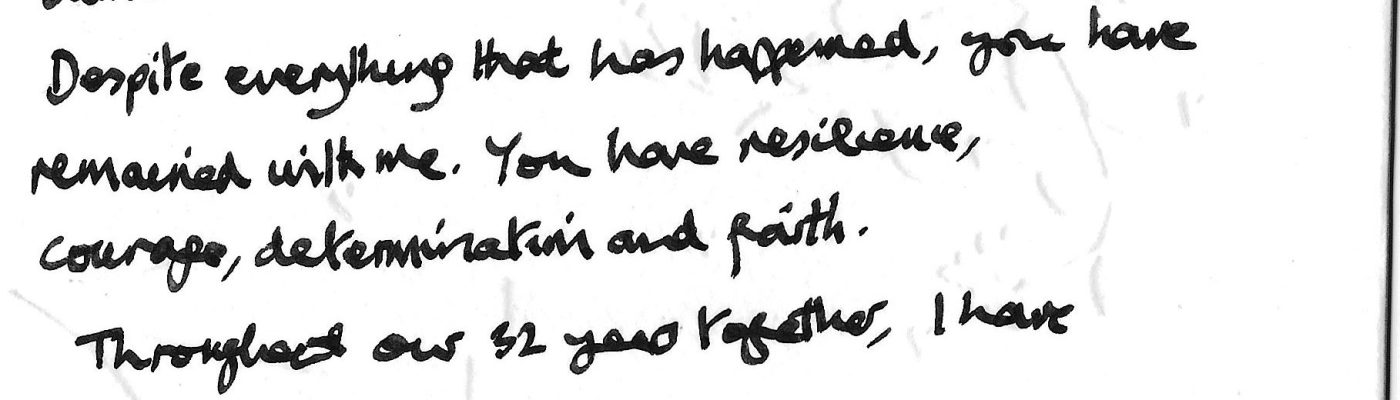
“For the first 20 years I have done nothing but upset you, and the previous 12 years before that you are resourceful and resilient and have courage and stayed with me. I will always love you.”
At first glance, it might sound like an admission of wrongdoing wrapped in affection.
But look more carefully.
There is something remarkable about the choice of words.
“I have done nothing but upset you.”
If the relationship involved prolonged emotional, psychological, physical and financial abuse, “upset you” is an extraordinary understatement.
Upsetting somebody suggests an argument, disappointment, hurt feelings or perhaps behaving badly on occasion.
It does not adequately describe coercive control, intimidation, humiliation, financial deprivation, isolation, threats, physical violence or the cumulative effects of living in an unsafe emotional environment.
The language therefore creates a curious psychological gap between what happened and what is being named.
That gap matters.
Calling serious abuse “upsetting someone” can soften the reality of the behaviour without actually denying that something happened.
It can sound like:
“I know I wasn’t very nice.”
rather than:
“I understand the seriousness of what I did to you.”
Those are psychologically very different statements.
The neuroscience of understatement
The brain is constantly trying to make sense of emotionally difficult experiences.
When behaviour is described accurately, the brain has a clearer framework for understanding it.
But when severe experiences are given relatively mild labels, there can be a disconnect between the emotional reality and the language used to describe it.
Someone who has spent years living with chronic stress may already have adapted by minimising, normalising or compartmentalising what happened simply to get through everyday life.
That is not weakness.
It is one of the ways human beings survive prolonged stress.
The nervous system becomes focused on getting through the next moment, rather than analysing the entire pattern.
A person may therefore hear:
“I upset you.”
while their body remembers something much bigger:
“I wasn’t safe.”
The words and the nervous system are telling two very different stories.
“You are resourceful and resilient.”
This is another interesting choice of words.
On one level, it is praise.
But there is an uncomfortable alternative interpretation.
Why did you need to become so resourceful?
Why did you need so much resilience?
Why did you need courage simply to remain in the relationship?
When somebody praises another person for their extraordinary ability to cope with difficult circumstances, it is worth asking whether they are also, perhaps unintentionally, acknowledging that the circumstances were exceptionally difficult.
In other words:
“You were incredibly strong” can sometimes sit beside “I gave you an awful lot to be strong about.”
And that distinction matters.
“And stayed with me.”
This may be the most revealing phrase of all.
It focuses on the fact that the recipient remained.
But staying does not necessarily mean the relationship was healthy.
People remain in complicated relationships for many reasons: love, hope, financial dependence, fear, children, isolation, conditioning, practical circumstances, trauma bonding, uncertainty and the belief that things might eventually change.
The fact that someone stayed does not retrospectively make the relationship acceptable.
Nor does it create an obligation to stay forever.
“I will always love you.”
Love and harmful behaviour can coexist.
That is one of the most difficult truths for people to process.
Someone can say they love you and still behave in ways that cause profound harm.
The existence of love does not automatically make behaviour loving.
And from a psychological perspective, intent and impact are not the same thing.
Someone may genuinely believe they love another person while simultaneously behaving abusively toward them.
That contradiction can be extraordinarily confusing for the recipient.
It can keep someone questioning their own reality:
“If he loves me, how could he treat me like this?”
The answer is that loving feelings do not necessarily produce healthy behaviour.
Healthy love requires more than emotion.
It requires respect, accountability, empathy, boundaries, safety and behaviour consistent with those values.
The anniversary paradox
There is something almost poignant about receiving a message like this on an anniversary.
An anniversary traditionally celebrates the relationship.
But the letter appears to contain an accidental admission that the relationship has also involved considerable suffering.
Twenty years of “upsetting” someone.
Twelve years before that in which the recipient was apparently “resourceful,” “resilient” and courageous enough to stay.
And then:
“I will always love you.”
Read together, those sentences create a strange emotional triangle:
I hurt you.
You endured it.
I love you.
But what is missing?
Accountability.
There is no detailed recognition of the behaviour.
No clear naming of what happened.
No acknowledgement of its impact.
No explicit responsibility for changing it.
And that distinction is psychologically significant.
The nervous system remembers more than the words
Prolonged exposure to threat or unpredictability can affect the way the nervous system responds to everyday situations.
The brain becomes highly attentive to cues of danger: tone of voice, facial expressions, footsteps, silence, changes in atmosphere and the possibility of conflict.
Over time, a person can become exceptionally skilled at monitoring another person’s mood.
That is why leaving an abusive relationship is not simply a matter of deciding:
“I’m going now.”
The body may have spent years learning that safety was conditional.
Recovery involves learning something entirely different:
I can relax.
I can make decisions.
I can enjoy myself.
I can disagree.
I can say no.
I can be happy without waiting for something bad to happen.
Eventually, the nervous system can begin to experience calm not as suspiciously quiet, but as normal.
Perhaps the most important question
Rather than asking:
“Did he love me?”
a more useful psychological question may sometimes be:
“What did his love feel like to live inside?”
Because love that repeatedly produces fear, humiliation, deprivation, intimidation or harm is not made healthy simply because the person says:
“I will always love you.”
The handwritten letter may therefore be meaningful in several ways.
It may demonstrate affection.
It may demonstrate some awareness that the recipient suffered.
It may even represent an attempt at remorse.
But the words themselves should not be allowed to rewrite the reality of what actually happened.
“I upset you” is not the same as “I abused you.”
“You were resilient” is not the same as “you should have had to be resilient.”
And “you stayed with me” is not the same as “I treated you well enough to deserve that loyalty.”
Perhaps the most important lesson is this:
A person’s ability to survive what happened to them should never be used as evidence that what happened wasn’t that bad.
Sometimes the strongest person in the room is strong precisely because they had to be.
And sometimes the most revealing sentence in an old letter is the one that sounds the most innocent.
“I have done nothing but upset you.”
Perhaps “upset” was simply the safest word the writer could find.
But for the person who lived it, the reality was much bigger than the word.

