The Pain of Repeated Abuse in Disbelieving Families

When history repeats itself and a family that once doubted or dismissed abuse finds themselves facing the same painful situation again, the emotional and psychological impact can be devastating. This recurrence often exposes deep patterns of denial, disbelief, and unresolved trauma within the family system. Families that previously did not believe victims of abuse may… Read More The Pain of Repeated Abuse in Disbelieving Families

The Moment of Reckoning: An Abuser Witnessing Their Own Legacy

When an abuser witnesses the impact of their own behavior on their children or grandchildren, especially in a courtroom setting where they observe further abuse unfolding, a complex and profound emotional and psychological dynamic emerges. This scenario reveals layers of denial, accountability, and the cyclical nature of abuse that can affect families deeply. Abuse often… Read More The Moment of Reckoning: An Abuser Witnessing Their Own Legacy

Because behaviour follows patterns

When an adult child seems distant, transactional, or only interested when there’s something to gain, psychology doesn’t jump straight to “they’re selfish.” It looks at what was reinforced over time. Because behaviour follows patterns like: If a child grows up in an environment where: …they can internalise a very specific belief: “Relationships are based on value… Read More Because behaviour follows patterns

🧭 What rebuilding often actually looks like

Rebuilding your life after decades of cruelty is less like “starting over” and more like relearning safety, identity, and choice in a system that trained you to survive, not live. It’s a slow reconstruction of both the nervous system and the sense of self. 🧭 What rebuilding often actually looks like 1. Learning that “calm” isn’t… Read More 🧭 What rebuilding often actually looks like

When Abuse Doesn’t End in Visible Violence: The Hidden Cost of Coercion and Control

Recent reports have highlighted a deeply concerning reality: in some cases, the impact of domestic abuse is so severe that victims take their own lives. This is not a separate issue from abuse.It is part of it. When a person is subjected to sustained fear, control, psychological harm, and isolation, the damage is not always… Read More When Abuse Doesn’t End in Visible Violence: The Hidden Cost of Coercion and Control

The Difference Between Cruelty and Abuse (and How the Brain Learns Both)

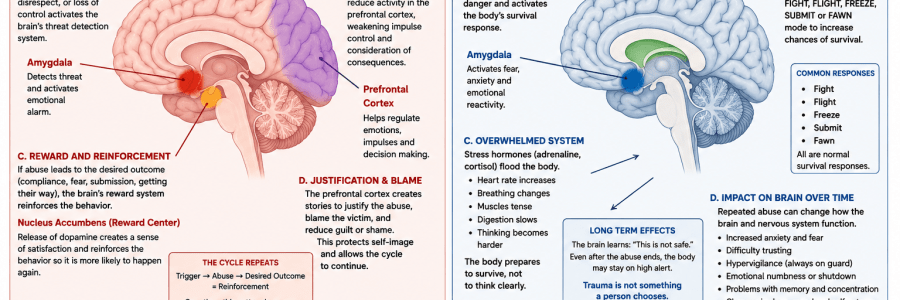
Cruelty and abuse are often used interchangeably, but they are not the same thing. Understanding the difference matters — not only psychologically and socially, but also in terms of how the brain processes repeated harm versus isolated harm. Cruelty: the act Cruelty refers to behaviour that causes emotional or physical pain, often without empathy or… Read More The Difference Between Cruelty and Abuse (and How the Brain Learns Both)

Moral Disengagement in Relationships & Abuse Dynamics

(How harm becomes “justified” inside relationships) In relationships where there is emotional harm, control, or chronic disrespect, people don’t usually see themselves as “abusive” or “harmful.” Instead, they often unconsciously use moral disengagement mechanisms described by Albert Bandura to reduce guilt and maintain their self-image. 🔁 1. Moral justification (“I’m not hurting them, I’m…”) Harmful behaviour is reframed as… Read More Moral Disengagement in Relationships & Abuse Dynamics

Childhood Attachment & Abuse Dynamics

Why some people tolerate what others would never accept Not everyone who experiences abuse stays.And not everyone who stays is weak. The difference often begins in childhood. 👶 The Original Blueprint As a child, you don’t choose your environment.You adapt to it. If love, safety, or attention were inconsistent, withdrawn, or conditional, your nervous system… Read More Childhood Attachment & Abuse Dynamics

Childhood Attachment & Abuse Dynamics

Why some people tolerate what others would never accept Not everyone who experiences abuse stays.And not everyone who stays is weak. The difference often begins in childhood. 👶 The Original Blueprint As a child, you don’t choose your environment.You adapt to it. If love, safety, or attention were inconsistent, withdrawn, or conditional, your nervous system… Read More Childhood Attachment & Abuse Dynamics