Those words are quite revealing, particularly when read alongside the earlier anniversary message. They sound deeply remorseful, but there is an important distinction between expressing regret and taking full responsibility.
What the words are actually saying
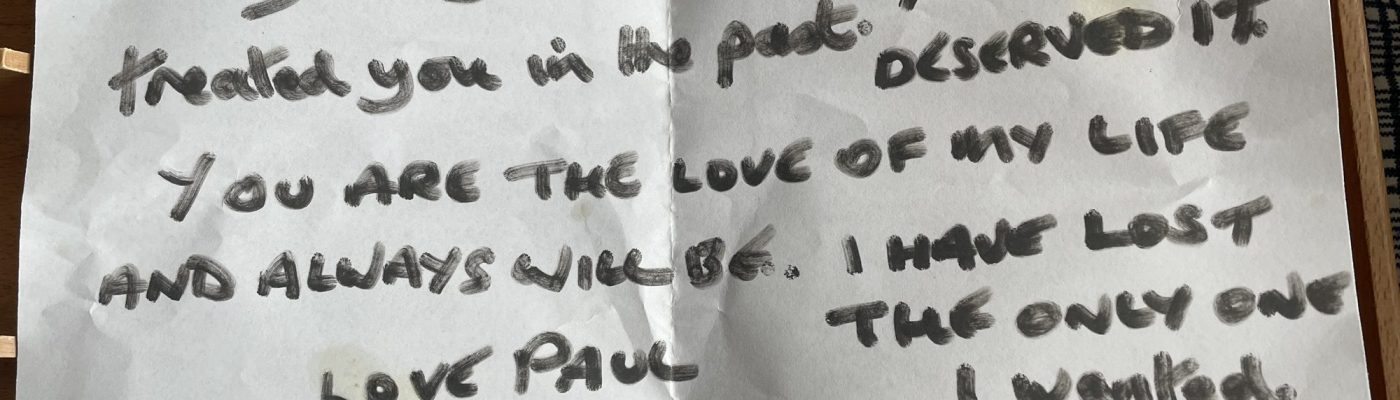
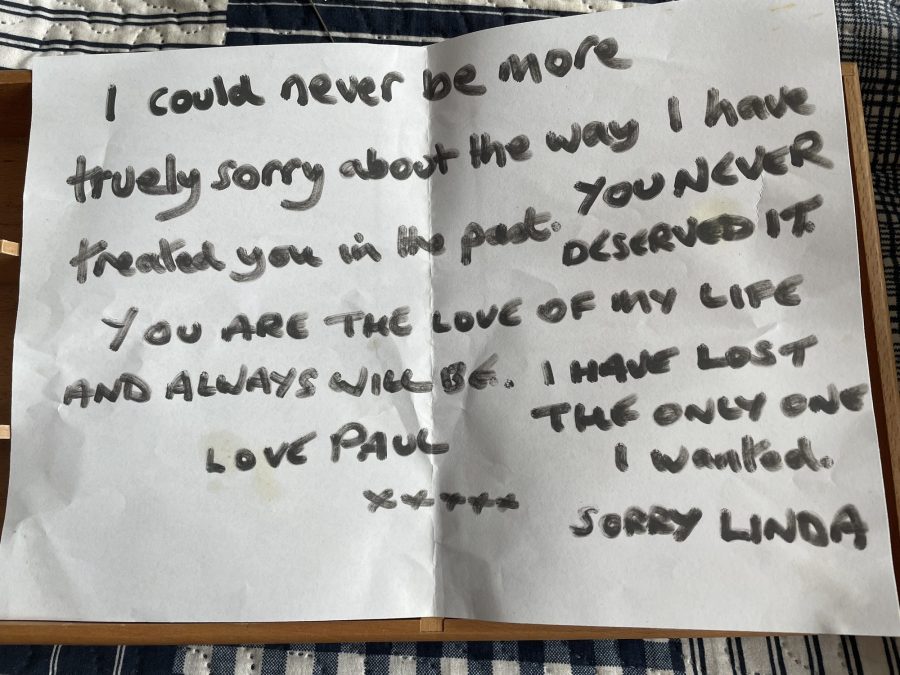
“I could never be more truly sorry for the way I have treated you in the past.”
This is an admission that the treatment was wrong. The phrase “the way I have treated you” is significant because it places the behaviour with the writer rather than blaming you.
But notice what isn’t specified.
There is no naming of what he did. If the reality was prolonged emotional, psychological, physical and financial abuse, then “the way I treated you” is a very broad euphemism.
It allows the writer to acknowledge wrongdoing without having to confront its full detail.
There is a considerable difference between:
“I’m sorry for the way I treated you.”
and
“I’m sorry that I abused, frightened, humiliated, controlled and financially deprived you.”
The second requires considerably more psychological confrontation.
“You never deserved it.”
This is probably the clearest validation in the message.
He is effectively saying:
“What happened to you was not justified by anything you did.”
That matters because abusive relationships can leave the victim questioning whether they somehow caused the behaviour — whether they were too demanding, too emotional, too difficult, or somehow responsible for provoking it.
This sentence removes that justification.
You didn’t deserve it.
“You are the love of my life.”
This is an expression of attachment, not necessarily evidence of healthy love.
Someone can genuinely feel enormous attachment to another person while behaving terribly towards them.
That’s one of the most psychologically confusing aspects of abusive relationships.
The brain naturally wants the two things to fit together:
“If you love me, you wouldn’t hurt me.”
But human behaviour isn’t always that coherent.
A person can experience love, dependency, possessiveness, fear of abandonment and genuine emotional attachment while simultaneously behaving in controlling or abusive ways.
So the statement may be emotionally sincere.
But sincerity doesn’t erase behaviour.
“And I have lost the only one I wanted.”
This is particularly interesting.
It shifts the emotional focus from what you experienced to what he has lost.
There is therefore a mixture of remorse and personal grief:
“I treated you badly.”
followed by:
“And now I have lost you.”
Those are not quite the same thing.
One is about your suffering.
The other is about his loss.
That doesn’t necessarily mean the regret is false. He may genuinely be devastated by losing you.
But genuine regret can contain both:
“I hurt you.”
and
“I can’t believe I’ve lost you.”
The psychologically important question is whether the first remains central when there is nothing left to gain.
And then there’s the neuroscience
After years of an abusive or highly stressful relationship, the nervous system doesn’t simply respond to words.
It has learned patterns.
It remembers unpredictability, conflict, tone of voice, tension and threat.
So receiving a deeply apologetic letter from the person who caused the distress can produce something very complicated.
One part of you may think:
“At last. He knows.”
Another may think:
“But why did it take so long?”
And another may simply think:
“The words are beautiful, but my lived experience was not.”
All three responses can coexist.
You don’t have to reject the sincerity of the apology in order to recognise that an apology cannot undo the past.
The most revealing contrast
Put the two letters together and there is a striking progression:
“I have done nothing but upset you.”
then:
“I could never be more truly sorry for the way I have treated you.”
then:
“You never deserved it.”
That suggests increasing acknowledgement.
But there is still a significant difference between recognising that you were treated badly and fully confronting the nature and consequences of the behaviour.
And perhaps that is why these handwritten words are so emotionally powerful.
They may be the closest he ever came to saying:
“I know I hurt you. I know you didn’t deserve it. I know I lost you because of what I did.”
But ultimately, you don’t have to use his words to decide what your experience was.
His apology can be genuine.
His love can have been genuine.
His regret can be genuine.
And the abuse can still have been real.
Those truths are not mutually exclusive.
And perhaps the most important sentence in the entire letter isn’t “I will always love you.”
It’s:
“You never deserved it.” No not from him and certainly not from the rest of his family!!!!
Because that finally puts responsibility where it belongs.

