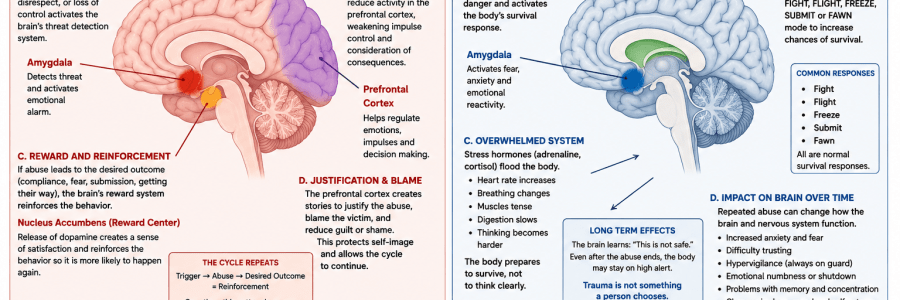
Why would someone respond to rejection, disagreement or a loss of control by accusing another person of wrongdoing? And what happens in the brain when a person feels challenged, humiliated, threatened or unable to influence an outcome? To understand this behaviour, we need to look at the interaction between the brain’s threat systems, emotional regulation, self-image, cognitive biases and the human need to maintain a sense of control. The central psychological question is this: when reality does not match what someone wants, can they tolerate the disappointment and take responsibility for their response, or do they construct a different explanation in which someone else becomes the problem? For some people, a painful disagreement remains a disagreement. For others, particularly where emotional regulation and accountability are limited, the experience can become a struggle to restore a threatened sense of power, status or self-worth. In some circumstances, a person may go further and make an accusation they know to be false. In others, they may genuinely believe their own interpretation because anger, fear and cognitive biases have distorted how they understand the event. These are psychologically different processes, and it is important not to confuse them. 1. The neuroscience of not getting what you want The human brain is designed to detect threats, respond to frustration and protect us from perceived danger. But not every threat is physical. Rejection, humiliation, loss of status, financial disappointment and the feeling of being powerless can all activate stress and emotional responses. When someone is confronted with an outcome they do not want, several processes may interact. The amygdala and threat detection The amygdala contributes to processing emotionally significant information, including potential threats. When a situation is interpreted as threatening, attention can become focused on the perceived source of the threat. In a conflict, this may mean concentrating on the other person’s refusal, rather than considering why the refusal occurred. This is not a dedicated “anger centre,” and amygdala activity cannot tell us whether someone is lying or telling the truth. The prefrontal cortex and emotional regulation Prefrontal brain regions contribute to evaluating consequences, reconsidering interpretations, inhibiting impulses and regulating emotional responses. Under stress, some people may find it harder to pause, examine alternative explanations or choose a measured response. However, stress does not automatically remove self-control or excuse deliberate behaviour. People vary in how they respond to frustration, and the brain’s regulatory systems do not simply switch off. +1 Reward, expectation and disappointment The brain continuously updates expectations about what will happen and whether our actions will achieve the desired outcome. When reality contradicts expectations, we experience a discrepancy that requires adjustment. A person who struggles to tolerate disappointment may keep trying to change the outcome, blame someone else or search for an explanation that restores their sense of being right. This is a useful psychological framework, although it does not establish why any particular individual makes an accusation. Research reviewing neural and cognitive studies of anger has found associations between anger-related processes, attention to anger-provoking stimuli, impulsivity and the functioning of brain networks involved in emotional regulation. These are group-level findings, not a neurological test for dishonesty. 2. When the ego cannot tolerate rejection For some individuals, not getting their own way is experienced as more than an ordinary disappointment. It may feel like a personal defeat. If a person’s self-worth depends heavily on being right, having influence or receiving validation, another person’s refusal can challenge the image they have of themselves. Instead of thinking, “I didn’t get the outcome I wanted,” their interpretation may become, “I have been wronged.” That shift matters. The first interpretation acknowledges an unwanted outcome. The second attributes blame to another person. If the person cannot tolerate the discomfort of rejection, blaming someone else may offer temporary emotional relief. Psychologists describe related processes through concepts such as defensive attribution, externalisation of blame and cognitive dissonance. These concepts are not diagnoses, and none necessarily leads to false accusations. They help explain how people may protect a preferred view of themselves when faced with uncomfortable information. The difficulty arises when preserving self-image becomes more important than establishing what actually happened. 3. The transformation of disappointment into accusation In some conflicts, a possible psychological sequence looks like this: 1. An unwanted outcome A refusal, rejection, financial disagreement or lost negotiation 2. Emotional threat Anger, humiliation, anxiety or a perceived loss of influence 3. Defensive interpretation The other person’s refusal is interpreted as hostile, unfair or deliberately harmful 4. Blame and justification Selective attention to supporting evidence; alternative explanations are discounted 5. An accusation In some cases, the conflict is described as abuse or wrongdoing This is an illustrative model, not a universal pathway. Many people experience every stage of emotional conflict without making a false accusation. An accusation may also arise from a genuine experience of abuse, a sincere but mistaken interpretation or a mixture of factors. The crucial distinction is whether the person is describing their experience honestly, misunderstanding events, or knowingly misrepresenting what happened. 4. Confirmation bias: when the mind starts building a case Once a person adopts a particular interpretation, confirmation bias can influence what they notice and remember. Suppose someone believes they have been deliberately mistreated. They may pay more attention to words that appear to support that belief, remember the most upsetting part of an interaction and give less weight to information that challenges their interpretation. A refusal becomes evidence of hostility. A firm boundary becomes evidence of intimidation. A disagreement becomes evidence of a pattern. But the reverse is also possible: someone accused of wrongdoing may focus only on evidence that supports their own innocence. This is why a fair assessment requires more than either person’s certainty. Investigators should examine the whole sequence of events, contemporaneous communications, independent evidence and plausible alternative explanations. Research on false allegations has also highlighted the potential role of motives, post-event information, mistaken interpretation and confirmation bias in some cases. However, the research varies by type of allegation, and findings from studies of sexual-assault allegations cannot automatically be generalised to domestic-abuse or coercive-control allegations. 5. Why would someone knowingly make a false accusation? Where an allegation is deliberately fabricated, several possible motives may be involved. Retaliation: punishing someone for rejection, disagreement or a perceived injury. Emotional validation: seeking sympathy, attention or reassurance from others. Reputational positioning: attempting to establish oneself as the injured party. Instrumental advantage: seeking leverage in a financial, family or legal dispute. Avoiding responsibility: redirecting attention away from one’s own conduct.… Read More The Psychology and Neuroscience of False Accusations: When Someone Cannot Accept Not Getting Their Own Way