An exploration of coercive control, psychological trauma, survival and the devastating consequences of having your autonomy taken away.
Trauma & Emotional Abuse | Neuroscience & Emotional Regulation | Relationships & Recovery

Dorothy Vallens, the lounge singer played by Isabella Rossellini in David Lynch’s Blue Velvet, is one of cinema’s haunting portrayals of a woman trapped in a world of violence, humiliation, fear and psychological domination. Her character offers a disturbing starting point for examining what can happen when abuse becomes so overwhelming that the boundaries between fear, attachment, submission and desire become profoundly confused.
Dorothy is not simply a woman experiencing violence. She is a woman whose freedom, security and sense of control have been systematically taken away. Her circumstances illustrate some of the psychological complexities that can arise when a person is subjected to prolonged intimidation, sexual violence and coercive control.
Her story invites us to ask an uncomfortable question: what happens when the person who terrifies you also becomes the person around whom your survival revolves?
1. When fear becomes part of the relationship
One of the most disturbing aspects of Dorothy’s situation is the way violence becomes entangled with her relationships and her attempts to survive.
Abuse is not always experienced as a straightforward decision to stay or leave. When someone is subjected to repeated threats, humiliation and intimidation, their attention can become increasingly focused on anticipating danger, managing the abuser’s behaviour and avoiding the next incident.
This is particularly relevant to coercive control, in which the abuse extends beyond individual episodes of violence. It can involve restricting freedom, creating dependency, undermining confidence and making ordinary decisions feel dangerous.
For someone living in these circumstances, the question may gradually change from:
What do I want?
to:
What do I need to do to get through today without making things worse?
Dorothy’s circumstances dramatise this loss of freedom. Her world is no longer organised around her ambitions, relationships or personal identity. It is dominated by the threat of what someone else might do.
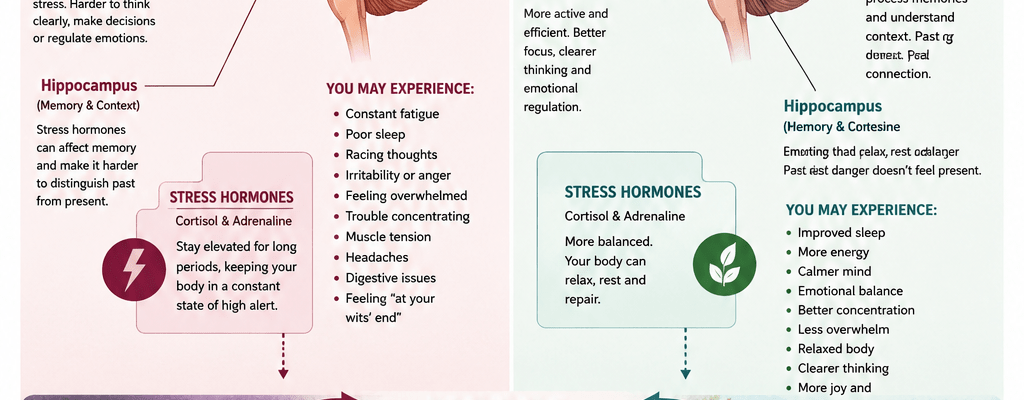
2. When the nervous system learns to expect danger
Trauma can change how the brain and body respond to the world.
When a person repeatedly experiences danger, the nervous system may become increasingly sensitive to potential threats. They may find themselves constantly scanning facial expressions, voices, movements and changes in mood.
This is often described as hypervigilance.
In an abusive relationship, hypervigilance can become an exhausting form of adaptation. The person may become exceptionally attentive to the abuser’s emotional state, not because they want to be, but because anticipating danger can feel essential to their safety.
The body can respond to a threatening situation before conscious reasoning has caught up. Heart rate may increase, muscles tense, breathing changes and attention narrows.
Over time, the experience of safety itself can become unfamiliar.
Dorothy’s portrayal can be understood through this lens: she appears caught in a world where danger is not an occasional interruption but the organising principle of her existence.
Importantly, trauma responses are not signs of weakness or a failure to think rationally. They are possible adaptations to overwhelming circumstances.
3. When desire and terror become confused
Perhaps the most unsettling psychological theme in Dorothy’s story is the apparent entanglement of sexuality, fear and violence.
It is essential to distinguish between genuine desire and behaviour that occurs under intimidation, coercion or threat.
A person may comply with an abuser, appear submissive, become emotionally attached or behave in ways that seem contradictory to an outside observer. None of these responses, by themselves, establish consent or demonstrate that the person wants the abuse.
Under conditions of threat, people may experience a range of survival responses, including fighting, fleeing, freezing, appeasing or dissociating. Their behaviour can be shaped by the perceived consequences of resistance.
Sometimes a person may also experience complicated emotional or physical reactions that do not match what they consciously want. The body is not a reliable measure of consent.
Dorothy’s story is disturbing partly because it confronts the viewer with the possibility that apparent participation can exist alongside profound fear and a lack of meaningful freedom.
Compliance is not consent. Attachment is not proof of safety. And a survival response is not an invitation to abuse.
4. The psychological consequences of humiliation and domination
Violence is not only about physical injury. Repeated humiliation, intimidation and degradation can also attack a person’s sense of identity.
Coercive relationships may create an environment in which the victim feels watched, judged, powerless or incapable of making independent decisions.
Over time, the person may begin to question their own perceptions and abilities. They may struggle to recognise their preferences, express disagreement or imagine a life outside the relationship.
Humiliation can be particularly destructive because it targets a person’s dignity.
When someone is repeatedly treated as though their feelings, boundaries and choices do not matter, they may begin to experience themselves through the distorted expectations imposed upon them.
Dorothy’s circumstances illustrate the extreme end of this loss of autonomy. Her suffering is not simply about being frightened. It is about being placed in a situation where another person’s power repeatedly overrides her own.
5. Why people do not always leave
One of the most damaging misconceptions about abuse is the belief that a person who is genuinely frightened will simply leave.
Leaving can be complicated by threats, financial dependency, isolation, concern for children, fear of retaliation and the practical difficulties of finding somewhere safe to go.
In some abusive relationships, the abuser deliberately creates or reinforces these barriers.
Even when a person physically leaves, the psychological effects of prolonged intimidation may continue. They may remain frightened, feel responsible for the abuser’s reactions or struggle to trust their own judgement.
Dorothy’s fictional situation is extreme, but it helps expose the inadequacy of judging an abused person by how quickly they escape.
A more meaningful question is what has happened to their freedom, what risks they face and what resources are available to them.
Leaving is not simply an act of willpower. It can require safety, support, money, practical planning and time.
6. Trauma bonding and the need to understand attachment
The term trauma bond is often used to describe an attachment that develops in the context of abuse, particularly where there are cycles of intimidation, intermittent kindness, dependency or relief.
It is important not to use the term as a universal explanation for every abusive relationship. Nor does it mean that every survivor loves their abuser or wants to return.
However, unpredictable changes between threat and apparent affection can complicate emotional responses.
When periods of fear are interrupted by moments of relief, kindness or apparent reconciliation, the contrast can become psychologically powerful. A person may hope that the kinder version of the abuser will return, or interpret temporary calm as evidence that the relationship is changing.
This can make the experience of attachment confusing, particularly when the person is also isolated or frightened.
Dorothy’s story provides an unsettling fictional example of the way domination and intimacy can become entangled, although her particular circumstances should not be treated as a clinical case study.
7. What happens to identity when survival takes over?
One of the less visible consequences of prolonged abuse is the loss of access to the self.
A person who has spent years monitoring someone else’s behaviour may have little energy left for their own interests, friendships, creativity or ambitions.
They may lose touch with the things that once made them feel alive.
This can involve:
- Difficulty identifying personal needs and preferences.
- Loss of confidence in independent decisions.
- Social withdrawal and isolation.
- Shame, self-blame or persistent fear.
- Difficulty trusting other people.
- Feeling disconnected from one’s body or emotions.
- Struggling to imagine a future that is not organised around the abuse.
Dorothy’s identity as a singer is particularly poignant in this context. She has a life and a public presence, yet her circumstances suggest how little outward visibility necessarily tells us about someone’s private freedom.
A person can appear functional, sociable or capable while living with profound fear behind closed doors.
The absence of visible evidence is not evidence of the absence of abuse.
8. Recovery begins with the return of choice
The opposite of coercive control is not simply the absence of violence. It is the restoration of autonomy.
For survivors, recovery may involve gradually rediscovering what it feels like to make decisions without anticipating punishment, to express disagreement without fear and to experience relationships in which boundaries are respected.
It can also mean learning that safety does not have to be earned through compliance.
Trauma-informed support may help survivors understand their responses, process traumatic experiences, rebuild self-trust and develop practical strategies for emotional regulation.
Recovery is not necessarily linear. Someone may feel confident one day and frightened the next. A reminder, a dream, a particular tone of voice or an unexpected encounter may reactivate old feelings.
These experiences do not automatically mean that recovery has failed.
For many survivors, one significant change is the gradual ability to distinguish the past from the present: to recognise that an old survival response may be appearing in a situation where they now have more choice.
And, over time, to discover that their lives can become about more than managing danger.
9. Why Dorothy’s story still matters
Blue Velvet is a disturbing work of fiction, not a clinical account of coercive control. Its depiction of sexual violence and psychological domination is stylised and should not be mistaken for a universal representation of survivors.
Nevertheless, Dorothy’s character raises important questions about the relationship between power, fear, intimacy and freedom.
Her story challenges the simplistic idea that a victim’s behaviour can always be understood by looking at what they appear to choose.
It reminds us that behaviour must be considered in context: the threats, dependency, power imbalance and available alternatives surrounding a person.
Most importantly, it challenges us to look beyond appearances.
A woman may appear compliant when she is frightened. She may remain attached while being harmed. She may struggle to leave while desperately wanting the abuse to end.
None of these contradictions makes the abuse less real.
The message beneath Dorothy’s story
When a person’s freedom has been repeatedly taken away, their behaviour may become organised around survival rather than choice.
Understanding this distinction is essential to understanding coercive control, sexual violence and the psychological consequences of prolonged abuse.
The question should never be simply why someone stayed, complied or appeared attached. It should also be what happened to their freedom, their safety and their ability to say no.
For anyone who recognises aspects of their own experience in Dorothy’s story, it is worth remembering that abuse does not have to look exactly like the violence portrayed in a film to be serious. Control, intimidation, humiliation and the erosion of autonomy can also have profound psychological consequences.

