Why some people respond to the pain they have caused with genuine remorse, while others respond with defensiveness, blame, resentment or retaliation.
There is an important psychological distinction between someone who feels terrible because they have hurt another person and someone who feels terrible because they have suffered the consequences of their own behaviour.
On the surface, these reactions can look remarkably similar. Both people may become upset, angry, distressed or withdrawn.
But underneath, the psychological processes can be very different.
To understand this, we need to examine four emotions: remorse, guilt, shame and humiliation.
They are often used interchangeably, but they are not the same.
They influence how people perceive themselves, how they respond to criticism, how they manage relationships and, importantly, whether they accept responsibility for their behaviour.
This is particularly relevant when examining destructive relationships, coercive control and antisocial personality traits. However, none of these emotional responses is exclusive to ASPD.
1. Remorse: Recognising that you have hurt another person
Remorse is an emotional response to recognising that your actions have caused suffering to someone else.
It involves more than knowing that something was wrong.
It involves recognising the human consequences of what you did.
A person experiencing genuine remorse may think:
- I hurt someone who trusted me.
- I caused unnecessary suffering.
- My behaviour was unacceptable.
- I cannot undo what happened.
- I need to take responsibility.
- I must make sure I do not repeat this behaviour.
What does genuine remorse look like?
It is usually demonstrated through behaviour rather than emotional displays.
For example:
- Acknowledging what happened without minimising it.
- Recognising the other person’s experience.
- Accepting responsibility without shifting blame.
- Respecting the other person’s boundaries.
- Making appropriate amends where possible.
- Demonstrating sustained behavioural change.
A person can feel remorse without being forgiven.
They can also feel remorse without expecting the relationship to continue.
That is an important distinction: genuine remorse is concerned with the harm caused, not simply with recovering what was lost.
Can someone with ASPD experience remorse?
Yes, potentially. Remorse varies between individuals with ASPD.
Some may experience guilt and regret, while others may demonstrate reduced remorse or limited concern about the impact of their behaviour.
It is not scientifically accurate to say that everyone with ASPD is incapable of remorse.
2. Guilt: I did something wrong
Guilt is generally associated with evaluating a particular action or behaviour.
The internal experience is:
“I did something wrong.”
Guilt can be a healthy psychological mechanism because it encourages us to recognise when our behaviour conflicts with our values.
For example:
- I should not have shouted.
- I should not have lied.
- I should not have frightened my partner.
- I should not have treated someone that way.
Healthy guilt can motivate someone to apologise, repair damage and behave differently.
Guilt and the brain
Guilt involves several interacting brain systems associated with emotional processing, self-evaluation, social understanding and decision-making.
The medial prefrontal cortex and anterior cingulate cortex are among the regions implicated in aspects of moral and social cognition.
However, guilt is not produced by one isolated brain region.
When guilt becomes unhealthy
Guilt can also become excessive or misplaced.
In abusive relationships, the person being harmed may gradually begin accepting responsibility for the other person’s behaviour.
They may think:
- Perhaps I provoked them.
- Perhaps I should have been quieter.
- Perhaps I asked for too much.
- Perhaps if I had behaved differently, they would have been kinder.
This is an important psychological distinction.
Healthy guilt encourages accountability for your own actions. Manipulated guilt can make you feel responsible for someone else’s.
3. Shame: There is something wrong with me
Shame is different from guilt.
Guilt concerns behaviour. Shame concerns identity and self-worth.
The internal experience is:
“I did something wrong” versus “There is something wrong with me.”
Shame can be an extremely painful emotion because it threatens the way someone sees themselves.
A person experiencing shame may feel:
- Inadequate.
- Exposed.
- Defective.
- Unworthy.
- Inferior.
- Rejected.
- Powerless.
Why does shame sometimes produce anger?
This is where the psychology becomes particularly interesting.
When someone cannot tolerate feelings of inadequacy or personal failure, they may respond defensively.
Instead of examining their behaviour, they may attempt to escape the uncomfortable emotion.
Possible responses include:
Blaming: “This is all your fault.”
Denial: “That never happened.”
Minimisation: “You’re making a big deal out of nothing.”
Counterattack: “You’re the one with the problem.”
Withdrawal: Refusing to discuss the situation.
Aggression: Responding to criticism with intimidation or hostility.
These reactions can function as psychological defences against shame.
However, shame does not inevitably produce aggression. Many people experience shame and respond with sadness, withdrawal, reflection or a desire to repair relationships.
Shame and narcissistic vulnerability
Research into narcissistic traits has examined the relationship between threatened self-esteem, shame, anger and defensive reactions.
Some individuals are particularly sensitive to criticism, rejection or perceived humiliation.
When their self-image is threatened, they may experience the criticism as an attack on their entire identity rather than an opportunity to consider their behaviour.
This can result in what is sometimes called narcissistic injury.
It is important not to confuse this with ASPD. Narcissistic personality disorder and ASPD are separate diagnoses, although some traits can overlap.
4. Humiliation: You have made me feel small
Humiliation is particularly relevant when examining relationships involving dominance, coercion and control.
It is an experience of being degraded, exposed, diminished or made to feel inferior.
Unlike guilt, which concerns your own behaviour, humiliation often involves how you perceive another person’s treatment of you.
The internal experience may be:
- You have disrespected me.
- You have made me look weak.
- You have challenged my authority.
- You have exposed my behaviour.
- You have rejected me.
- You have taken away my position.
Humiliation versus shame
Although related, they are different.
| Shame | Humiliation |
|---|---|
| I feel inadequate. | I feel degraded by what happened. |
| My self-image is threatened. | My status or dignity feels threatened. |
| I feel defective. | I feel diminished or exposed. |
| I may want to hide. | I may want to restore my standing. |
| I may withdraw. | I may become angry or resentful. |
Humiliation can be especially difficult when someone places considerable importance on status, authority, dominance or how others perceive them.
Why can humiliation produce retaliation?
For some individuals, perceived humiliation can trigger an intense desire to restore their sense of power or standing.
Possible reactions include:
- Trying to discredit the person who challenged them.
- Rewriting the history of the relationship.
- Spreading damaging stories.
- Attempting to regain influence.
- Intimidation or harassment.
- Retaliatory behaviour.
This is sometimes discussed in psychological literature in connection with threatened self-esteem and aggressive responses to perceived rejection or insult.
But we must be careful: humiliation does not automatically lead to violence, and most people who experience humiliation do not retaliate.
Retaliation is a behaviour and a choice, even when strong emotions contribute to it.
5. Why losing control can feel different from losing a relationship
This is one of the most important distinctions in understanding coercive and controlling relationships.
When a relationship ends, two people may experience the same event very differently.
One person may experience grief because they have lost someone they love.
Another may experience anger because they have lost influence, familiarity, financial security or access to someone who previously met their needs.
These experiences can coexist, but they are not equivalent.
Losing a relationship
A person grieving the loss of a relationship may experience:
- Sadness.
- Loneliness.
- Regret.
- Longing.
- Reflection.
- Recognition of their own mistakes.
- Concern about their former partner’s wellbeing.
Healthy grieving eventually involves accepting that the other person has the right to leave.
Losing control
Where a relationship has involved coercive control, separation can also represent the loss of an established power dynamic.
For someone accustomed to controlling another person’s decisions, movements, finances or emotional responses, independence may be experienced as a threat.
They may struggle with:
- No longer having access to their former partner.
- Being unable to influence their decisions.
- Losing financial or practical advantages.
- Being unable to dictate the terms of separation.
- Discovering that the other person is rebuilding their life.
- Losing the ability to provoke a response.
The psychological experience may be less about missing the relationship and more about struggling to accept the loss of influence.
The important distinction is that wanting someone back does not necessarily mean wanting to rebuild a healthy relationship with them.
Someone may want to restore access without wanting to restore mutual respect, trust or emotional intimacy.
This is why behaviour following separation can be so revealing.
6. Why does confrontation sometimes produce anger instead of remorse?
Imagine a situation in which one partner confronts the other about years of harmful behaviour.
The conversation might begin:
“I have spent years trying to explain how much your behaviour has hurt me. I cannot continue living like this.”
There are several possible psychological responses.
Response A: Accountability
“I understand. I have behaved badly, and I need to take responsibility.”
Constructive response
Recognition, responsibility and willingness to change.
Response B: Defensiveness
“You’re exaggerating. You always make me out to be the bad person.”
Defensive response
The focus shifts away from the behaviour and towards defending the self.
Response C: Counterattack
“What about everything you’ve done to me?”
Blame reversal
The injured person is placed in the position of defending themselves.
Response D: Intimidation
“You’ll regret doing this.”
Threatening response
The discussion moves from accountability towards fear and control.
These responses do not establish a particular psychiatric diagnosis.
But they illustrate something important: a person’s response to being confronted can reveal how they manage responsibility, criticism and threats to their self-image.
7. The psychology of blame reversal
One particularly damaging relationship pattern is the reversal of responsibility.
Instead of addressing the original behaviour, the person confronted redirects attention towards the person who has raised the concern.
This can involve:
- Denying what happened.
- Attacking the other person’s character.
- Claiming to be the real victim.
- Reinterpreting events.
- Bringing up unrelated mistakes.
- Accusing the other person of causing the problem.
This can overlap with a communication pattern often described as DARVO:
Deny, Attack, Reverse Victim and Offender.
For example:
- You raise an incident of harmful behaviour.
- They deny or minimise it.
- They attack your credibility or character.
- They present themselves as the injured party.
- You end up defending yourself instead of discussing what happened.
The psychological consequences for the other partner can be considerable.
Repeated exposure to this dynamic may create confusion, self-doubt, anxiety and an increasing need to justify one’s own experiences.
The original issue never gets resolved because the conversation continually changes direction.
8. What happens psychologically to the person on the receiving end?
We should not overlook the effects on the person who has spent years trying to maintain a relationship in which accountability, affection or emotional safety are missing.
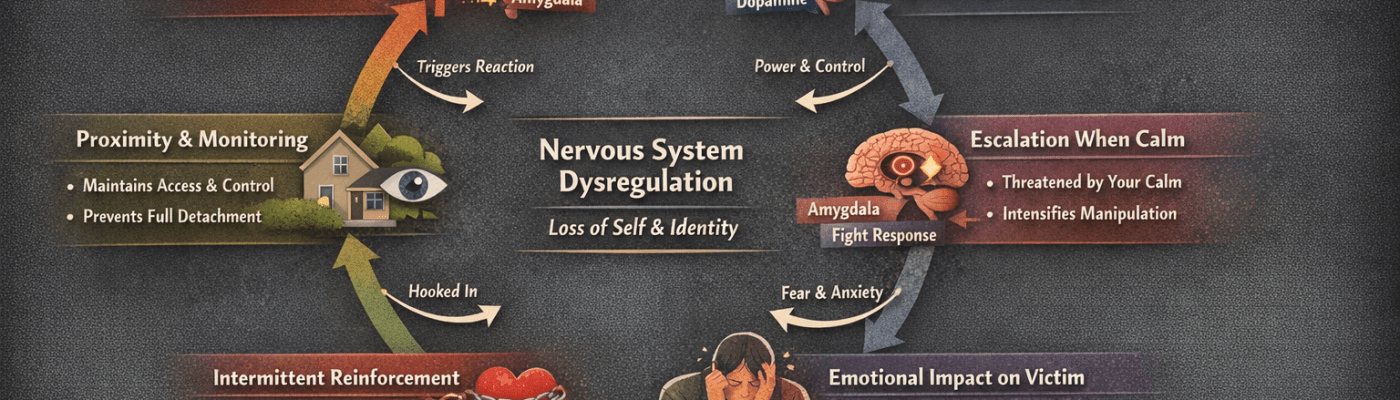
Prolonged exposure to emotional abuse and coercive control can affect the nervous system and emotional regulation.
The stress response
When someone lives with unpredictable anger, criticism, intimidation or emotional withdrawal, their brain can become increasingly alert to possible threats.
The amygdala contributes to threat processing, while the hypothalamic-pituitary-adrenal (HPA) axis is involved in the body’s stress response.
Over time, repeated stress can contribute to:
- Hypervigilance.
- Sleep difficulties.
- Anxiety.
- Emotional exhaustion.
- Difficulty concentrating.
- Reduced confidence.
- Fear of confrontation.
- Persistent self-questioning.
Some people develop symptoms of post-traumatic stress disorder (PTSD), although this is not inevitable.
Why does the person keep trying to explain themselves?
There can be a powerful psychological motivation to restore emotional safety.
They may believe:
“If I can explain this properly, perhaps they will finally understand.”
They may write letters, send messages, explain their feelings repeatedly and try different approaches to communication.
They may become increasingly focused on obtaining an acknowledgement that never arrives.
This can create a painful cycle:
Hurtful behaviour
Attempt to explain the emotional impact
Denial, blame or defensiveness
Increased self-doubt and emotional distress
Another attempt to obtain understanding
An illustrative pattern, not an inevitable sequence in every abusive relationship.
Breaking this cycle often begins when someone recognises that they cannot make another person accept responsibility.
You can communicate clearly, but you cannot manufacture empathy, remorse or accountability in someone else.
9. Can someone feel humiliation, anger and resentment without feeling remorse?
Yes.
These emotions can occur independently.
For example, someone might feel:
- Humiliated because their behaviour has been exposed.
- Angry because they have lost influence.
- Resentful because their former partner has moved on.
- Ashamed because their self-image has been damaged.
But they may not demonstrate meaningful concern about the suffering they caused.
Equally, a person can experience all these emotions and still have genuine remorse.
We cannot determine someone’s internal emotional experience simply from their behaviour.
What we can examine is whether their actions demonstrate responsibility, respect and sustained change.
This is particularly important when considering post-separation abuse.
A former partner’s inability to accept separation, repeated unwanted contact, intimidation or attempts to undermine someone’s independence should be taken seriously regardless of diagnosis.
10. A comparison: four emotions and their relationship consequences
| Emotion | Internal experience | Potential behavioural response |
|---|---|---|
| Remorse | I hurt someone. | Accountability and repair |
| Guilt | I did something wrong. | Apology and correction |
| Shame | I am inadequate or defective. | Withdrawal or defensiveness |
| Humiliation | I have been degraded or diminished. | Anger, withdrawal or attempts to restore status |
These are broad psychological tendencies, not fixed rules.
The same person may experience several of these emotions at once.
11. The most important lesson: understanding is not the same as accepting
There is a danger in becoming so absorbed in understanding someone’s psychology that we begin to excuse their behaviour.
We might spend years trying to establish:
- Why they behave this way.
- Whether they have empathy.
- Whether they experience remorse.
- Whether they understand what they have done.
- Whether they are capable of love.
- Whether their behaviour is related to personality, addiction or mental illness.
These are legitimate psychological questions.
But there is another question that matters just as much:
What is the impact of their behaviour on the person living with it?
Mental illness is not a moral failing. Addiction is not simply a lack of willpower. Personality disorders are complex clinical conditions.
But none of these removes another person’s right to safety, dignity and independence.
We must distinguish between explaining behaviour and excusing behaviour.
A person can struggle psychologically and still be responsible for seeking help, respecting boundaries and not harming others.
12. Rebuilding your understanding of love, respect and accountability
Perhaps the greatest shift after leaving a destructive relationship is recognising that love should not require you to repeatedly negotiate for basic kindness.
Healthy relationships do not require one person to continually explain why cruelty is painful.
They do not require someone to beg for affection, justify their independence or sacrifice their dignity to keep the peace.
A healthier understanding of relationships involves:
- Self-respect rather than self-sacrifice.
- Mutual affection rather than emotional deprivation.
- Accountability rather than blame.
- Independence rather than control.
- Consistency rather than uncertainty.
- Compassion rather than cruelty.
- Emotional safety rather than fear.
And perhaps most importantly, recognising that someone else’s inability or unwillingness to love you in the way you deserve is not a measure of your worth.
Conclusion: The difference between losing someone and losing control
There is a profound difference between being upset because you have hurt someone and being upset because you have lost something you wanted to keep.
One response directs attention towards another person’s suffering.
The other may direct attention towards your own loss.
Both can produce sadness, anger and distress, but they do not necessarily reflect the same emotional experience.
Genuine remorse involves recognising the humanity of the person you have hurt. It means accepting that their feelings matter independently of what they can offer you.
And genuine love recognises that another person is not property, possession or an extension of your own needs.
You can miss someone without having loved them well. You can regret losing a relationship without regretting the harm you caused. And you can understand someone’s pain without necessarily taking responsibility for it.
Ultimately, healthy love is not measured by how desperately someone wants to keep you.
It is measured by how consistently they respect you, how safely you can exist alongside them, and how they treat you when things do not go their way.
Suggested scientific reading and references
- June Tangney and Ronda Dearing – research on shame, guilt and moral behaviour.
- Albert Bandura – moral disengagement and how people justify harmful behaviour.
- Paul Gilbert – shame, self-criticism and compassion-focused approaches.
- Jennifer Freyd – betrayal trauma and the psychological effects of interpersonal harm.
- Evan Stark – coercive control and the restriction of personal liberty.
- NICE – clinical guidance on antisocial personality disorder.

