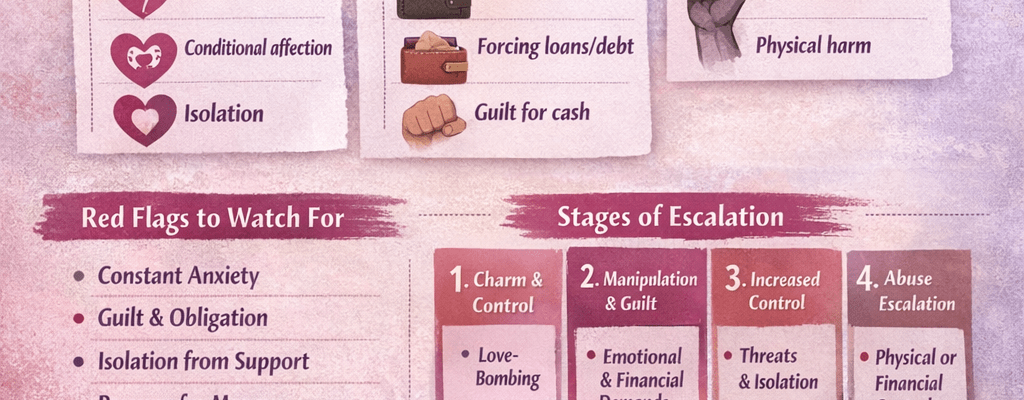
Emotional neglect, financial control, conditional affection and the difference between looking generous and actually being a generous person.
Trauma & Emotional Abuse | Coercive Control | Relationships & Recovery
There is a particular kind of emotional deprivation that can occur in an abusive relationship. It is not necessarily the absence of everything. It is the experience of being given just enough, occasionally, to keep hoping that one day the relationship will become what you need it to be.
The bare minimum of affection. The bare minimum of attention. The bare minimum of conversation, kindness, intimacy, consideration and financial contribution. Sometimes even the bare minimum of respect.
And when you ask for more, you are made to feel demanding, ungrateful, unreasonable or impossible to please.
What makes this particularly confusing is that the same person may appear extraordinarily generous to everybody else.
They may buy expensive presents, send flowers, pay for lavish meals, open expensive bottles of wine and make a considerable display of looking after friends, acquaintances and people whose admiration they value.
Yet behind closed doors, their partner may experience an entirely different reality.
This contrast can be deeply damaging because it raises a painful question: Why can you give so much to everybody else, but so little to me?
1. When everything becomes a transaction
In a healthy relationship, giving and receiving are part of an ongoing exchange of affection, consideration, practical support and mutual responsibility. That does not mean everything is perfectly equal every day. It means both people generally feel valued and cared for.
In a controlling or emotionally neglectful relationship, however, giving can become conditional.
Affection may be offered when it serves a purpose. Sex may become associated with obligation, reward or control. Money may be withheld, monitored or provided only when it benefits the person controlling it. Conversation may be available when the other person wants attention but disappear when their partner needs emotional connection.
Even presents and everyday kindness can become part of an unspoken bargaining system.
The underlying message can feel like this:
You receive what I decide you deserve, when I decide you deserve it, and on terms that benefit me.
The result is not simply disappointment about material things or a lack of romance. It can be a persistent feeling that you are not being loved freely, but managed through the selective distribution of what you need.
2. The bare minimum is not the same as a healthy compromise
Every relationship involves compromise. There will be differences in libido, communication styles, spending habits, emotional expression and expectations.
But compromise is not the same as repeatedly having to plead for ordinary consideration.
There is a difference between a partner who has limited money but shows thoughtfulness, and one who uses money to establish power.
There is a difference between someone who finds emotional conversations difficult but makes an effort, and someone who repeatedly dismisses your feelings.
There is a difference between a relationship in which affection naturally fluctuates and one in which affection appears to be deliberately withheld until you comply, withdraw a complaint or threaten to leave.
The bare minimum can become especially painful when it is not even consistently available.
You may find yourself celebrating a small gesture that would ordinarily be an everyday expression of care, simply because you have become so accustomed to receiving so little.
A bunch of flowers, a kind word, a meal prepared without being asked or an evening of genuine conversation can begin to feel like an extraordinary event rather than a normal part of intimacy.
And this is where deprivation can become psychologically confusing: the occasional gesture may feel disproportionately meaningful precisely because the ordinary experience of being cared for is missing.
3. When generosity is a performance for other people
One of the most confusing experiences in these relationships is witnessing a partner demonstrate generosity, warmth and thoughtfulness in public while experiencing emotional and material deprivation in private.
To friends, they may appear charming, attentive, successful and exceptionally giving.
They might buy expensive presents, send flowers, pay for meals, offer financial help or make a point of treating people to things they would never consider providing at home.
The contrast can leave their partner questioning their own experience.
If everybody else sees such a generous person, why does the person closest to them experience so little generosity?
There can be several possible explanations for this difference. Public generosity may provide admiration, social status, a sense of influence or the satisfaction of being seen as successful and giving. Private withholding may reflect entitlement, resentment, a desire for control or a lack of willingness to recognise a partner’s needs.
We cannot know another person’s precise motivation simply from this contrast. But we can recognise the effect it may have on the person living with it.
The public image of generosity does not cancel out private experiences of neglect or control.
Someone can be generous with people whose approval they want while being persistently ungenerous towards the person with whom they share their life.
And someone can spend considerable money on appearances while refusing to contribute fairly to ordinary household needs.
The important distinction is not how much money a person spends. It is how they treat others, whether they respect their partner’s needs and whether giving is accompanied by freedom rather than obligation or control.
4. When affection only appears if you threaten to leave
Perhaps one of the most emotionally exhausting patterns is the sudden appearance of affection when the relationship is in serious danger.
For a long time, you may have asked for attention, affection, intimacy, conversation or some indication that you matter.
Your requests may have been dismissed, ignored or turned into arguments.
You may have gradually lowered your expectations, hoping that asking for less would make the relationship easier.
Then something changes.
You reach your limit. You seriously consider leaving. You stop trying to persuade your partner. Or you make it clear that you can no longer continue living as you have been.
Suddenly, the affection appears.
There may be flowers, presents, promises, attention, sexual interest, apologies or an unexpected willingness to discuss the relationship.
For a moment, you may feel that the person you have been waiting for has finally arrived.
But if the gestures disappear once the immediate danger to the relationship has passed, the experience can become a painful cycle of hope and disappointment.
This can reinforce uncertainty and make it difficult to decide what the relationship actually means to you.
It is important to distinguish genuine attempts at repair from temporary changes in behaviour. A meaningful change involves sustained accountability, respect for boundaries and a willingness to address the underlying behaviour, even when there is no immediate threat of separation.
A sudden increase in affection, by itself, does not establish that anything fundamental has changed.
5. Financial withholding: when money becomes another form of power
Financial abuse can involve restricting access to money, monitoring spending, preventing someone from working, creating financial dependency or using financial resources to influence their decisions.
But financial control is not always immediately obvious.
Sometimes it takes the form of a partner who has sufficient resources but consistently refuses to contribute fairly, leaving the other person to carry the practical and emotional burden.
In other situations, money may be provided selectively, with the recipient expected to show gratitude, comply with demands or accept conditions.
The important issue is not whether one partner earns more or whether couples choose to divide their expenses equally or unequally.
It is whether the financial arrangement is freely agreed, transparent and fair, or whether one person uses their financial position to restrict the other’s choices.
When financial support is repeatedly treated as a favour rather than a shared responsibility, the recipient may begin to feel indebted for ordinary necessities.
They may become reluctant to ask for anything, even when the expenditure is reasonable or the money is jointly available.
Over time, financial uncertainty can become emotional uncertainty.
You may find yourself thinking not only about whether you can afford something, but whether asking for it will trigger anger, punishment, humiliation or withdrawal.
That is a very different experience from simply having different attitudes towards money.
6. When sex and intimacy become another bargaining system
Sexual intimacy can become particularly complicated when affection, approval and power are already unevenly distributed.
In some relationships, sex may be withheld as a means of punishment or used to secure compliance. In others, a partner may expect sex regardless of the other person’s emotional state, boundaries or willingness.
There may be periods of intense sexual attention when the relationship is threatened, followed by prolonged disinterest or emotional distance.
However, it is important not to confuse a difference in sexual desire with abuse. Nobody owes their partner sex, and neither partner should be expected to provide intimacy on demand.
The concern arises when sexual behaviour is connected to coercion, intimidation, humiliation, punishment or a disregard for consent.
Healthy intimacy allows both people to express desire, uncertainty, refusal and changing needs without fear.
When a person feels they must provide sex to obtain affection, prevent an argument or maintain financial security, intimacy can stop feeling like a freely shared experience.
And when someone feels unwanted, rejected or emotionally abandoned for long periods, the absence of sexual connection may become part of a much wider experience of not being valued.
The question is not simply how often a couple has sex. It is whether both people feel free, respected and emotionally safe.
7. The psychological effect of having to earn ordinary kindness
When the basic ingredients of a loving relationship are repeatedly withheld, people can gradually change their expectations of what they deserve.
They may stop asking for affection because they anticipate rejection.
They may stop raising financial concerns because they expect an argument.
They may avoid difficult conversations because they know that expressing dissatisfaction will be treated as criticism.
They may become grateful for gestures that offer only temporary relief from a persistently painful situation.
This can create a form of emotional adaptation in which the person learns to live with less and less.
It may also encourage self-questioning:
- Am I asking for too much?
- Am I being unreasonable?
- Perhaps this is just how long-term relationships work.
- Maybe I should be grateful for what I do receive.
- If I were more affectionate, attractive, patient or understanding, perhaps things would improve.
These thoughts are not proof that the person has lost their judgement. They may reflect prolonged exposure to an environment in which their needs are repeatedly challenged or dismissed.
The person may become increasingly focused on changing their own behaviour in the hope of receiving a different response.
But a relationship cannot become mutually caring simply because one person becomes better at suppressing their needs.
8. The difference between being generous and looking generous
True generosity is not measured solely by the price of a present, the extravagance of a dinner or the number of people who witness a kind gesture.
It is also expressed in the everyday details of a relationship.
It is remembering what matters to someone. It is noticing when they are tired. It is offering support without making them feel indebted. It is being willing to listen, to share responsibility and to consider another person’s needs even when there is no audience.
Someone who spends lavishly in public may genuinely enjoy giving. Public generosity is not, in itself, evidence of manipulation or hypocrisy.
But when public generosity exists alongside persistent private withholding, it is reasonable to examine the discrepancy rather than allowing the public image to define the entire relationship.
A partner should not have to compete with friends, acquaintances or strangers for the basic consideration that makes a relationship feel reciprocal.
And they should not have to demonstrate how much they have suffered before their needs are taken seriously.
9. Why the occasional good moment can make the deprivation harder to recognise
When a relationship contains both neglect and occasional affection, it can be difficult to make sense of the whole experience.
The loving moments may be genuine, or they may be gestures intended to restore the relationship temporarily. Sometimes the person giving them may have mixed motivations that even they do not fully understand.
But the emotional impact of inconsistency can be significant.
You may remember the beautiful evening, the expensive present, the affectionate conversation or the unexpected kindness and wonder whether that is the real person.
You may then struggle to reconcile those experiences with the indifference, withholding or humiliation you experience at other times.
This can keep you focused on the possibility of improvement rather than the relationship’s established pattern.
A useful question is not whether your partner has ever been kind, affectionate or generous.
It is whether care, respect and consideration are consistently present enough for you to feel secure, valued and free to be yourself.
Occasional kindness does not erase repeated neglect. Equally, one difficult period does not automatically define an entire relationship. What matters is the broader pattern, its impact and whether there is genuine, sustained change.
10. Recovery: learning that love should not have to be negotiated
One of the important parts of recovering from an emotionally neglectful or controlling relationship is recognising the difference between a reasonable need and an unreasonable demand.
Wanting affection is not unreasonable.
Wanting meaningful conversation, mutual interest, respect, consideration and intimacy that is freely chosen is not unreasonable.
Wanting a fair financial arrangement and a partner who contributes to shared responsibilities is not unreasonable.
And wanting to receive kindness without having to threaten the relationship, plead, bargain or prove your worth is not unreasonable.
Recovery may involve rebuilding the confidence to identify what you need and the freedom to decide what you are willing to accept.
It may also involve grieving the relationship you hoped you had, rather than continuing to measure your experience against the occasional moments when it seemed possible.
For some people, that process includes recognising how much of their energy was spent trying to obtain something that should have been freely and mutually offered.
The objective is not to become demanding, suspicious or unwilling to compromise.
It is to develop a clearer understanding of reciprocity, boundaries and emotional safety.
And to understand that another person’s unwillingness to meet you with care is not a measurement of your worth.
The bare minimum should never become the measure of your worth.
A relationship is not made loving by the occasional flower, expensive present, affectionate evening or generous public gesture.
Love is also found in the ordinary moments: the conversation, the consideration, the willingness to share, the respect for boundaries and the everyday reassurance that your feelings matter.
You should not have to threaten to leave to discover that you are worth caring for.

