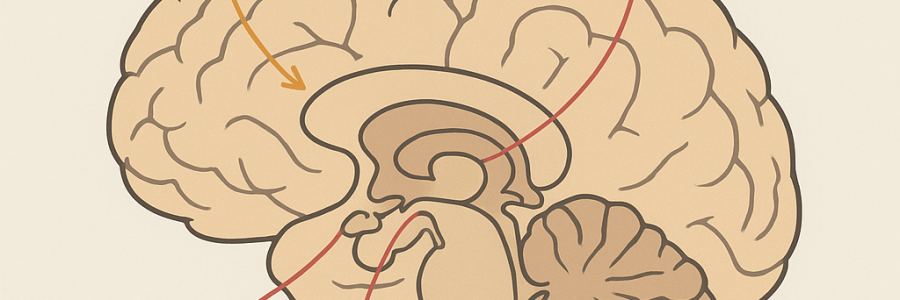
What’s happening in your brain during therapy

1. The threat system starts to settle At the beginning of therapy—especially if someone is anxious or traumatised—the brain often has a more active: As you speak in a safe, structured environment, something important happens: the brain starts to detect “this is not danger” This reduces hypervigilance over time. 2. The thinking brain comes back… Read More What’s happening in your brain during therapy

Why people have therapy (neuroscience + psychology)

1. Emotional overload (the nervous system is stuck “on”) From a neuroscience view, chronic stress keeps the amygdala overactive (threat detection system), while the prefrontal cortex (reasoning, regulation) becomes less effective. People come to therapy because: Therapy helps retrain the brain to feel safety again. 2. Trauma and memory processing Trauma isn’t just a memory—it’s a stuck survival response. The… Read More Why people have therapy (neuroscience + psychology)

A divorce party

A divorce party—especially after leaving an abusive relationship—is not really about celebrating a marriage ending. It’s about celebrating you returning to yourself. For many people, divorce marks grief and loss.For others, particularly survivors of coercive control or abuse, it marks something very different: freedom. It can be the first day in years that your nervous system begins… Read More A divorce party

“Normal enough to survive.”

`The human brain is remarkably good at adapting—even to unhealthy environments. That’s one of its greatest strengths, and sometimes one of its greatest traps. Normalization through adaptation. Habituation When something happens repeatedly—criticism, control, emotional coldness, instability—the brain starts to treat it as:“normal enough to survive.” Not because it is healthy.Because it is familiar. 1. The… Read More “Normal enough to survive.”

People often repeat familiar relational patterns—even destructive ones.

A well-recognized pattern in abuse psychology: for some people, the issue is not the specific partner—it’s the function the relationship serves for them. In other words:they are not primarily seeking mutual intimacy;they may be seeking regulation, control, validation, or power. Sometimes this is informally called “supply.” Narcissistic Supply That term is often used in popular psychology, but the underlying… Read More People often repeat familiar relational patterns—even destructive ones.

Pattern repetition is a major red flag

The psychological shift from seeing an event as an isolated incident to seeing it as a repeated pattern. That changes everything. The first time, people often think: The second time—especially if it happened to a previous partner—you begin to ask a different question: “Is this who they are?” That is psychologically very important. Pattern repetition is a major… Read More Pattern repetition is a major red flag

Family collusion: the psychology

Multiple incidents that may look unrelated on their own but together suggest a broader pattern—is exactly what investigators, courts, and clinicians often mean by “building a picture” or establishing a pattern of behavior. In psychology, this can map onto: Coercive Control and, if multiple people appear involved, Collusion Why patterns matter more than single events A single event… Read More Family collusion: the psychology

Paperwork

When dealing with Domestic Abuse or Gender-Based Violence, the amount of paperwork can feel relentless: It can feel like a second job layered on top of surviving trauma. That’s exhausting—and it’s also why many survivors feel re-traumatized by the process. Why documentation matters psychologically and legally 1. Trauma affects memory Trauma Memory During abuse, the brain… Read More Paperwork

Moral Disengagement

Albert Bandura developed Moral Disengagement to explain something many people struggle to understand: How can someone hurt another person—and not seem to feel bad about it? His answer:They don’t usually stop having morals. They temporarily switch them off. That’s moral disengagement. Moral Disengagement The core idea Most people have an internal moral code: When behavior violates that code,… Read More Moral Disengagement