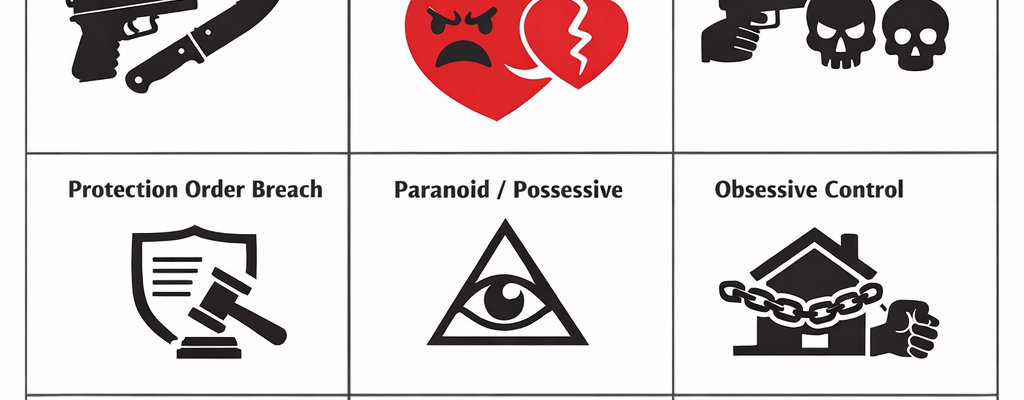
Warning signs, dangerous combinations and when to seek help
By Linda CJ Turner | Trauma Therapist | Neuroscience & Emotional Intelligence Practitioner
Content warning: This article discusses domestic abuse, strangulation, threats, stalking and domestic homicide.
Leaving a relationship is not always the end of domestic abuse. For some people, it is the point at which the behaviour escalates.
A partner who has used intimidation, manipulation or coercive control may struggle to accept the loss of control when the other person decides to leave. They may increase their threats, monitor their former partner, turn up unexpectedly, use children or relatives to maintain contact, or attempt to frighten them into returning.
In the most dangerous situations, abuse can escalate to serious injury or homicide.
Research and professional guidance identify several warning signs associated with increased risk of severe violence. These include previous violence, strangulation, threats to kill, stalking, coercive control, access to weapons and escalating behaviour. Separation can add to the risk, particularly when it occurs alongside these factors. <Cite refs={[“turn917758search0″,”turn917758search2″,”turn917758search3”]}/>
You do not have to wait for an assault to become serious before seeking help. Abuse is not something you must endure until you have enough evidence to justify leaving.
Part 1: Warning signs and danger levels
The following levels are intended to help readers recognise concerning patterns. They are not a validated risk-assessment tool, and they cannot predict whether someone will commit homicide. One serious warning sign may be enough to require urgent professional assessment.
Level 1 — Concerning behaviour
Examples include:
- Repeated humiliation, insults, name-calling or intimidation.
- Excessive jealousy, possessiveness or accusations.
- Monitoring your phone, messages, spending or whereabouts.
- Restricting contact with friends and family.
- Controlling access to money, transport or employment.
- Making you feel frightened of expressing an opinion.
- Using threats of separation, abandonment or financial hardship to control you.
These behaviours may indicate a pattern of coercive control, particularly when several occur together and your independence is gradually reduced.
What to do: Take the behaviour seriously. Consider speaking confidentially with a domestic abuse specialist and keeping a record of incidents if it is safe to do so.
Level 2 — Escalating abuse
Examples include:
- Increasing frequency or severity of threats and intimidation.
- Destroying possessions, punching walls or damaging property to frighten you.
- Blocking exits, taking your keys or preventing you from leaving.
- Following you, repeatedly appearing where you are or monitoring your movements.
- Threatening to take children, harm pets or damage your reputation.
- Using relatives or other people to intimidate or harass you.
- Ignoring clear requests for no contact or repeatedly violating protective boundaries.
These behaviours become especially concerning when they occur alongside possessiveness, previous physical violence or attempts to end the relationship.
What to do: Seek specialist advice promptly and discuss a safety plan. If you believe an assault is imminent, get to safety and contact emergency services.
Level 3 — High-risk warning signs
The following are recognised risk factors for severe or potentially lethal violence:
- Previous physical assaults, particularly when the severity or frequency is increasing.
- Strangulation, choking or interference with breathing.
- Threats to kill you, your children, other family members or pets.
- Stalking combined with threats, physical violence or extreme possessiveness.
- Sexual violence or forced sexual activity.
- Threats or attempts involving weapons.
- Threats of suicide used alongside threats to harm you or others.
- Escalating violence when you announce your intention to leave.
- Repeated breaches of protective orders alongside continuing threats or stalking.
What to do: Seek urgent specialist risk assessment and safety planning. Do not confront the person or announce your plans if doing so could increase the danger. If there is immediate danger, call emergency services.
Strangulation requires urgent medical assessment even if there are no visible injuries. Serious internal injury can occur without obvious marks.
Level 4 — Immediate or potentially lethal danger
Treat the situation as an emergency if a partner or former partner:
- Is attacking you or attempting to strangle, suffocate or seriously injure you.
- Has threatened to kill you and appears to be acting on that threat.
- Is pursuing you while armed or attempting to force entry.
- Has a weapon and is threatening you or someone else.
- Is escalating threats and violence while actively pursuing you after separation.
- Has made a credible, specific threat and is taking immediate steps that make you fear an imminent attack.
What to do: Call emergency services as soon as you safely can. Move away from the person and towards a safer location with other people if possible. Do not stop to collect possessions. Follow emergency responders’ advice.
You do not need to establish the person’s intentions or assess the situation yourself before asking for help.
Part 2: Dangerous combinations of abuse
Individual behaviours matter, but professionals also examine how they interact. The following combinations deserve particular attention.
| Combination of warning signs | Why it is concerning |
|---|---|
| Coercive control + separation + escalating intimidation | The person may be responding to the loss of control with increasingly threatening behaviour. |
| Extreme jealousy + stalking + threats | Possessiveness combined with persistent pursuit and threats may indicate an increased risk of serious violence. |
| Previous physical violence + strangulation | A history of strangulation is a particularly serious warning sign associated with increased risk of lethal violence. |
| Threats to kill + access to weapons | Threats combined with the means and apparent intention to carry them out require urgent assessment. |
| Stalking + physical assault + refusal to accept separation | Continued pursuit combined with violence can signal serious danger after a relationship ends. |
| Coercive control + threats of suicide or homicide | Threats involving harm to oneself or others, particularly alongside controlling behaviour, require urgent professional attention. |
| Violence + protective-order breaches + escalating threats | Repeated disregard for legal restrictions alongside further abuse may indicate continuing danger. |
| Threats against children or pets + extreme possessiveness | Threats against loved ones or animals can be used to frighten and control a partner and may indicate wider safeguarding concerns. |
These combinations are drawn from recognised domestic abuse risk factors described by the European Institute for Gender Equality, police guidance and other specialist authorities. They are not a scoring system, and the table does not assign a scientifically validated probability of homicide. <Cite refs={[“turn917758search0″,”turn917758search2″,”turn917758search7”]}/>
A person does not need to display every warning sign for the situation to be dangerous. Conversely, the presence of a single factor does not mean homicide will occur.
Part 3: Why separation can be a particularly dangerous time
For someone experiencing coercive control, leaving may represent the loss of the control the abusive partner has exercised over their daily life.
The person using abuse may respond by:
- Increasing calls, messages or unwanted visits.
- Following or monitoring the former partner.
- Making threats about what will happen if they do not return.
- Using legal proceedings, money, children or family members to continue exerting pressure.
- Threatening self-harm or harm to others.
- Escalating from psychological abuse to physical violence.
Professional guidance warns that domestic abuse and the risk of serious harm can continue after separation. The period around leaving therefore needs careful safety planning, especially where there is a history of violence, stalking, strangulation or threats. <Cite refs={[“turn917758search0″,”turn917758search1”]}/>
This does not mean that leaving is the wrong decision. It means that leaving should be supported by a safety plan when there are signs of danger, rather than treated as a simple conversation or confrontation.
A person experiencing abuse may need specialist help to decide how and when to leave safely.
Part 4: Questions to ask yourself
If you are worried about your own relationship, consider these questions privately, provided it is safe to do so.
- Am I frightened of how my partner will react if I disagree, say no or leave?
- Has the abuse become more frequent, more severe or less predictable?
- Has my partner ever strangled me, threatened to kill me or used a weapon to frighten me?
- Does my partner follow me, monitor my movements or repeatedly appear where I do not expect them?
- Does my partner become more threatening when I assert my independence?
- Has my partner threatened my children, family members or pets?
- Have they ignored protective boundaries or repeatedly breached court orders?
- Am I changing my decisions because I am afraid of what they might do?
- Do I believe my partner could seriously harm me?
- Would I feel safe telling my partner that I am seeking help?
Your own fear and understanding of the person’s behaviour matter. If you believe you are in danger, tell a specialist service what has happened and why you are frightened. Do not wait until you can answer every question.
These questions are prompts for reflection, not a diagnostic test. A trained professional can help assess the full circumstances.
Part 5: Making a safety plan
If you are concerned about escalation, a domestic abuse specialist can help you develop a plan appropriate to your circumstances.
Depending on your situation, this may include:
- Identifying a safe place to go and people who can help.
- Agreeing on a code word with someone you trust.
- Keeping essential medication, identification, keys and emergency contacts accessible if it is safe to do so.
- Considering whether your phone, accounts, location settings or vehicle are being monitored.
- Preserving threatening messages and other evidence somewhere the abusive person cannot access.
- Seeking medical care for injuries or strangulation.
- Informing the police about threats, stalking, escalating violence or breaches of protective orders.
- Arranging safe communication with lawyers, support services or trusted people.
Do not make changes to devices or accounts if doing so might alert the person and increase your risk. A specialist can help you plan safer options.
Where to get help in Spain
- 112: Emergency services if you are in immediate danger.
- 016: Information and support for violence against women in Spain, including legal and psychosocial guidance. Telephone, WhatsApp and other contact options are available; check the official service for current details.
- Guardia Civil or Policía Nacional: For reporting threats, assaults, stalking or breaches of protective measures.
- Local domestic violence services: For individual safety planning, legal guidance and support.
If your device may be monitored, use a safer phone or device if possible.
Final message
Domestic abuse is not always visible. A person may appear charming in public while using fear and control in private. Psychological abuse can be serious even when there are no physical injuries.
Not every abusive relationship ends in homicide, and nobody can predict the outcome from a checklist alone. But threats, strangulation, stalking, escalating violence and coercive control must never be dismissed.
You do not need to wait for the worst to happen before you take your safety seriously.
You deserve to live without fear. You deserve to make decisions without intimidation. And you deserve professional support when you are concerned about what someone may do.
Linda CJ Turner | Trauma Therapist | Neuroscience & Emotional Intelligence Practitioner
Educational information only. This article is not a substitute for a professional domestic abuse risk assessment, emergency assistance or an individual safety plan.


*THE MINISTRY OF WISDOM: WISDOM TO BUILD A GODLY AND SUCCESSFUL FAMILY*
*1.* The ministry of wisdom is not just about preaching on the pulpit, it is about building a home that glorifies God because Proverbs 24:3-4 says By wisdom a house is built and through understanding it is established through knowledge its rooms are filled with rare and beautiful treasures which means your family will only be as strong, as peaceful and as successful as the wisdom you apply inside it daily
*2.* Wisdom to relate with your wife as a husband is to love her sacrificially and not harshly, to listen to her heart and not just correct her words, because Ephesians 5:25 says, Husbands, love your wives, just as Christ loved the church and gave himself up for her so a wise husband does not beat, insult or neglect his wife, but he covers her, provides for her, prays with her and makes her feel safe, honored and valued in the home
*3.* Wisdom to relate with your husband as a wife is to honor him with respect and not with contention to support his vision and not compete with him because *Proverbs 14:1 says The wise woman builds her house, but with her own hands the foolish one tears hers down, and *Ephesians 5:22 says wives should submit to their own husbands as to the Lord,* which means submission is not slavery but wisdom to allow peace, order and God’s blessing to reign in your marriage.
*4.* Wisdom for both spouses to relate to each other is to learn the art of communication, forgiveness and agreement, because Amos 3:3 asks Can two walk together, except they be agreed therefore a godly home is built where husband and wife decide to talk and not shout, to forgive and not keep malice, to pray together every morning and night, and to never allow third parties, family members or social media to control the affairs of their marriage.
*5.* Wisdom to train your children to live a godly life is not by shouting and cursing them when they make mistakes, but by teaching them, showing them example and disciplining them in love, because *Deuteronomy 6:6-7 says, These commandments that I give you today are to be on your hearts. Impress them on your children. Talk about them when you sit at home and when you walk along the road, and Proverbs 22:6 says, Train up a child in the way he should go, and when he is old he will not depart from it,* so your children learn more from what they see you do than from what you tell them to do.
*6.* Wisdom to build a godly home is to make Jesus the center of your family, to have a family altar, to worship, to pray, to study the Word together, and to protect your home from strange friends, immoral movies and unholy habits that corrupt, because *Joshua 24:15 declares, “But as for me and my household, we will serve the LORD,”* and when you put God first in your family, no storm of sickness, poverty or quarrel will be able to destroy what God has built with wisdom.
*A TRANSFORMING WORD FOR YOU:* Beloved, your family is your first ministry, before you preach to the world, preach love, patience and godliness at home; God is not looking for a perfect family, He is looking for a family that is willing to grow in wisdom daily, and if you apply this wisdom, your home will become a testimony and a light to other homes in Abuja and beyond.
*Prayer:* Father in the name of Jesus, give me the ministry of wisdom to build my family; teach me to love my spouse, to train my children in Your fear, and to build a godly home that will stand and bring glory to Your name, in Jesus name.
LikeLiked by 2 people