Limerence

The psychological term most often linked to “love at first sight” is “instant attraction” or “limerence” when the feelings become intense, obsessive, and emotionally consuming. In neuroscience and psychology, researchers also talk about rapid romantic attachment or thin-slice attraction — where the brain forms powerful impressions within seconds. From a neuroscience perspective, something very real does happen, although scientists debate whether it is truly “love”… Read More Limerence

Love, Attachment, and the Neurobiology of Human Connection

Why can love feel euphoric, addictive, calming, terrifying, healing, and emotionally overwhelming all at the same time? Modern neuroscience suggests that romantic attachment is not “just emotion.” It involves complex interactions between brain reward systems, attachment pathways, stress regulation networks, memory systems, hormones, and social bonding mechanisms. Over the last two decades, research reviews and… Read More Love, Attachment, and the Neurobiology of Human Connection

Grooming, Sexual Manipulation, and Why It Can Be Difficult to Detect

In recent years, psychology and safeguarding research have increasingly focused on grooming behaviours, coercive manipulation, and the psychological processes involved in abusive dynamics — both online and offline. One of the most important findings across the research is this: grooming is often subtle, gradual, and psychologically strategic. It rarely begins with obvious abuse. Instead, it… Read More Grooming, Sexual Manipulation, and Why It Can Be Difficult to Detect

Love Bombing, Idealisation, and the Emotional High–Crash Cycle

“Love bombing” is a term now widely used to describe a pattern of overwhelming affection, attention, admiration, and emotional intensity early in a relationship. While the phrase itself is often used casually online, psychology and relationship research do recognise patterns of manipulative idealisation and devaluation that can occur in unhealthy or coercive dynamics. In the… Read More Love Bombing, Idealisation, and the Emotional High–Crash Cycle

Situational Predators and Opportunists: When Vulnerability Attracts Exploitation

People who deliberately exploit vulnerability in others do exist, and psychology research does recognise patterns sometimes associated with grooming, coercive control, manipulation, fraud, or exploitative relationship behaviour. A more balanced and accurate way to describe it would be: Periods of major life change can leave people emotionally vulnerable. Divorce.Bereavement.Financial instability.Loneliness.Illness.Relocation.Emotional exhaustion after long-term stress or… Read More Situational Predators and Opportunists: When Vulnerability Attracts Exploitation

“Don’t Discuss Our Relationship with Anyone” — A Serious Red Flag

One of the most dangerous things that can happen inside an unhealthy or abusive relationship is silence. Not peace.Not privacy. Silence. The kind of silence created when one person slowly conditions the other to: If you are repeatedly told: please pay attention. Because healthy relationships do not require enforced secrecy. Of course every couple deserves… Read More “Don’t Discuss Our Relationship with Anyone” — A Serious Red Flag

Protection Doesn’t End After Divorce — It Continues for Your Safety

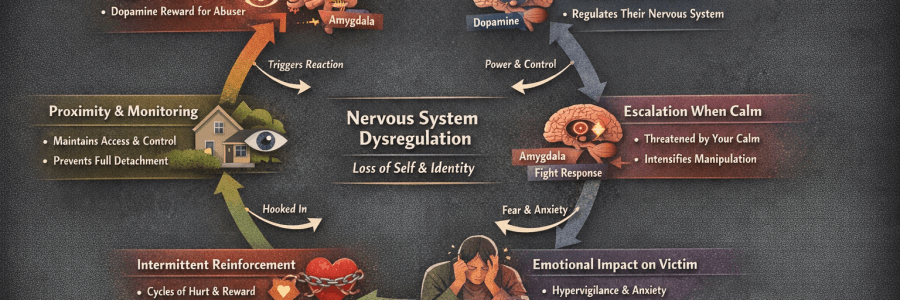
One of the biggest misconceptions people have about abusive or coercive relationships is that once the relationship ends, the danger automatically disappears. Unfortunately, psychology, neuroscience, and real-life experience often tell a very different story. For many people, separation and divorce are not the end of emotional pressure, intimidation, control, or fear. In fact, research consistently… Read More Protection Doesn’t End After Divorce — It Continues for Your Safety

Good to Know the Guardia Civil Will Still Be Protecting Me When I Move Home

There is a strange kind of relief that comes when you realise safety does not end at the front door of one particular house. For a long time, “home” stopped feeling like a place of peace. It became somewhere filled with tension, uncertainty, hypervigilance, and the exhausting emotional mathematics of constantly assessing moods, reactions, and… Read More Good to Know the Guardia Civil Will Still Be Protecting Me When I Move Home