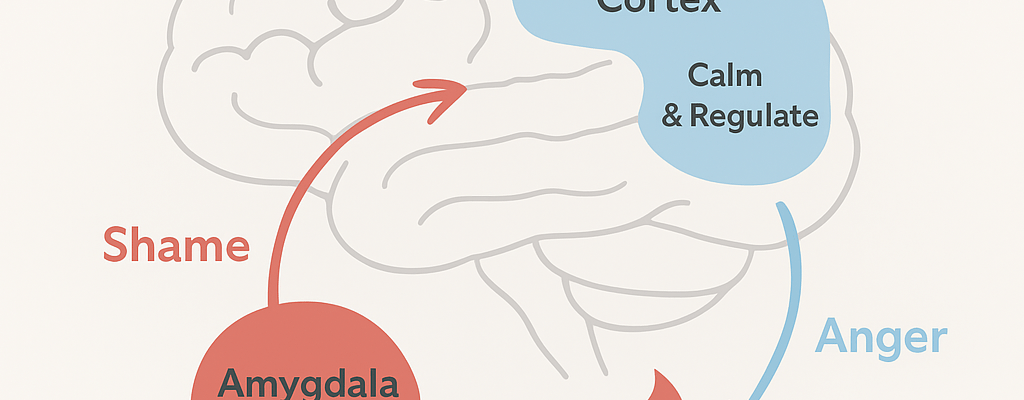
Understanding the shame-defensive pattern, and how to protect yourself from it
Most of us know someone who cannot be told they were wrong. A gentle comment turns into a storm. An apology never arrives, or arrives wrapped in blame. And when the relationship ends or they feel rejected, the reaction can be out of all proportion: jealousy, revenge, smear stories, even threats.
Often what lies beneath this behaviour is not strength, but shame they cannot bear to feel. This article explains how the pattern works, how it differs from healthy emotional functioning, and what to do when you are on the receiving end.
Healthy vs shame-defensive: a side-by-side view
| Healthy person | Shame-defensive person | |
|---|---|---|
| When triggered | Reflects | Reacts |
| When wrong | Takes responsibility | Attacks |
| Inner experience | Feels guilt | Feels annihilating shame |
| After conflict | Repairs | Destroys |
| Style of expression | Communicates | Intimidates |
| Emotions | Regulates | Dysregulates |
In real life these are tendencies, not fixed boxes. Almost all of us slip towards the right-hand column when we’re exhausted, frightened or humiliated. The difference lies in how quickly we recover, and whether we repair afterwards or keep the pattern going.
Notice, too, that the last row drives all the others. The ability to regulate emotion is what makes reflection, responsibility, repair and honest communication possible.
Guilt and shame are not the same
The heart of the difference is here.
- Guilt says: “I did something bad.” It is uncomfortable, but it is about behaviour, and behaviour can be changed. Guilt points toward an apology and repair.
- Shame says: “I am bad.” It is about the whole self. It feels like exposure, rejection and being unworthy of belonging.
A person who can tolerate guilt can say, “I got that wrong. I’m sorry.” A person for whom admitting fault feels like annihilation cannot. Their mind must protect them, and the fastest route is to turn the pain outward: “It’s your fault. You made me do this. You’re the problem.”
This is why trying to make a shame-defensive person feel guilty usually backfires. To them it doesn’t feel like a fair correction. It feels like an attack on their survival.
What dysregulation looks like in the body and the mind
Emotion regulation is the ability to feel a strong emotion without being swept away by it, and to settle again afterwards. Psychologists often describe a window of tolerance: the zone in which we can feel difficult emotions and still think clearly.
A person with a narrow window is pushed out of it very quickly. When shame is triggered, the nervous system registers danger, and the response can look like:
- Fight: rage, contempt, sarcasm, blame, intimidation, threats
- Flight: avoidance, disappearing, refusing to discuss the issue
- Freeze or collapse: going blank, stonewalling, or dramatic self-pity (“I’m worthless, I might as well not be here”)
- Fawn: sudden charm, over-apologising or gifts to restore the connection, followed by a return to the old pattern
The stages often look like this:
- Trigger: criticism, rejection, being replaced, losing control of someone, or being exposed as having made a mistake.
- Shame floods in, often so quickly that the person is not even aware of it.
- The defence activates: blame, attack, denial, or withdrawal.
- Escalation: because there is no internal capacity to soothe, the intensity builds instead of settling.
- Aftermath: temporary relief, then perhaps remorse, charm or victimhood, which keeps the cycle turning.
Importantly, the person may sincerely feel like the victim in all of this. Their internal experience is one of being wounded, even while they wound others.
Why moving on can set it off
For a shame-defensive person, seeing a former partner happy with someone else can feel like proof of their deepest fear: “I wasn’t enough.” Because they cannot hold that pain inside, it comes out as jealousy, revenge or an urgent need to regain control.
This is rarely about you. It is about what your independence stirs up in them. But it can still be harmful, and sometimes dangerous, so it needs to be treated seriously.
What helps, and what doesn’t
What tends not to help
- Trying to make them feel remorse or insight
- Long explanations, justifications or emotional appeals
- Arguing the facts in the heat of the moment
- Hoping that being kinder, calmer or more perfect will change them
These tend to add fuel, because each one touches the shame.
What tends to help
- Keep contact minimal, calm and factual. Short, written and boring gives shame very little to attach to.
- Don’t defend your character to them. Your worth does not depend on their verdict.
- Stay out of the escalation. You don’t have to respond to every provocation.
- Put boundaries and protections in place. Document incidents, limit access to your life, and use legal or professional protections where they exist.
- Build your own support. Trusted friends, family and, where needed, a trauma-informed therapist or advocate.
- Treat threats as threats. Understanding why someone behaves this way is never a reason to tolerate intimidation or danger. If you feel unsafe, contact your local emergency services or a specialist helpline.
A note on empathy and boundaries
It is possible to understand that someone is carrying unbearable shame, and still refuse to be their target. Compassion for the pattern does not mean access to your life. The person who needs help with their shame is responsible for seeking it, and you are not required to be the one who absorbs it.
When the pattern is closer to home
Most of us recognise ourselves in the right-hand column at times. If you do, that’s not a verdict. It’s an opening. A few questions can help:
- What happens in my body when I feel criticised or rejected?
- Can I say “I got that wrong” without feeling destroyed?
- What helps me come back to calm after I’ve reacted?
Building self-compassion, learning grounding and breathing techniques, and working with a therapist can all widen the window of tolerance, so that guilt becomes bearable and repair becomes possible.
A closing thought
Shame-driven behaviour can look powerful, but it usually grows out of fragility. That doesn’t make it your burden. You can understand the pattern, protect yourself from its effects, and keep your attention on building a calmer, safer life.
This article is for general information and emotional support only. It describes patterns and is not a diagnosis of any person. It is not a substitute for professional medical, psychological, legal or safety advice. If you are in immediate danger, contact your local emergency services.

