There is a moment in recovery that is difficult to describe until you have lived it.
It is the moment when you realise that they can no longer take anything from you.
They cannot control your money.
They cannot manipulate your emotions.
They cannot frighten you into doing what they want.
They cannot use anger, silence, guilt or intimidation to make you doubt yourself.
They cannot threaten your independence.
And, most importantly, they no longer have control over your sense of who you are.
After years of emotional, psychological, financial or physical abuse, that kind of freedom can feel almost unfamiliar.
For so long, life may have revolved around managing another person’s moods, anticipating their reactions, avoiding conflict and trying to keep the peace.
You may have learned to think:
What will happen if I say no?
Will they become angry?
Will they punish me financially?
Will they leave me?
Will they threaten me?
What will they do if I stand up for myself?
This constant anticipation can keep your nervous system in a state of vigilance. You are not simply living your life; you are continually monitoring the environment for danger.
Then something changes
Eventually, you begin to rebuild.
Perhaps you regain financial independence.
Perhaps you have your own home.
Perhaps you establish boundaries.
Perhaps you stop explaining yourself.
Perhaps you begin to trust your own decisions again.
Perhaps you realise that saying “no” does not make you selfish.
Perhaps you discover that another person’s anger does not mean you have done something wrong.
And slowly, something extraordinary happens.
You stop living your life around their reactions.
That is freedom.
Peace is not the absence of everything that happened
Finding peace does not mean pretending the abuse never happened.
It does not mean that you suddenly forget the years of fear, manipulation, humiliation or control.
And it certainly does not mean that healing happens overnight.
Peace means that what happened no longer gets to determine who you become.
You can remember without returning.
You can understand what happened without blaming yourself.
You can grieve what you lost while still being grateful for what you have regained.
And you can build a life that belongs entirely to you.
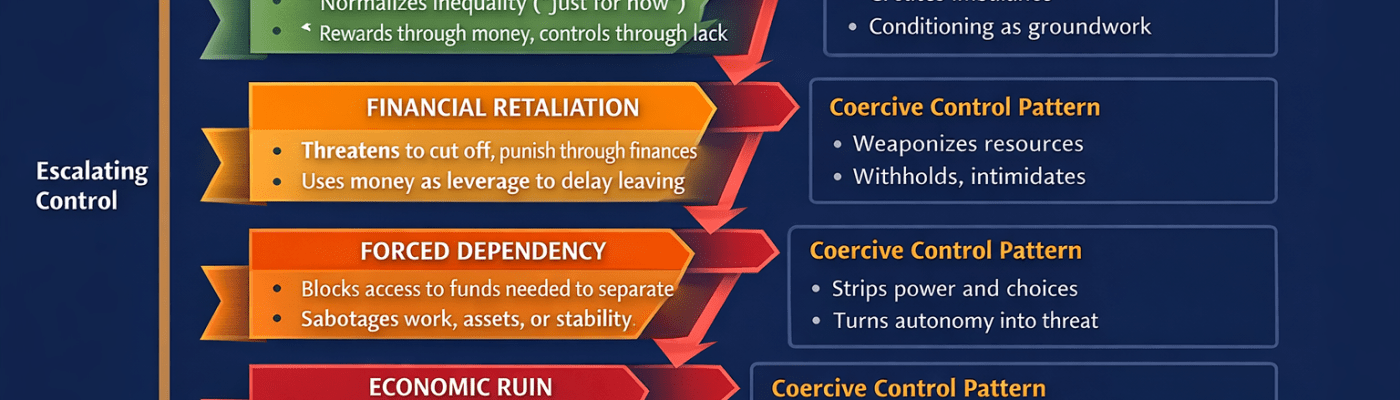
When financial control disappears
Financial abuse can be particularly powerful because money is connected to freedom.
When someone controls your access to money, accounts, property, employment or basic resources, they can make you feel as though leaving is impossible.
Rebuilding financial independence can therefore be much more than having money in your own account.
It can represent something much deeper:
I can support myself.
I can make my own decisions.
I don’t need permission.
My future belongs to me.
That realisation can be profoundly healing.
When emotional control disappears
Emotional control can be harder to recognise because there may be no visible injury.
It can look like guilt.
Manipulation.
Gaslighting.
Silent treatment.
Threats of abandonment.
Constant criticism.
Jealousy.
Intimidation.
Blaming you for their behaviour.
Making you responsible for their feelings.
Over time, you may begin to question your own judgement.
Recovery involves learning to hear your own voice again.
You begin to recognise:
Their feelings are theirs.
Their choices are theirs.
Their anger is not my responsibility.
Their disappointment does not mean I have done something wrong.
That is a very different way of living.
When physical control disappears
Physical abuse can leave wounds that are visible and wounds that are not.
Even after the physical danger has ended, the body can continue to remember.
A sudden noise.
A raised voice.
Someone standing too close.
A slammed door.
A particular tone of voice.
Your body may react before your conscious mind has had time to understand why.
This is one reason why recovery is not simply about “moving on.”
The nervous system may need time and safety to learn that the danger has passed.
Healing can involve gradually teaching your body:
I am safe now.
I have choices now.
I can protect myself now.
I am allowed to rest.
And then comes the quiet
Perhaps one of the strangest parts of freedom is the quiet.
No one is demanding an explanation.
No one is checking where you have been.
No one is deciding what you can spend.
No one is telling you what you should think.
No one is deliberately provoking you and then blaming you for reacting.
You can sit in your own home and breathe.
You can make a cup of coffee.
You can close the door.
You can make plans.
You can laugh.
You can sleep.
You can wake up and realise that your day belongs to you.
At first, that freedom can feel strange.
After living in survival mode, peace can even feel uncomfortable.
But gradually, the nervous system begins to recognise something new:
Nothing is required of me right now.
You become your own safe place
One of the most powerful parts of recovery is discovering that safety does not have to come from another person.
It can begin within you.
You learn your boundaries.
You trust your instincts.
You listen to your body.
You recognise red flags.
You stop negotiating with behaviour that once frightened you.
You understand that love should not require you to surrender your autonomy.
And you become much more protective of your peace.
Not because you have become cold.
Not because you no longer care.
But because you finally understand your worth.
Your freedom may be the thing they can never take away
There may have been a time when someone convinced you that you could not cope without them.
Perhaps they told you that you were incapable.
Too old.
Too emotional.
Too dependent.
Too difficult.
Perhaps they convinced you that nobody else would want you.
That you could never manage financially.
That you would fail on your own.
But one day you look around and realise:
I’m still here.
And not only are you still here.
You are becoming someone they can no longer control.
You are making your own decisions.
You are rebuilding your confidence.
You are creating your own future.
You are discovering yourself again.
And there is an extraordinary freedom in knowing that your peace no longer depends upon someone else’s permission.
You don’t have to become who you were before the abuse.
You can become someone new.
Someone wiser.
Someone stronger.
Someone with boundaries.
Someone who knows what she will and will not accept.
Someone who understands that love without respect is not enough.
Someone who knows that financial security is part of independence.
Someone who knows that emotional safety matters.
Someone who knows that her body belongs to her.
Someone who knows that peace is not something she has to earn.
It is something she is allowed to have.
And perhaps the greatest victory is not proving anything to the person who hurt you.
It is reaching the point where you no longer need them to understand, apologise, approve or change.
You have changed.
You have chosen yourself.
And finally, your life belongs to you.
That is freedom.
That is healing.
That is peace.

