When Someone Suggests They Know Something About A Child That You Don’t Know — Don’t Ignore the Alarm Bells
Sometimes the most important warning sign isn’t what someone tells you. It’s what they imply they know. Imagine someone makes an apparently casual comment about your child. Perhaps they mention something you didn’t know. Perhaps they imply they have information about your child’s life that hasn’t been shared with you. Perhaps they say: “I know… Read More When Someone Suggests They Know Something About A Child That You Don’t Know — Don’t Ignore the Alarm Bells

Would You Believe the Evidence — or Protect the Person You Love?

The content discusses the complexities of recognizing and addressing potential grooming behaviors towards children by trusted individuals. It emphasizes the psychological challenges parents face when confronted with allegations against those they know and care for, urging them to remain vigilant for warning signs and prioritize their children’s safety above discomfort or reputations.… Read More Would You Believe the Evidence — or Protect the Person You Love?

Deny, Deny, Deny: The Psychology of Denial When Someone Is Confronted With Evidence of Grooming

The text discusses how denial, defensiveness, loyalty, and fear can impact responses to suspected grooming behaviors. It highlights psychological conflicts individuals face when confronted with evidence against trusted people, often resulting in minimizing concerns or attacking the witness instead of addressing the allegations. The focus should remain on investigating behavior, not reputation.… Read More Deny, Deny, Deny: The Psychology of Denial When Someone Is Confronted With Evidence of Grooming

When You Finally Reach a Place of Peace Where No One Can Control You Anymore

Recovery from abuse involves reclaiming control over one’s life, finances, and emotions. It signifies the moment when one realizes they are no longer bound by another’s manipulation or fear. True freedom lies in establishing boundaries, trusting oneself, and recognizing that peace is innate, independent of past trauma. Healing fosters autonomy and personal growth.… Read More When You Finally Reach a Place of Peace Where No One Can Control You Anymore

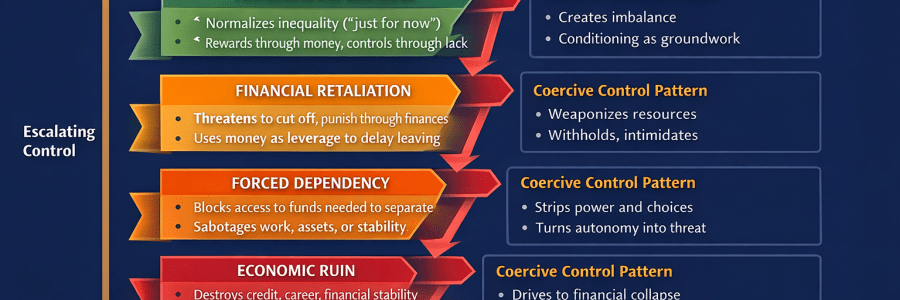
Coercive Control: When a Relationship Becomes About Power and Control

Coercive control is a subtle form of abuse that limits an individual’s autonomy through behaviors like monitoring, financial control, and isolation. Often difficult to recognize, especially for those over 40, it can manifest gradually, leading to hypervigilance and anxiety. Recognizing these patterns is vital for regaining personal freedom and healthy relationships.… Read More Coercive Control: When a Relationship Becomes About Power and Control

Types and Indicators of Abuse

Understanding the Different Forms of Abuse — and the Signs to Look For

Abuse is not always obvious.

It isn’t always physical, and it doesn’t always leave visible injuries. Abuse can involve patterns of behaviour designed to control, intimidate, manipulate, isolate, humiliate or undermine another person.

A person may also experience more than one type of abuse at the same time.

Recognising the signs can be an important first step towards understanding what is happening.

Important: The presence of one indicator on its own should not be taken as proof that abuse is occurring. However, it may indicate that further assessment is needed. The examples below are not exhaustive, and individual circumstances should always be considered.… Read More Types and Indicators of Abuse

Trauma-Informed Risk Assessment Framework

This framework helps evaluate risk levels in relationships or environments where abuse and compulsive/ritualistic behaviours intersect. 1️⃣ Assess the Type and Severity of Abuse Abuse Type Key Indicators Risk Implication Physical Hitting, choking, pushing, slapping Immediate risk of injury or escalation Emotional / Mental Gaslighting, verbal threats, humiliation High risk of psychological trauma, anxiety, PTSD Financial Controlling… Read More Trauma-Informed Risk Assessment Framework

Why Risk Levels Increase with Combined Behaviours

1. Amplified Control Dynamics Example: 2. Unpredictability and Escalation Example: 3. Increased Psychological Harm Effect: 4. Difficulty Predicting Behaviour Example: 5. Reinforcement Loop of Aggression and Anxiety 6. High-Risk Profile Summary When abuse and compulsive/trauma-driven behaviours intersect, the overall risk level skyrockets because: Factor Impact on Risk Physical abuse + rituals Unpredictable violence, increased chance of injury Emotional abuse + hypervigilance/paranoia Psychological harm,… Read More Why Risk Levels Increase with Combined Behaviours

High-Risk & Compulsive Behaviour Chart

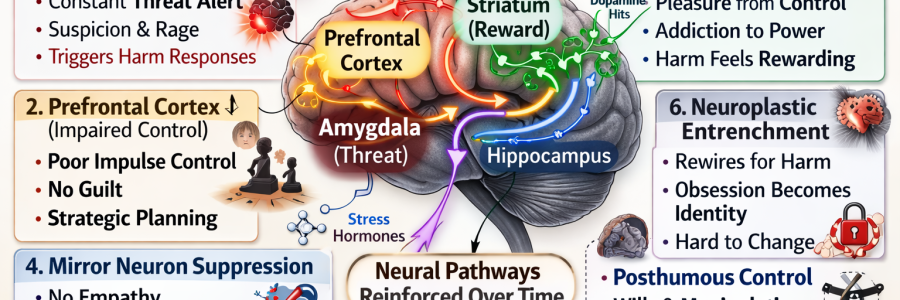
Behaviour / Pattern What It Looks Like Why It Happens (Psychology / Neuroscience) Danger Level Physical Abuse Hitting, slapping, choking, pushing Rage dysregulation, power/control, trauma history 🔴 Extreme Mental / Emotional Abuse Gaslighting, intimidation, verbal attacks, humiliation Power/control, ego protection, emotional dysregulation 🔴 Severe psychological harm Financial Abuse Restricting money, controlling spending, blocking employment Control,… Read More High-Risk & Compulsive Behaviour Chart