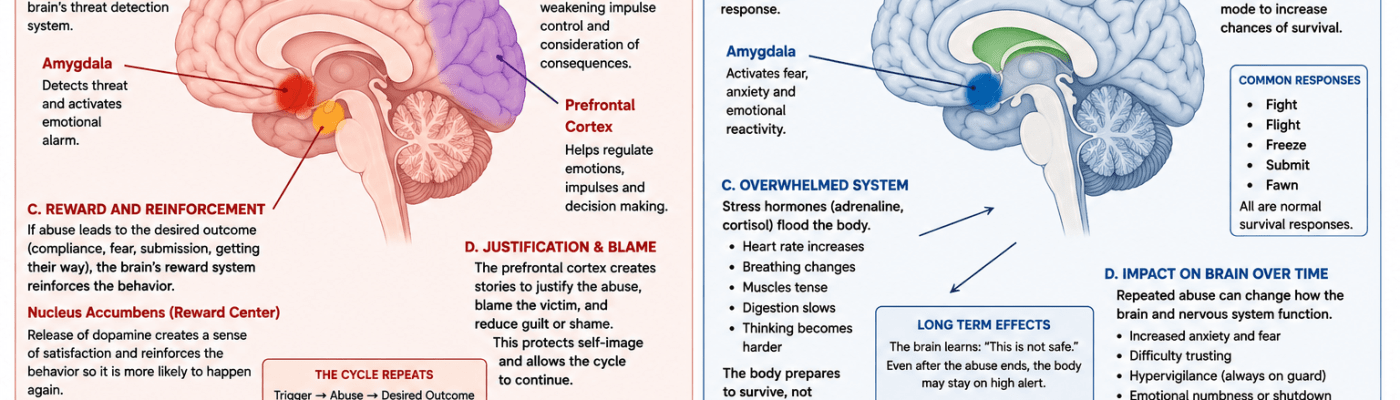
From a neuroscience perspective, abuse involves changes in the brain and nervous system of both the person being abused and, potentially, the person carrying out the abuse—but we have to be careful not to suggest that there is a single “abuser brain.” People become abusive through complex interactions among learning, personality, emotion regulation, beliefs, environment and behaviour.
What can happen in the abuser’s brain during abusive behaviour?
1. Threat and anger systems become highly activated
When an abuser perceives rejection, criticism, loss of control or a challenge to their authority, brain systems involved in threat and emotional salience can become strongly activated. The amygdala and related networks are involved in detecting emotionally significant or threatening situations.
But importantly, anger does not automatically cause abuse. Many angry people don’t become violent.
2. The prefrontal cortex normally helps regulate impulses
The prefrontal cortex contributes to inhibition, decision-making and consideration of consequences. During intense emotional arousal, regulatory control can become less effective.
However, this doesn’t mean an abuser “can’t control themselves.” Abusive behaviour can also be deliberate and instrumental—used specifically to frighten, punish, dominate or obtain compliance.
3. The reward system can reinforce abusive behaviour
This is particularly important.
If intimidation produces the desired result—perhaps the victim becomes silent, complies, stops arguing or gives the abuser what they want—the behaviour can be reinforced.
In simple terms:
Trigger → abusive behaviour → desired outcome → behaviour becomes more likely to be repeated.
That’s a basic learning mechanism.
4. The brain can learn that aggression “works”
Repeated experiences can strengthen behavioural patterns.
If someone repeatedly discovers that shouting produces compliance, or threats produce submission, those behaviours can become increasingly automatic or habitual.
This doesn’t mean the brain is programmed to abuse.
It means behaviour that repeatedly produces a desired consequence can become strongly learned.
5. Empathy and perspective-taking can be overridden
Healthy relationships require us to recognise another person’s distress and modify our behaviour accordingly.
During abusive behaviour, an individual’s beliefs may instead become:
“They deserve this.”
“They made me do it.”
“They need to learn.”
“I’m entitled to control this.”
These cognitive distortions can reduce the psychological barrier that would normally stop someone from deliberately causing another person distress.
And then there is the victim’s nervous system
This is where the neuroscience becomes particularly important.
While the abuser may be seeking control, the victim’s brain may be interpreting the situation as danger.
The sympathetic nervous system can activate.
Heart rate rises.
Attention narrows.
Muscles tense.
The person may fight, flee, freeze, submit or become extremely quiet.
With repeated abuse, the nervous system can become increasingly sensitive to cues associated with danger.
A raised voice.
Footsteps.
A particular facial expression.
A slammed door.
A certain tone of voice.
The body can learn:
“This comes before something bad happens.”
That is one reason trauma can continue affecting someone even after the abusive relationship has ended.
The crucial distinction
Neuroscience can help explain how abusive behaviour is learned, reinforced and maintained.
It does not excuse it.
An explanation is not an excuse.
And there is no single neurological abnormality that makes someone an abuser.
The most important question is not simply “What is happening in his brain?”
It is also:
“What behaviour is he choosing, what function does that behaviour serve, and what happens when it succeeds?”
That is where neuroscience, psychology and the study of coercive control come together.

