Trauma is not defined only by what happened

Trauma is not defined only by what happened; it also involves how the nervous system and mind respond to what happened. Different types of trauma Another useful distinction Trauma can also be described according to duration: Single-event trauma → repeated trauma → prolonged trauma → complex trauma And according to source: Accidental → interpersonal → relational →… Read More Trauma is not defined only by what happened

The Psychology of Child Sexual Abusers: What Research Actually Tells Us

Child sexual abuse is often imagined as being committed by a recognisable type of person: someone obviously disturbed, socially isolated, aggressive or visibly predatory. Research tells us something considerably more complicated. There is no single psychological profile, personality disorder or psychiatric diagnosis that identifies a child sexual abuser. People who sexually abuse children are a heterogeneous… Read More The Psychology of Child Sexual Abusers: What Research Actually Tells Us

The Hidden Wounds of Domestic Abuse: Why Justice Must Recognise More Than Bruises

For generations, domestic abuse was often viewed as a “private family matter.” Unless there were visible injuries, many survivors were dismissed, disbelieved, or told to simply “work things out.” Today, the courts are beginning to recognise a truth that survivors have always known: abuse leaves wounds that cannot always be seen. A recent Canadian court… Read More The Hidden Wounds of Domestic Abuse: Why Justice Must Recognise More Than Bruises

Landmark Canadian domestic-abuse judgment.

The case is significant not only because of the extreme violence described, but because the court recognized that long-term intimate-partner violence can justify a substantial civil damages award. Justice Susan Vella of the Ontario Superior Court of Justice awarded the woman $400,000 in damages after a nine-day trial. The decision followed a 54-year marriage in which the judge found… Read More Landmark Canadian domestic-abuse judgment.

When Abuse Is Minimized: The Hidden Psychological Harm

Trauma can leave survivors questioning their own memories, doubting their judgement, and wondering whether what they experienced was “bad enough” to matter. This self-doubt is often the result of years of gaslighting, manipulation, and coercive control, where the perpetrator repeatedly distorts reality until the survivor begins to mistrust their own thoughts, feelings, and experiences. The psychological… Read More When Abuse Is Minimized: The Hidden Psychological Harm

Why Having Abuse Recognised Matters: The Psychology and Neuroscience of Acknowledgement

For many survivors, divorce is one chapter. A financial settlement is another. Neither of those processes necessarily addresses what happened behind closed doors. Legal matters determine how assets are divided, where people live, and how finances are resolved. They do not automatically acknowledge years of coercive control, emotional abuse, psychological manipulation, intimidation, or violence. For many… Read More Why Having Abuse Recognised Matters: The Psychology and Neuroscience of Acknowledgement

Why People Stay in Harmful Relationships: Understanding Trauma Bonding, Intermittent Reinforcement, Confirmation Bias, the Sunk Cost Fallacy and Cognitive Dissonance

One of the most common questions people ask after leaving a harmful relationship is: “Why didn’t I leave sooner?” Friends and family often ask a similar question: “Why couldn’t they see what everyone else could see?” These questions have been studied for decades by psychologists and neuroscientists. The answer is rarely about weakness, lack of… Read More Why People Stay in Harmful Relationships: Understanding Trauma Bonding, Intermittent Reinforcement, Confirmation Bias, the Sunk Cost Fallacy and Cognitive Dissonance

When Domestic Abuse Crosses Into Child Abuse

Understanding the Overlap Between Intimate Partner Violence and Harm to Children Domestic abuse and child abuse are often discussed as separate issues. In reality, they frequently exist within the same household and can be driven by the same underlying patterns of coercion, control, and entitlement. Research consistently shows that while not every person who abuses… Read More When Domestic Abuse Crosses Into Child Abuse

Different Types of Abuse: Recognising Harmful Patterns and Warning Signs

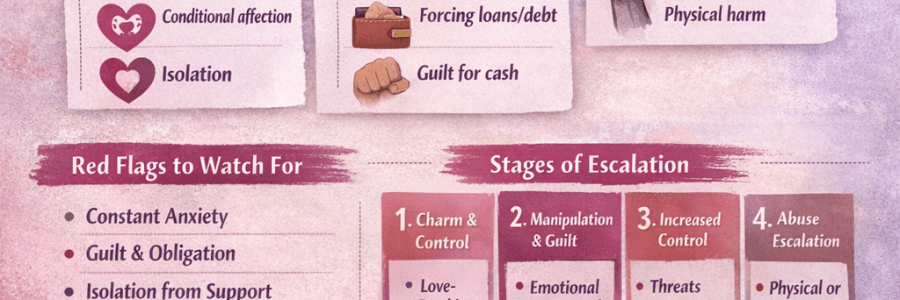
Type of Abuse What It Looks Like Common Warning Signs Physical Abuse The use or threat of physical force to intimidate or cause harm. Hitting, pushing, grabbing, restraining, blocking exits, throwing objects, unexplained injuries, threats of violence. Psychological / Emotional Abuse Behaviour that damages confidence, identity or emotional wellbeing. Constant criticism, humiliation, insults, silent treatment,… Read More Different Types of Abuse: Recognising Harmful Patterns and Warning Signs

Why Do Serial Abusers Leave a Trail of Apologies? The Psychology and Neuroscience Behind the Pattern

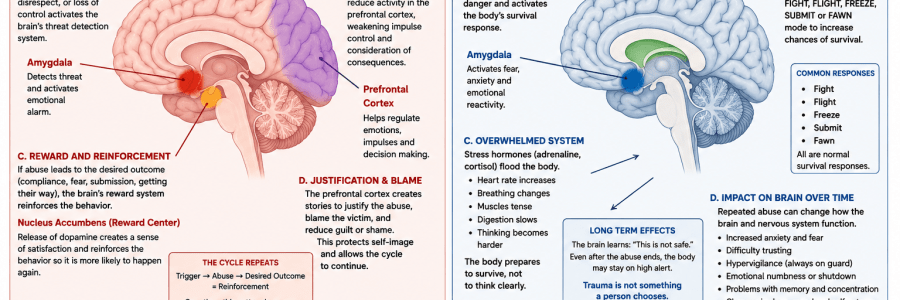
One of the most confusing experiences for survivors is discovering years of letters, cards and messages saying: “I’m sorry.” “I know I’ve hurt you.” “I’ll change.” Yet the behaviour never changes. How can someone repeatedly acknowledge their actions and still continue the same pattern for decades? The Cycle of Abuse Psychologists have long recognised a… Read More Why Do Serial Abusers Leave a Trail of Apologies? The Psychology and Neuroscience Behind the Pattern