Detecting Hidden Violent Tendencies: What Psychologists Look For
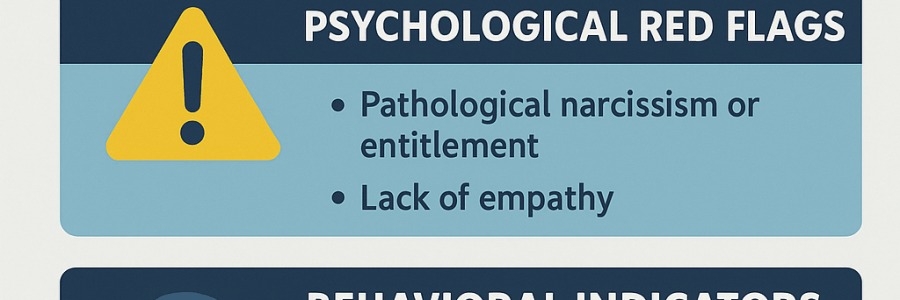
Even when someone seems calm in public, experts can spot warning signs behind closed doors. These signs are subtle and often show up in behavior, speech, or even social media activity. 1. Neuroscience Clues Amygdala hyperactivity: The amygdala regulates fear and aggression. Overactivity can make a person more prone to impulsive aggression. Prefrontal cortex dysfunction: This brain area… Read More Detecting Hidden Violent Tendencies: What Psychologists Look For

🇪🇸 DIVORCE IN SPAIN INVOLVING DOMESTIC VIOLENCE

When a divorce in Spain involves domestic violence (“violencia de género”), the process is handled with special legal protections and urgency to safeguard the victim. Below is a clear overview of how it works — legally, practically, and emotionally. 🇪🇸 DIVORCE IN SPAIN INVOLVING DOMESTIC VIOLENCE 1. Immediate Protection Comes First If domestic violence has occurred, the family court (“Juzgado… Read More 🇪🇸 DIVORCE IN SPAIN INVOLVING DOMESTIC VIOLENCE

Legal overview — Why hidden cameras are illegal in Spain

If you’ve discovered — or suspect — hidden cameras in your home, that is a serious violation of your privacy and possibly a criminal offence in Spain. Below is a clear explanation of what this means legally, what to do immediately, and how to protect yourself emotionally and practically. ⚖️ 1. Legal overview — Why hidden cameras… Read More Legal overview — Why hidden cameras are illegal in Spain

The Neuroscience of Sadistic Personality Traits: When Cruelty Becomes Rewarding

Some individuals don’t just hurt others for gain — they hurt because it feels good. This is the unsettling core of sadistic personality traits: deriving pleasure, excitement, or even arousal from another person’s suffering. While many people can act aggressively under certain conditions, true sadism involves pleasure from pain — an active pursuit of cruelty for its own… Read More The Neuroscience of Sadistic Personality Traits: When Cruelty Becomes Rewarding

When “Concern” Turns into Surveillance: The Neuroscience of Hidden Control

When someone has taped your phone, planted a hidden camera, or placed a tracker on your car, it’s not love — it’s surveillance.These actions are meant to dominate, not protect. From a neuroscience perspective, this kind of violation rewires the brain’s safety systems. The moment we sense that our privacy has been invaded, the amygdala — the brain’s fear… Read More When “Concern” Turns into Surveillance: The Neuroscience of Hidden Control

⚠️ When the Abuser’s Family Suddenly Sends You a Friend Request — Hidden Motives and the Psychology Behind It

After years or even decades of silence, you might suddenly get a friend request or message from your abuser’s family.It can feel confusing — part curiosity, part unease.But often, these “friendly” gestures have ulterior motives, and it’s wise to stay cautious. 🧠 The Psychology Behind the Behavior When someone from the abuser’s circle reaches out, it’s rarely… Read More ⚠️ When the Abuser’s Family Suddenly Sends You a Friend Request — Hidden Motives and the Psychology Behind It

🧠 Why “Hidden Truths” Eventually Surface

There’s a deep psychological and even neurological explanation for why situations like this unfold the way they do, and why it feels both shocking and relieving when “hidden” truths start surfacing. Let’s break it down from a neuroscience + psychology lens: 🧠 Why “Hidden Truths” Eventually Surface Cognitive Load on DeceptionWhen someone lies or hides things, their prefrontal… Read More 🧠 Why “Hidden Truths” Eventually Surface

🏦 Hidden Assets & Deception

Here’s a structured list of the main forms of financial abuse in domestic or family settings — especially where control, coercion, and hidden assets are involved. 💳 Direct Control of Money Taking partner’s wages, benefits, or pensions. Restricting access to joint bank accounts. Forcing partner to ask for money or “allowances.” Monitoring every purchase, demanding receipts. Cancelling cards… Read More 🏦 Hidden Assets & Deception

Characteristics of Hidden Cruelty

“Hidden cruelty,” —likely referencing Alice Miller’s work on poisonous pedagogy—refers to subtle, socially accepted forms of harm inflicted on children that are not overtly recognized as abuse. Unlike obvious physical violence or screaming, hidden cruelty is covert, psychologically manipulative, or morally justified, making it hard for both children and society to label it as abusive. Let’s break it… Read More Characteristics of Hidden Cruelty

Medication, Libido, and Abuse: The Neuroscience Behind a Hidden Struggle

Many clients ask me how to recognise an abuser. My own story is a painful example—I spent decades in an abusive relationship, cut off from friends and family, convinced for years that it was love. Only when the abuse became physical and uncontrollable did my doctors and psychologist urge me to leave for my own… Read More Medication, Libido, and Abuse: The Neuroscience Behind a Hidden Struggle