A sentence of community service is still a criminal conviction trabajos en beneficio de la comunidad

In Spain, community service is a recognized criminal sentence that can replace or accompany imprisonment based on the Penal Code. Courts may impose it due to the offense’s nature, as a condition for suspended sentences, or based on the offender’s circumstances. It typically lasts from one day to one year and must be supervised, with non-compliance reported to authorities.… Read More A sentence of community service is still a criminal conviction trabajos en beneficio de la comunidad

Comparative chart — selected jurisdictions, 2026

Different legal systems address multidimensional abuse uniquely, with some recognizing coercive control as a specific offence. Notably, jurisdictions like England, Scotland, Ireland, and Queensland focus on patterns of behavior rather than isolated incidents. Ultimately, the consideration of cumulative behavior significantly impacts sentencing and acknowledges the complex nature of such abuse.… Read More Comparative chart — selected jurisdictions, 2026

What does the AMPD actually assess?

AMPD, or the Alternative Model for Personality Disorders, is a dimensional approach in the DSM-5 that assesses personality functioning and maladaptive traits. It evaluates identity, self-direction, empathy, and intimacy while categorizing traits under negative affectivity, detachment, antagonism, disinhibition, and psychoticism. This model aids in a comprehensive understanding for treatment planning, without labeling individuals as abusive.… Read More What does the AMPD actually assess?

Operant Conditioning in Childhood

Behaviour What the person is trying to prevent Immediate consequence What the nervous system learns Long-term effect Keeping quiet Argument, criticism or anger Temporary peace “Silence keeps me safer.” Stops expressing needs, opinions and feelings Appeasing Escalation or punishment The other person may calm down “Giving in reduces the danger.” Boundaries become weaker; self-abandonment can… Read More Operant Conditioning in Childhood

Operant conditioning

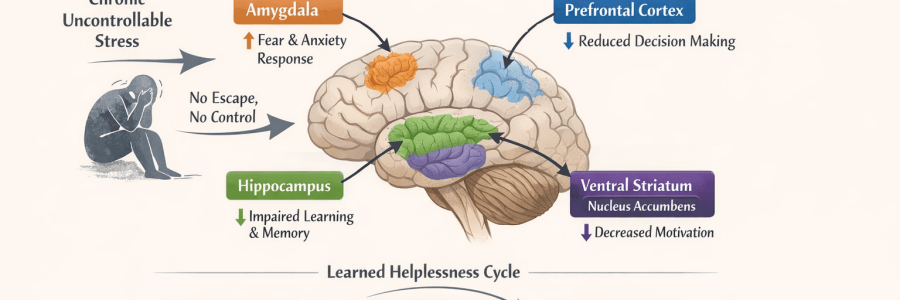
B.F. Skinner’s operant conditioning illustrates how behaviors are learned through reinforcement, as seen in both animal studies and complex human relationships. In abusive environments, individuals adapt their behavior based on unpredictable consequences, leading to automatic responses. However, upon leaving such situations, new positive experiences can foster healthier behavioral patterns.… Read More Operant conditioning

Two Years Later: When You Can Finally Breathe Again

Two years after leaving an abusive environment, the individual discovers the profound transformation of their existence. They shift from survival to genuine living, where silence becomes peaceful and ordinary moments regain significance. Recovery involves redefining identity and addressing the past without fear, ultimately embracing a life of choice, safety, and self-ownership.… Read More Two Years Later: When You Can Finally Breathe Again

The Wider Impact of Abuse: When One Abusive Relationship Affects an Entire Relational System

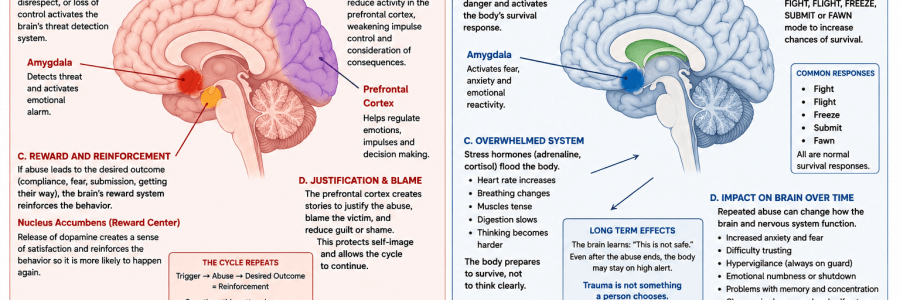
Domestic abuse is not confined to the victim; it impacts the entire relational environment, affecting children, relatives, and friends. Chronic exposure to abuse leads to altered behaviors, hypervigilance, and emotional exhaustion within the social network. Recognizing these wider effects is crucial for understanding and addressing the full repercussions of such abuse.… Read More The Wider Impact of Abuse: When One Abusive Relationship Affects an Entire Relational System

Family Systems of Denial

The content discusses the effects of witnessing intergenerational abuse, emphasizing the psychological complexities of denial within families. Survivors often struggle with acknowledging their experiences when family members refuse to recognize the abuse, creating feelings of isolation. Therapy can help survivors separate their experiences from their family’s responses, allowing healing and agency.… Read More Family Systems of Denial

Trauma Informed Assessment

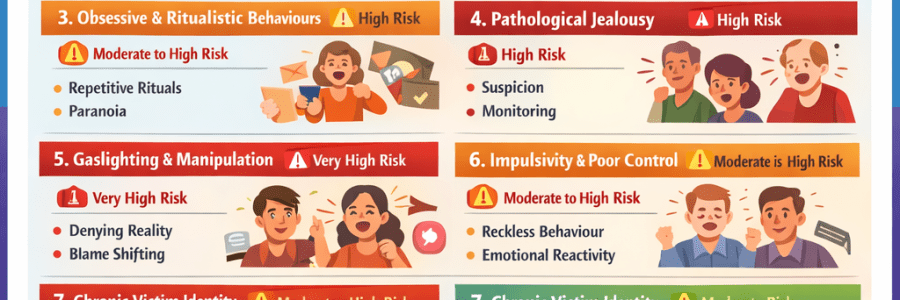
When a clinician is assessing for multidimensional abuse, they are generally looking beyond a single incident and examining the pattern, domains, severity, impact, risk and degree of control within the relationship. It is not simply a checklist asking, “Were you hit?” A good assessment tries to understand the person’s lived environment. What a clinical assessment may examine 1. Psychological and… Read More Trauma Informed Assessment