If you have survived an abusive or controlling relationship, you may still be trying to understand what happened.
You may ask yourself:
Why did I stay?
Why did I keep hoping things would change?
Why did I start doubting myself?
Why do I still feel anxious, even though I’m away from the relationship?
Why is it so difficult to trust my own decisions?
These questions are incredibly common after emotional abuse and coercive control.
And the answer is not that you were weak.
Abuse can gradually affect the way you think, feel, respond and see yourself. When you live with unpredictability, criticism, manipulation, intimidation or control, your nervous system can begin adapting to survive.
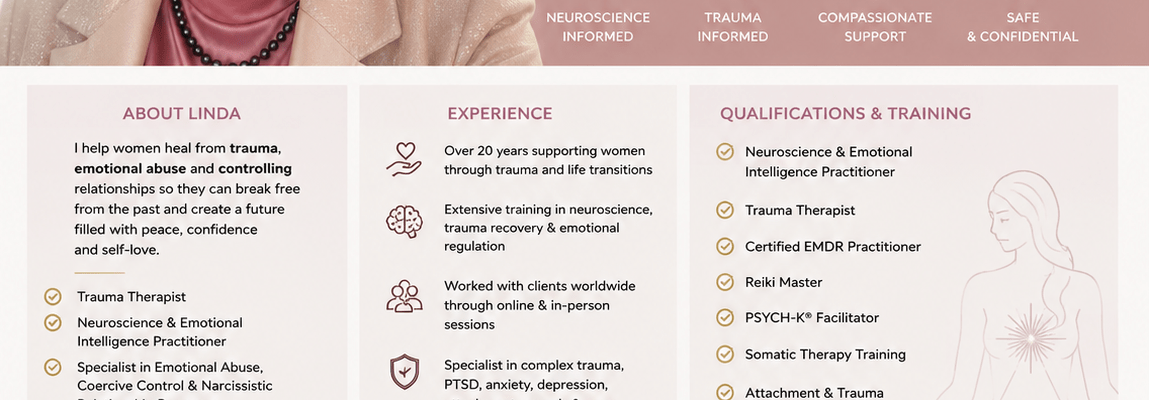
I understand this not only through my professional work, but also through my own experience of abuse.
The Psychology of Control
Abusive behaviour is ultimately about power, control and entitlement. It can take many forms, including emotional manipulation, financial control, isolation, intimidation, gaslighting and coercive control.
Not every person who behaves abusively has a mental health disorder or narcissistic personality disorder. It is important not to assume a diagnosis from behaviour alone.
What matters most is the impact of the behaviour and the pattern of control.
Gaslighting and the loss of self-trust
One of the most damaging experiences can be having your reality repeatedly questioned.
You may be told that something didn’t happen when you know it did. Your feelings may be dismissed. You may be called “too sensitive,” “crazy,” difficult or unreasonable.
Over time, you can begin questioning yourself.
Was it really that bad?
Did I cause it?
Am I imagining things?
This erosion of self-trust can continue long after the relationship ends.
The cycle of hope and hurt
Abusive relationships can also contain periods of affection, apologies, promises or apparent change followed by criticism, control or abuse.
Those moments of connection can create powerful hope that the person you love will return to the version of themselves you remember.
You may find yourself waiting for the “good times” to come back.
This does not mean you were foolish.
It means you were responding to a complicated emotional relationship in which love, fear, hope and uncertainty became intertwined.
What Happens to Your Nervous System?
Living with chronic emotional threat can keep your nervous system on high alert.
You may become:
- Hypervigilant
- Easily startled
- Anxious or overwhelmed
- Emotionally exhausted
- Afraid of making the wrong decision
- Constantly scanning other people’s moods
- Disconnected from your own needs
- Unable to relax even when you are finally safe
Your brain and nervous system are designed to protect you.
When danger is unpredictable, your system may learn to anticipate danger before it happens.
That can be useful for survival—but exhausting when the danger has passed.
Why You May Still Feel This Way After Leaving
Leaving an abusive relationship does not necessarily mean your nervous system immediately feels safe.
Your mind may understand:
“I’m away from them.”
But your body may still be saying:
“Stay alert.”
Healing can involve gradually teaching yourself that you no longer have to live in constant survival mode.
This is where trauma-informed support, emotional regulation and an understanding of neuroscience can become valuable.
Your Healing Is About You—Not Fixing the Abuser
You do not have to understand every aspect of your abuser’s psychology before you can heal.
You don’t have to diagnose them.
You don’t have to make sense of every contradiction.
And you don’t have to forgive them in order to move forward.
Your healing begins when you start turning your attention back toward yourself.
Rebuilding self-trust
You can begin learning to trust your instincts again.
Rebuilding boundaries
You can learn that saying no does not make you selfish or unkind.
Reclaiming your identity
You can rediscover the woman who existed underneath the fear, responsibility and survival.
Regulating your emotions
You can learn to recognise what your nervous system is communicating and develop healthier ways to respond.
Reclaiming your future
Your past may have shaped you.
It does not have to define the rest of your life.
If You’re Starting Again After 45
For many women, leaving an abusive or controlling relationship later in life can bring an unexpected question:
“Who am I now?”
Perhaps you’ve spent decades being a partner, mother, carer, professional or the person who kept everything together.
Now you have an opportunity to discover yourself beyond those roles.
Starting again at 50, 60 or beyond is not too late.
It can be the beginning of a deeply meaningful new chapter.
You Are Not Broken
If abuse changed the way you think, feel or respond, that does not mean there is something fundamentally wrong with you.
Your responses may have developed because you were trying to survive.
And what has been learned can, with appropriate support and time, begin to change.
You survived it. Now it’s time to heal from it.
Healing is not about becoming the woman you were before.
It is about becoming more fully yourself—with greater self-trust, stronger boundaries, emotional safety and the freedom to choose what comes next.
If you are recovering from emotional abuse, coercive control, relationship trauma or a difficult life transition, I offer online support for women and men, with a particular focus on women 45+.
Heal Trauma. Restore Safety. Reclaim Your Life.
🌐 lindacjturner.com
📞 +34 623 545 007
Linda C J Turner | Trauma & Relationship Specialist | Neuroscience & Emotional Regulation | Emotional Abuse & Coercive Control Recovery

