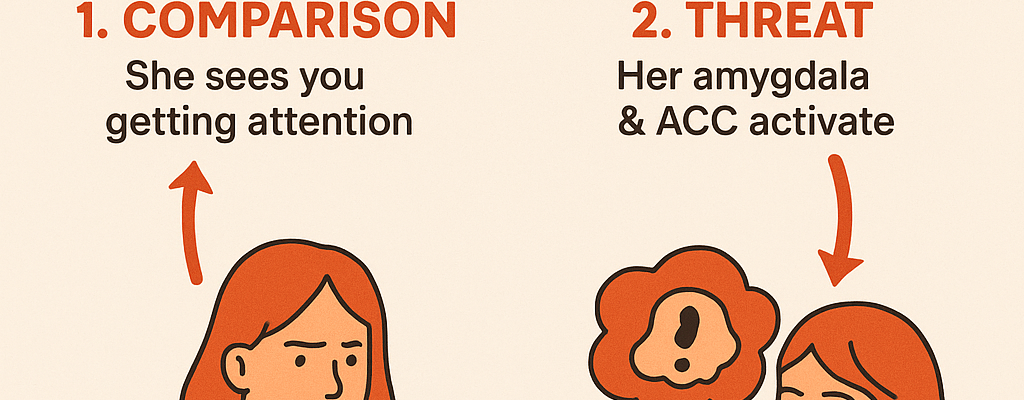
Psychologists distinguish between benign envy and malicious envy. Although both involve wanting something another person has, they lead to very different thoughts, emotions and behaviours.
| Benign Envy | Malicious Envy |
|---|---|
| “I’d like to achieve that too.” | “I don’t want them to have it.” |
| Inspires self-improvement. | Motivates attempts to reduce another person’s success. |
| Leads to admiration and learning. | Leads to resentment, criticism or sabotage. |
| Focuses on personal growth. | Focuses on pulling others down. |
| Creates healthier relationships. | Damages trust and relationships. |
| Associated with secure self-esteem. | More often associated with insecurity and threatened self-worth. |
Example 1: Within a Family
Benign Envy
A sister learns that her brother has received a promotion.
Her first reaction is:
“I’m so pleased for him. He’s worked incredibly hard. I hope I can achieve something similar one day.”
She may ask how he prepared for the interview or what skills helped him succeed.
His success becomes a source of inspiration.
Malicious Envy
The same promotion is announced.
Instead of congratulations, the response becomes:
“He only got it because he knows the right people.”
“It won’t last.”
“He’s changed since earning more money.”
Soon, subtle criticisms begin.
Family gatherings become uncomfortable.
The successful family member is excluded, criticised behind their back or made to feel guilty for doing well.
The goal is no longer understanding the success—it is reducing its emotional impact by diminishing the person.
Example 2: Between Adult Siblings
One sibling starts a successful business.
A healthy response is curiosity, pride and encouragement.
A maliciously envious response may involve:
- constantly predicting failure,
- spreading rumours,
- questioning every achievement,
- refusing to celebrate successes,
- bringing up past mistakes whenever praise is received.
The success becomes difficult to tolerate because it threatens the other sibling’s self-image.
Example 3: An Abusive or Controlling Partner
A woman receives recognition at work.
Healthy Partner
“I’m really proud of you. Let’s celebrate.”
Her success strengthens the relationship because both partners understand that one person’s achievement benefits the family as a whole.
Controlling or Abusive Partner
Instead of celebration, the response may be:
“Don’t get too full of yourself.”
“You’ll probably fail anyway.”
“Who were you trying to impress?”
“You’re neglecting the family.”
Rather than expressing pride, the partner redirects attention, criticises the achievement or creates conflict.
Research on coercive control suggests that some controlling partners perceive growing independence or confidence as a threat to their influence within the relationship. This does not describe all abusive relationships, but it is a recognised pattern.
Example 4: A Child Receiving Praise
Imagine a child proudly showing excellent school results.
A supportive parent responds with encouragement:
“I’m proud of how hard you’ve worked.”
A parent driven by malicious envy or a strong need to remain the centre of attention may respond differently:
- ignoring the achievement,
- immediately changing the subject,
- criticising minor imperfections,
- comparing the child unfavourably with others,
- or making the achievement about themselves.
The child learns that success is not always welcomed and may begin hiding achievements to avoid conflict.
The Neuroscience Behind the Difference
Both forms of envy begin with social comparison, a normal human tendency described by psychologist Leon Festinger.
The difference lies in how the brain interprets the comparison.
With benign envy, emotional regulation systems—including the prefrontal cortex—help reframe the situation:
“Their success doesn’t diminish mine. I can learn from this.”
This response encourages motivation, planning and problem-solving.
With malicious envy, the comparison is more likely to be experienced as a threat.
Research suggests that social threats can activate the amygdala, which helps detect emotionally significant events. If someone interprets another person’s success as a threat to their identity, status or self-worth, defensive emotions such as shame, anger or resentment may become more prominent.
Rather than asking:
“How can I improve?”
the mind shifts toward:
“How can I reduce their advantage?”
This is where criticism, ridicule, controlling behaviour or attempts to undermine another person can emerge.
Why It Happens
For some people, another person’s success feels like evidence of their own failure.
This often reflects a scarcity mindset:
- If they are admired, there is less admiration available for me.
- If they become financially successful, I have somehow become less successful.
- If they become more confident, I lose importance.
Psychologically, this is a false comparison.
Healthy self-esteem recognises that another person’s achievements do not reduce our own worth.
The Hallmark of Emotional Security
Emotionally secure people generally have little difficulty celebrating the people they love.
They understand that love, respect, pride and success are not finite resources.
A partner’s promotion, a child’s achievements or a sibling’s financial success are viewed as additions to the family’s wellbeing, not as personal threats.
One of the strongest signs of emotional maturity is the ability to genuinely celebrate another person’s success without feeling diminished by it.
Conversely, when someone repeatedly responds to the achievements of those closest to them with criticism, resentment or attempts to undermine them, it may suggest that the success has been experienced as a threat rather than a joy. While that pattern can occur for many reasons and does not by itself identify a particular psychological condition, repeated responses of this kind can have a profound impact on family relationships and emotional wellbeing.

