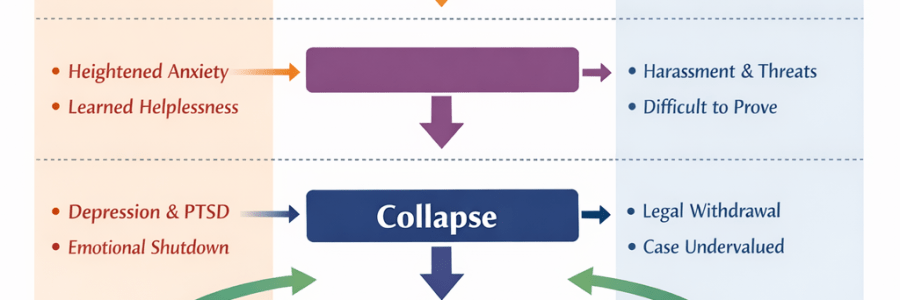
Abuse → Denial → Escalation → Collapse: Conceptual Map
Step 1: Abuse Step 2: Family Denial Step 3: Escalation Step 4: Collapse Interaction with Silence as a Protective Strategy
Therapy, also known as psychotherapy or counseling, is a collaborative process between a trained mental health professional and an individual, couple, family, or group. The goal of therapy is to address and overcome emotional or psychological challenges, improve mental well-being, and facilitate personal growth and development. Therapists use various therapeutic approaches and techniques to help clients explore their thoughts, feelings, and behaviors, ultimately leading to positive changes in their lives.
Step 1: Abuse Step 2: Family Denial Step 3: Escalation Step 4: Collapse Interaction with Silence as a Protective Strategy
Yes, if ALL of the following are true: Your lawyer’s role is precisely to hold information so you don’t have to. Why this is protective (neuroscience & psychology) 🧠 1. Cognitive offloading This is healthy delegation, not avoidance. 🧠 2. Containment reduces trauma activation Uncontained information keeps trauma circuits “open.” A lawyer provides: Your nervous system needs closure,… Read More Should you pass the information to your lawyer?
Definition:Repetition compulsion is a concept introduced by Sigmund Freud in psychoanalytic theory. It refers to the tendency of individuals to repeat behaviors, situations, or relationships that mirror unresolved conflicts or traumatic experiences from the past, often unconsciously. How It Manifests Example:A person who grew up with inconsistent parental care may unconsciously seek partners who are emotionally unavailable,… Read More Repetition Compulsion in Psychodynamic Therapy
I am safe. I have spoken out. My healing is progressing. Now it’s time to focus on my life, my growth, and my well-being. Step 1: Maintain Trauma-Informed Support Step 2: Recalibrate my Nervous System Step 3: Reclaim my Identity Step 4: Set and Enforce Boundaries Step 5: Integrate my Trauma Step 6: Educate and Empower… Read More Next Chapter: A Step-by-Step Guide
When a trained psychologist is visibly shocked, it tells you something important about the severity and objectivity of what you endured. This is not about validation through emotion. It’s about clinical reality breaking through professional neutrality. 🧠 Why a Psychologist’s Shock Is Neurologically Significant Psychologists are trained to: So when their face gives it away, something unusual is happening at a… Read More 🧠 Why a Psychologist’s Shock Is Neurologically Significant
IntroductionSurvivors of long-term abuse often experience a profound psychological weight. Decades of emotional, physical, or relational trauma can shape not only beliefs and behaviors but also neural architecture. Emerging from such a context into a space of autonomy—symbolized here by “having no ring on your finger”—can trigger complex emotional, cognitive, and neurobiological responses. Psychological Perspective… Read More Freedom After Decades of Abuse: The Neuroscience of Choice and Self-Determination
Common psychological phenomenon in families of abuse survivors, and it has both neuroscientific and social-psychological dimensions. Here’s a clear breakdown: 1. Minimization and Denial by Family Members Even if there’s a documented history of serious abuse (e.g., previous wife harmed), they may ignore or dismiss it because acknowledging it would require action or confronting uncomfortable truths.… Read More Minimization and Denial by Family Members
Discovering that someone close to you has a deeply troubling or criminal past, especially involving exploitation or abuse, can be profoundly destabilizing. Seeking help and therapy afterward is critical for processing trauma, reclaiming a sense of safety, and rebuilding your life. Here’s a structured guide: 1. Acknowledge Your Emotional Reality 2. Seek Professional Support 3. Create… Read More Seek Professional Support
Here’s a step-by-step guide for dealing with a toxic or dangerous ex when new evidence, letters, or stories keep emerging, tailored to your situation: 1. Acknowledge Your Emotional Response 2. Set Boundaries 3. Document Evidence Safely 4. Seek Emotional and Psychological Support 5. Control the Narrative 6. Legal and Safety Considerations 7. Rebuilding and Moving Forward Optional… Read More Document Evidence Safely
How EMDR and Somatic Therapies Facilitate Neural Recalibration Trauma leaves lasting imprints on neural circuits responsible for threat detection, emotional regulation, and self-reference. EMDR (Eye Movement Desensitization and Reprocessing) and somatic therapies (body-focused approaches) specifically target these disrupted networks, promoting neuroplasticity and functional recovery. 1. EMDR: Processing Trauma Through Bilateral Stimulation Mechanism: Neuroscience effects: Clinical… Read More Neuroscience of EMDR and Somatic Therapies in Trauma Recovery