When Healing Shows: How Trauma Recovery Transforms Mind, Brain & Body

Two years ago, under extreme psychological stress and PTSD from an abusive marriage, my eyesight measured just 70% without glasses.Eighteen months after leaving that environment, my vision is now 90% without glasses. The optician also said something unexpected:“You look lighter. Brighter.” And that moment says everything about trauma, healing, and the incredible power of the human… Read More When Healing Shows: How Trauma Recovery Transforms Mind, Brain & Body

Choosing EMDR after strangulation and psychological abuse is not recovery — it is reclamation.

Strangulation is one of the most dangerous and psychologically devastating forms of assault.It directly impacts the brain’s fear system, memory processing, emotional regulation, and sense of safety. But survival rewires the brain for endurance.Healing rewires it for freedom. EMDR allows trauma to be reprocessed so it no longer controls the nervous system, emotions, identity, or self-worth. This… Read More Choosing EMDR after strangulation and psychological abuse is not recovery — it is reclamation.

Trauma recovery often feels like time travel.

When you live for years in survival mode — emotional suppression, hyper-vigilance, constant adaptation — your nervous system is focused only on one thing: getting through. You don’t live.You endure. Psychologically, this creates a version of you built for survival, not for authenticity.You silence your needs.You shrink your emotions.You disconnect from parts of yourself just to… Read More Trauma recovery often feels like time travel.

Neuroscience & Therapeutic Map: Boundaries, Safety, and Recovery

1. Enforcing One Boundary Rewires Safety Faster Than Insight Key idea:Action speaks louder than thought. The brain needs proof, not reasoning. Mechanism: Clinical/Legal translation: Example: 2. Silence as the Final Neurological Boundary Key idea:Silence is not passive. It is active nervous-system regulation. Mechanism: Clinical/Legal translation: Example: 3. How the Brain Knows It’s Safe to Feel Again Key… Read More Neuroscience & Therapeutic Map: Boundaries, Safety, and Recovery

🌱🧠 What Recovery Looks Like After Intimidation Ends

This is the part people rarely explain — but it matters most.Recovery after intimidation is real, predictable, and neurological. It doesn’t happen all at once, and it doesn’t mean “forgetting.” It means your nervous system relearns safety. Here’s what recovery actually looks like, stage by stage. 🌱🧠 What Recovery Looks Like After Intimidation Ends Phase 1: Threat Removal… Read More 🌱🧠 What Recovery Looks Like After Intimidation Ends

🧠 ANGER vs GRIEF IN TRAUMA RECOVERY

(Brain → function → outcome) 🔥 ANGER Purpose: protection and containment 🧠 Brain state 🧭 Function after trauma Anger says: “This should not have happened.” That is a healthy early response. 🧍 Behavioural expressions 🧠 Nervous-system effect This is why anger often comes before grief. 🌊 GRIEF Purpose: integration and release 🧠 Brain state 🧭 Function after trauma… Read More 🧠 ANGER vs GRIEF IN TRAUMA RECOVERY

Neuroscience of EMDR and Somatic Therapies in Trauma Recovery

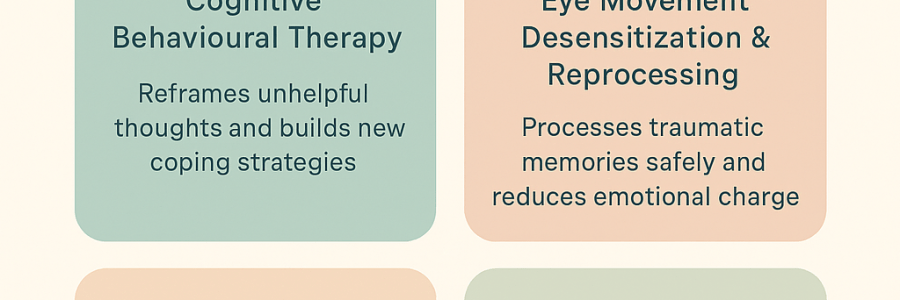
How EMDR and Somatic Therapies Facilitate Neural Recalibration Trauma leaves lasting imprints on neural circuits responsible for threat detection, emotional regulation, and self-reference. EMDR (Eye Movement Desensitization and Reprocessing) and somatic therapies (body-focused approaches) specifically target these disrupted networks, promoting neuroplasticity and functional recovery. 1. EMDR: Processing Trauma Through Bilateral Stimulation Mechanism: Neuroscience effects: Clinical… Read More Neuroscience of EMDR and Somatic Therapies in Trauma Recovery

Hippocampal Atrophy in Chronic Domestic Abuse: Clinical Implications and Recovery Pathways

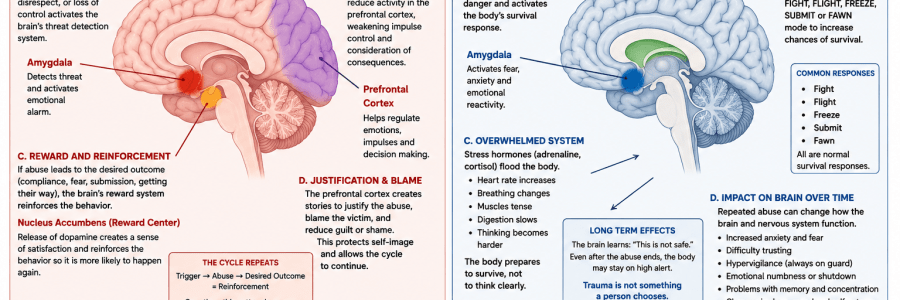
Professional Summary for Therapists, Advocates, and Educators Long-term interpersonal trauma—particularly coercive control, emotional deprivation, chronic unpredictability, and relational threat—produces well-documented neurobiological changes. These changes are not metaphorical. They are structural, functional, and measurable. One of the most clinically significant is hippocampal shrinkage. 1. Neurobiological Impact: What the Evidence Shows Hippocampal Atrophy Research spanning two decades (Bremner,… Read More Hippocampal Atrophy in Chronic Domestic Abuse: Clinical Implications and Recovery Pathways

Trauma Recovery & Nervous System Regulation Infographic

Flow: Trauma → Healing Steps → Nervous System Regulation 1️⃣ Trauma (Impact Stage) 2️⃣ Healing Steps (Action Stage) Step Action Brain/Body Effect Visual Cue Step 1: Establish Safety 🔒 Safe environment, non-toxic spaces Amygdala calms, body tension decreases Green shield icon Step 2: Trauma-Informed Support 🤝 Psychologist, counseling mPFC & hippocampus strengthen Blue hands icon Step 3:… Read More Trauma Recovery & Nervous System Regulation Infographic

Safety + empowerment + vigilance + recovery.

Just because you’re feeling great, fantastic, renewed… don’t lose sight of the truth:your abusers will not be feeling the same. And that’s exactly why you stay grounded, steady, and smart. Healing does not mean becoming careless.Freedom does not mean forgetting what you survived.Confidence does not mean abandoning caution. This is the chapter where you rise… Read More Safety + empowerment + vigilance + recovery.