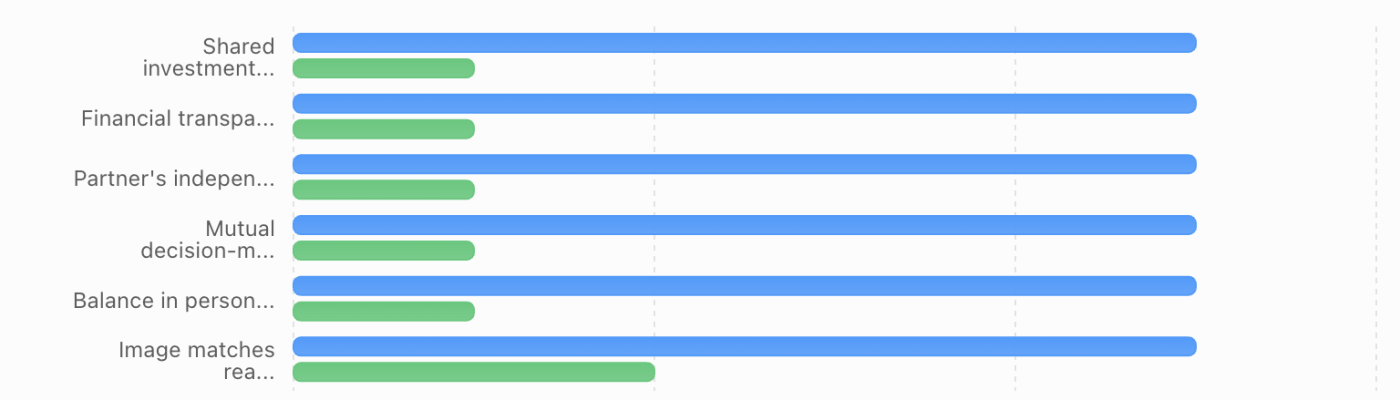
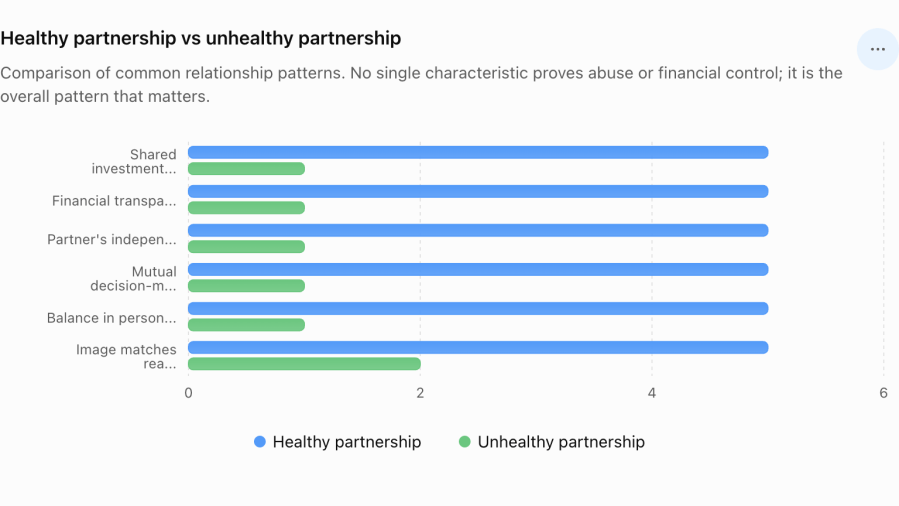
Healthy partnership vs unhealthy partnership
Comparison of common relationship patterns. No single characteristic proves abuse or financial control; it is the overall pattern that matters.
Healthy partnership
When Image and Reality Don’t Match
A healthy relationship is rarely measured by income alone. It is measured by how resources, respect, and responsibilities are shared.
Someone may describe themselves as highly successful and financially comfortable. Yet if their lifestyle consistently shows a striking imbalance—for example, one partner enjoys expensive hobbies, designer clothing, luxury equipment and a new car, while the other wears second-hand clothes, works multiple jobs, worries constantly about money, and the home receives little investment—it is reasonable to ask whether words and behaviour are consistent.
Psychology calls this behavioural congruence. Trust grows when what people say matches what they repeatedly do.
Healthy relationships are characterised by partnership. Both people benefit from the family’s resources. Decisions are discussed openly. Both partners feel secure, respected, and financially included. There is transparency rather than secrecy.
By contrast, some unhealthy relationships involve a persistent imbalance where one partner’s wants consistently take priority over the other’s needs. If this pattern is accompanied by controlling access to money, requiring one partner to account for every expense while the other spends freely, preventing financial independence, or using money to control choices, psychologists recognise these as possible features of financial abuse.
The home itself often reflects a couple’s shared priorities. A healthy partnership does not require wealth or luxury. It may be modest, but both partners generally benefit equally from the available resources. The emphasis is on fairness rather than appearance.
Neuroscience helps explain why these patterns matter. Chronic financial stress and inequality within a relationship can keep the body’s stress response activated. When one partner feels powerless or constantly anxious about money, the brain may remain in a heightened state of vigilance, affecting emotional wellbeing, decision-making, confidence, and physical health over time.
Perhaps the most important lesson from psychology is this:
Listen to what people say—but pay even closer attention to what they consistently do.
Character is revealed through repeated behaviour, not through titles, income, or carefully managed appearances. Healthy relationships are built on honesty, mutual respect, shared responsibility, and fairness. Those qualities cannot be bought, and they cannot be convincingly faked for long.
This comparison is based on well-established relationship psychology. It is also important to remember that none of these signs on their own prove financial abuse or deception. Psychologists and courts look for a consistent pattern of behaviour over time rather than relying on a single observation.

