Unprocessed Experiences and the Brain: How Survival Becomes Pattern—and How Healing Becomes Possible

In both Psychology and Neuroscience, it is well understood that human beings are shaped by experience—not just emotionally, but biologically. When difficult experiences such as trauma, neglect, chronic stress, or unsafe relationships are not fully processed, they do not simply fade away. Instead, they can become embedded in how the brain learns to interpret and… Read More Unprocessed Experiences and the Brain: How Survival Becomes Pattern—and How Healing Becomes Possible

Chronic dysregulation becoming a long-term pattern of functioning.

If these experiences and patterns are left untreated over time, the impact is usually not that they “stay the same,” but that the brain and body adapt around them in increasingly rigid or extreme ways. In Neuroscience and Psychology this is understood as chronic dysregulation becoming a long-term pattern of functioning. It’s important to be clear: this is… Read More Chronic dysregulation becoming a long-term pattern of functioning.

When Brain and Behaviour Become Dysregulated: Understanding the Signs, the Science, and the Path to Healing

Human behaviour is shaped by a complex interaction between our brain, our life experiences, our environment, and our relationships. In both psychology and neuroscience, we understand that many of our emotional and behavioural patterns are governed by core systems in the brain—systems responsible for emotional processing, reward sensitivity, impulse control, social processing, and stress regulation.… Read More When Brain and Behaviour Become Dysregulated: Understanding the Signs, the Science, and the Path to Healing

Distorted, underdeveloped, overactive, or impaired

When these systems are distorted, underdeveloped, overactive, or impaired, it can affect how a person thinks, feels, behaves, and relates to others. In Neuroscience this can happen because of genetics, development, injury, chronic stress, trauma, or learned patterns. In Psychology it shows up as patterns in personality and behavior. Important: “missing” is usually not literal—these systems… Read More Distorted, underdeveloped, overactive, or impaired

The “abusive pattern” in the brain (psychology + neuroscience)

1. Control is used as emotional regulation Many abusive behaviours function as a way to manage internal discomfort. Brain systems involved: amygdala (threat + emotional reactivity) prefrontal control systems (planning, inhibition) Pattern: distress → attempt to regain control over another person dominance reduces internal anxiety short-term So control becomes: a regulation strategy, not just behaviour 2.… Read More The “abusive pattern” in the brain (psychology + neuroscience)

🧠 Real love vs trauma bond (in real time)

Real love feels safe and expanding.Trauma bond activation feels urgent, narrow, and dysregulating. Your body actually tells the difference before your mind catches up. 💚 1. Nervous system state 💚 Real love steady heartbeat relaxed breathing grounded body calm alertness (not hypervigilance) Your system feels: “I can be myself here.” ⚡ Trauma bond activation racing… Read More 🧠 Real love vs trauma bond (in real time)

🧠 Why trauma bonding is so sticky (neuroscience + psychology)

Trauma bonding and coercive control are hard to break because they don’t just sit in “thoughts” or “choices” — they get wired into reward systems, threat systems, and attachment systems in the brain at the same time. That combination creates a powerful loop that feels emotionally convincing even when it’s harmful. 1. Intermittent reinforcement = strongest… Read More 🧠 Why trauma bonding is so sticky (neuroscience + psychology)

What’s happening in your brain during therapy

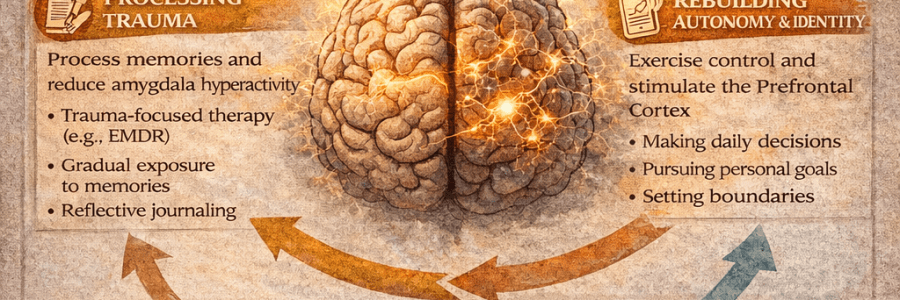
1. The threat system starts to settle At the beginning of therapy—especially if someone is anxious or traumatised—the brain often has a more active: amygdala (alarm system) stress hormones like cortisol As you speak in a safe, structured environment, something important happens: the brain starts to detect “this is not danger” This reduces hypervigilance over time.… Read More What’s happening in your brain during therapy

Why people have therapy (neuroscience + psychology)

1. Emotional overload (the nervous system is stuck “on”) From a neuroscience view, chronic stress keeps the amygdala overactive (threat detection system), while the prefrontal cortex (reasoning, regulation) becomes less effective. People come to therapy because: anxiety won’t switch off panic or hypervigilance persists emotional reactions feel “too big” Therapy helps retrain the brain to feel safety again. 2.… Read More Why people have therapy (neuroscience + psychology)