🚩 Red Flags Your Nervous System Already Noticed (But You Talked Yourself Out Of)

Your brain is smarter than your dating diary. In fact, long before you say “something feels off”, your nervous system has already filed a full report… you just didn’t read it properly. Let’s translate what your body already knows. 🧠 1. “I FEEL UNEASY AFTER HE TEXTS” This is not chemistry. It is activation without safety. If… Read More 🚩 Red Flags Your Nervous System Already Noticed (But You Talked Yourself Out Of)

💘 Dating and the Human Brain: The Good, The Bad & The Slightly Unhinged

Dating: that magical experience where you can feel like a glowing goddess on Monday, a detective by Wednesday, and emotionally retired by Sunday. But what is actually happening in your brain while all this romantic chaos unfolds? Let’s break it down scientifically… and slightly sarcastically. 🌟 THE GOOD: “I AM ALIVE AND GLOWING” When dating… Read More 💘 Dating and the Human Brain: The Good, The Bad & The Slightly Unhinged

🔮 The Neuroscience Topics Everyone Is Talking About

Welcome to your compelling, science‑meets‑soul guide to the neuroscience breakthroughs, trends, and ideas shaping our understanding of the brain today. This isn’t academic jargon. This is why your brain works the way it does… and how you can actually use that knowledge to live better, think smarter, and feel more powerful. 🧠 1. Decision Neuroscience How your brain chooses —… Read More 🔮 The Neuroscience Topics Everyone Is Talking About

The Neuroscience of Letting Go: Why Surrender Regulates Your Mind and Reclaims Your Power

What feels like “letting go” emotionally…is actually a profound shift happening inside your brain and nervous system. This isn’t just spiritual.It’s biological. When you try to control everything — outcomes, people, timing —your brain perceives uncertainty as a threat. This activates your amygdala — the part of the brain responsible for fear and survival. Your body moves… Read More The Neuroscience of Letting Go: Why Surrender Regulates Your Mind and Reclaims Your Power

Your Brain & Heart Recovery Plan (After Years of Emotional Uncertainty)

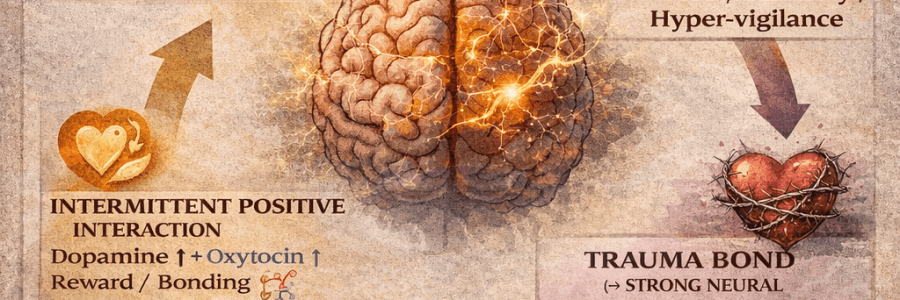
Phase 1: Awareness – “This Was Conditioning, Not Love” Goal: Break the emotional spell What happened to you wasn’t just a relationship—it was conditioning. 👉 Reframe (daily):“Consistency is safe. Confusion is not chemistry.” This alone starts weakening the old neural pathways. Phase 2: Nervous System Reset – “I Am Safe in Certainty” Goal: Calm the hypervigilance your body learned… Read More Your Brain & Heart Recovery Plan (After Years of Emotional Uncertainty)

Rewiring for Freedom: Stepping Beyond the Comfort Zone

For decades, the brain seeks safety, and often we listen. We make the “safe” choice, follow the familiar path, and convince ourselves it is security. Neuroscience reveals why: the amygdala—the brain’s early-warning system—flags uncertainty as threat, while the prefrontal cortex weighs risk versus reward. Yet what feels “safe” is often just habitual; it does not… Read More Rewiring for Freedom: Stepping Beyond the Comfort Zone

A powerful stage of post-traumatic growth

A powerful stage of post-traumatic growth, where surviving hardship not only strengthens you but also clarifies your vision of life. It’s like finally having a compass after being lost in a storm—you know your direction and values. Here’s a structured way to map out your life after trauma and step confidently into your future: 1. Acknowledge Your Journey… Read More A powerful stage of post-traumatic growth

🌿 Choosing Yourself: The Neuroscience and Psychology of Taking Time for You

Life is full of connections—some light, some deep, some intense, some fleeting. And sometimes, even when a connection feels powerful and real, it can leave us feeling hurt, uncertain, or emotionally off-balance. That’s when stepping back and choosing to focus on yourself can be one of the most powerful moves you make. 🧠 The Science… Read More 🌿 Choosing Yourself: The Neuroscience and Psychology of Taking Time for You

“Everyone comes into your life for a reason”

The idea that —“everyone comes into your life for a reason”—feels spiritual, but there is a real neuroscience and psychology lens that explains why it feels so true. Let’s ground it in how your brain actually works: 🧠 1. Your brain is wired to create meaning Humans don’t just experience life—we interpret it. This comes from the brain’s drive for… Read More “Everyone comes into your life for a reason”

Neuroscience of Feeling Unloved

2. Psychological Factors 3. Practical Steps Backed by Science 💡 Key Insight: Neuroscience shows your brain’s wiring, shaped by past relationships, influences how you perceive love—but it is plastic. Meaning, through mindful practice, therapy, and supportive relationships, your brain can learn to recognize love more fully, and heal from the feeling that it was “never there.”