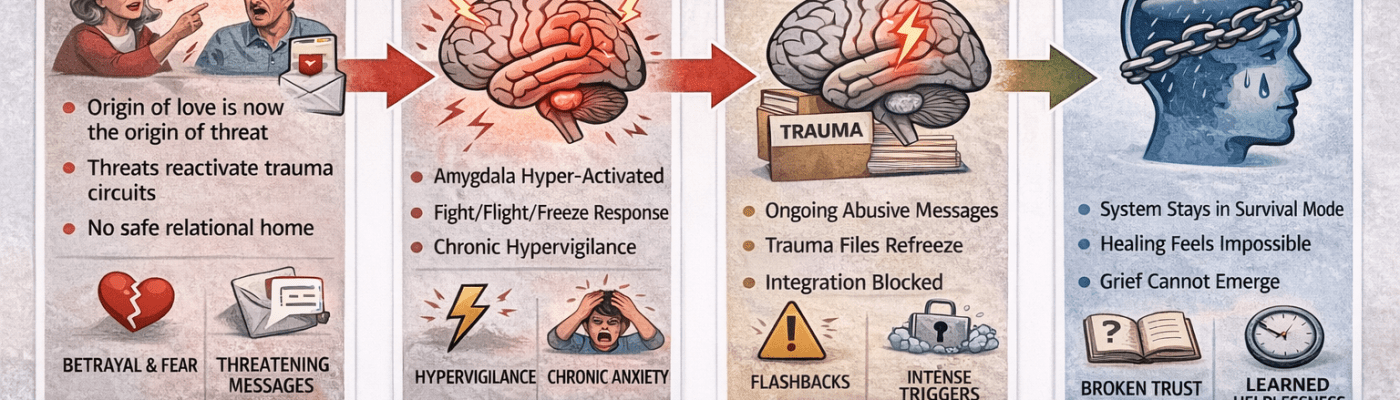
A common belief is that separation from an abusive partner should naturally lead to a reduction in abusive behaviour. In reality, many people experience the opposite: control, intimidation, manipulation, or emotional aggression continues — and sometimes intensifies.
Neuroscience and psychology help explain why this happens.
1. The Brain Does Not Automatically “Improve” With Age
There is a misconception that people naturally become calmer or more emotionally balanced as they get older. While some individuals do mature emotionally, this is not guaranteed.
Neuroscience shows that:
- Personality patterns are deeply encoded in neural pathways
- Repeated behaviour strengthens those pathways over time
- The brain becomes more efficient at what it repeatedly practices — even if that behaviour is unhealthy
So if someone has used control, intimidation, or emotional dominance for decades, those neural circuits become highly reinforced, not weakened.
2. Without Insight, the Brain Repeats What It Knows
Change in behaviour typically requires insight + emotional responsibility + motivation to change.
When those are absent:
- The brain defaults to familiar coping strategies
- Stress increases reliance on habitual responses
- Conflict triggers automatic defensive or controlling behaviour
In other words, separation does not create insight — it often removes external structure that once limited behaviour.
3. Emotional Regulation Often Declines Under Chronic Personality Patterns
Psychological research shows that long-term patterns of poor emotional regulation do not resolve without intervention.
Instead, over time:
- Frustration tolerance can decrease
- Reactivity becomes faster and more automatic
- Minor triggers can produce disproportionate responses
- Rigid thinking patterns become more fixed
This is especially true when the individual has never developed healthy emotional regulation skills.
4. Entitlement and Rigidity Tend to Increase, Not Decrease
One of the strongest psychological patterns seen in long-term controlling personalities is cognitive rigidity.
This includes:
- “I am right, therefore others are wrong” thinking
- Difficulty adapting to new relationship boundaries
- Increased need to maintain dominance or control
- Interpreting disagreement as disrespect or betrayal
As people age, these patterns often become more entrenched, not less — particularly if they have been reinforced for decades.
5. Separation Can Trigger Loss of Control Responses
For some individuals, separation is not experienced as emotional loss — but as loss of control.
Neuropsychologically, this can activate:
- Threat responses in the amygdala (the brain’s alarm system)
- Heightened stress reactivity
- Attempts to reassert control through legal, emotional, or relational pressure
This is why post-separation behaviour can sometimes escalate rather than soften.
6. Empathy Does Not Automatically Develop With Age
Another important misunderstanding is the idea that ageing naturally increases empathy.
In reality:
- Empathy depends on emotional capacity and reflection
- It requires perspective-taking ability and emotional awareness
- It can remain limited if it was never developed earlier in life
Without insight or accountability, there is no neurological “automatic upgrade” to empathy.
7. The Brain Strengthens What It Repeats
From a neuroscience perspective, one principle is key:
Neural pathways that are repeatedly activated become dominant pathways.
So if someone has spent decades using:
- control instead of communication
- blame instead of reflection
- dominance instead of vulnerability
those patterns become the brain’s default setting under stress.
Separation does not erase those pathways — it often activates them.
8. Why This Matters for Families and Ex-Partners
Understanding this is not about hopelessness. It is about clarity.
It explains why:
- Behaviour may not improve after separation
- Attempts to “reason” with the person may not work
- Boundaries may be met with escalation rather than acceptance
- Emotional cycles can continue long after the relationship ends
This is not because people “refuse to understand” — but because their brain is operating from deeply entrenched survival and control patterns.
9. What Actually Helps Change (When It Is Possible)
Sustained change requires conditions that are often absent in long-term abusive dynamics:
- Genuine self-awareness
- Willingness to accept responsibility
- Long-term therapeutic intervention
- Motivation to change internal identity, not just behaviour
Without these, behaviour tends to remain consistent or intensify under stress.
Final Thought
Separation changes the structure of a relationship, but it does not automatically change the brain that was operating within it.
Neuroscience is clear: people do not simply “grow out of” deeply reinforced behavioural patterns. They change only when there is insight, accountability, and sustained effort to build new neural pathways.
Without that, the brain returns to what it knows best — even when it causes harm.
And that is why abuse does not always stop when the relationship ends.

