You Don’t Have to Rebuild Your Life Alone
Taking control of your life is empowering yet challenging after experiencing various forms of control. It can lead to self-doubt and anxiety, prompting questions about identity and trust. Therapy offers a supportive space to rebuild confidence, establish healthy boundaries, and rediscover your voice. Embrace your journey toward freedom.… Read More You Don’t Have to Rebuild Your Life Alone

Taking Back Your Life: From Control to Freedom

Taking back your life from control involves small, impactful decisions rather than a dramatic transformation. Key steps include recognizing what was taken, reclaiming personal choices, rebuilding support networks, achieving financial independence, and fostering self-confidence. It’s essential to create boundaries, allow for grief, and embrace a future free from past constraints.… Read More Taking Back Your Life: From Control to Freedom

When You Finally Reach a Place of Peace Where No One Can Control You Anymore

Recovery from abuse involves reclaiming control over one’s life, finances, and emotions. It signifies the moment when one realizes they are no longer bound by another’s manipulation or fear. True freedom lies in establishing boundaries, trusting oneself, and recognizing that peace is innate, independent of past trauma. Healing fosters autonomy and personal growth.… Read More When You Finally Reach a Place of Peace Where No One Can Control You Anymore

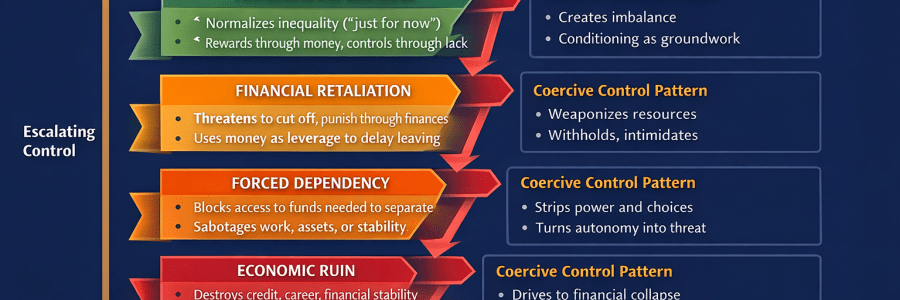
How Financial Abuse Hides in Long-Term Marriages

After leaving a toxic relationship, individuals often gain clarity on long-term manipulation and financial abuse. The realization reveals patterns of control, isolation, and hidden finances, highlighting a system designed to benefit one partner. Recovery offers empowerment as survivors understand their experiences and the importance of protecting their assets before it’s too late.… Read More How Financial Abuse Hides in Long-Term Marriages

Coercive Control: When a Relationship Becomes About Power and Control

Coercive control is a subtle form of abuse that limits an individual’s autonomy through behaviors like monitoring, financial control, and isolation. Often difficult to recognize, especially for those over 40, it can manifest gradually, leading to hypervigilance and anxiety. Recognizing these patterns is vital for regaining personal freedom and healthy relationships.… Read More Coercive Control: When a Relationship Becomes About Power and Control

Types and Indicators of Abuse

Understanding the Different Forms of Abuse — and the Signs to Look For

Abuse is not always obvious.

It isn’t always physical, and it doesn’t always leave visible injuries. Abuse can involve patterns of behaviour designed to control, intimidate, manipulate, isolate, humiliate or undermine another person.

A person may also experience more than one type of abuse at the same time.

Recognising the signs can be an important first step towards understanding what is happening.

Important: The presence of one indicator on its own should not be taken as proof that abuse is occurring. However, it may indicate that further assessment is needed. The examples below are not exhaustive, and individual circumstances should always be considered.… Read More Types and Indicators of Abuse

Healthy Anger vs Abusive / Harmful Behaviour 

The content outlines the distinctions between healthy anger and abusive behavior across various dimensions, including emotional tone, verbal expression, and physical actions. Healthy anger is described as regulated and communicative, while abusive behavior is characterized as dysregulated and controlling. The key message emphasizes that healthy anger maintains boundaries, whereas abusive anger creates fear and safety risks.… Read More Healthy Anger vs Abusive / Harmful Behaviour