When a doctor tells you once that they are concerned about your safety, you may dismiss it. When they tell you twice, you may begin to wonder. When they tell you three times—and your psychologist is also repeatedly advising you to leave—it is time to stop and listen.
Not because professionals know everything about your relationship.
Not because they are making the decision for you.
But because trained professionals are often able to recognise patterns of danger that someone living inside an abusive relationship may have become psychologically adapted to.
When danger has become your normal
One of the most confusing aspects of abuse is that the person experiencing it can gradually become accustomed to behaviour that would immediately concern an outsider.
What initially feels shocking can become:
“That’s just how he is.”
“It wasn’t that bad this time.”
“Perhaps I provoked him.”
“He was stressed.”
“He apologised afterwards.”
“Things are better now.”
This is not because the person is weak or lacking intelligence.
It can be part of the psychological adaptation to chronic threat.
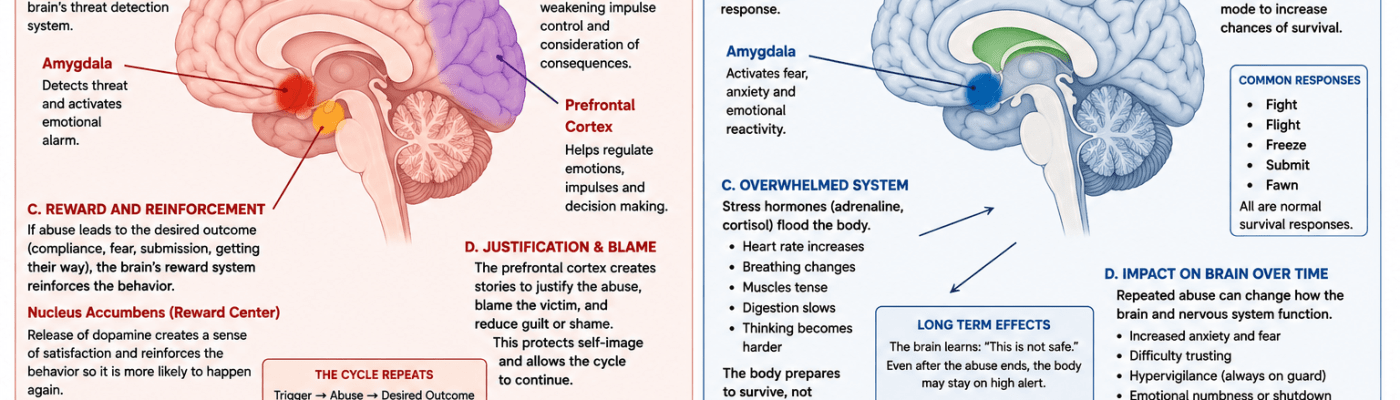
When someone lives with unpredictable anger, intimidation, humiliation, coercive control or physical violence, the brain becomes increasingly focused on managing the immediate environment.
Instead of asking:
“Is this relationship safe?”
the nervous system may become preoccupied with:
“How do I get through today without making things worse?”
That is a very different question.
The nervous system can adapt to danger
The human brain is designed to detect threats and keep us alive.
When threatening behaviour becomes chronic, the brain can become highly focused on anticipating the next episode.
You may begin monitoring:
- their mood
- their voice
- their footsteps
- their facial expression
- what you say
- when you speak
- where you go
- who you see
- whether something might make them angry.
This is a form of hypervigilance.
The brain is constantly scanning the environment for information that might predict danger.
Over time, however, living this way can create an extraordinary paradox:
you can become extremely good at detecting the abuser’s mood while becoming less able to recognise the seriousness of what is happening to you.
Your attention becomes focused on surviving the individual incidents rather than stepping back and looking at the entire pattern.
Why an experienced doctor may see something you cannot
Healthcare professionals are not simply listening to individual events.
They may be noticing a pattern.
A doctor may hear about:
- repeated injuries
- unexplained physical symptoms
- anxiety and sleep disturbance
- fear of a partner
- controlling behaviour
- isolation
- escalating incidents
- threats
- intimidation
- previous violence.
A psychologist may additionally observe:
- hypervigilance
- fear responses
- diminished self-confidence
- self-blame
- trauma responses
- emotional dysregulation
- difficulty making decisions
- constantly monitoring another person’s behaviour.
WHO recognises healthcare professionals as being in a particularly important position to identify and respond to intimate-partner violence because women frequently seek healthcare after experiencing violence, sometimes without initially disclosing it.
They are trained to consider the pattern, not simply the isolated incident.
When two different professionals reach the same concern
This is particularly important.
Suppose you tell your doctor about what is happening.
The doctor advises you to leave.
You return.
You explain more.
The doctor again expresses concern and advises you to leave.
Then your psychologist independently reaches the same conclusion.
At that point, it is worth asking yourself:
“What are these professionals seeing that I have become accustomed to?”
Their advice does not automatically mean that leaving is simple or immediately safe. In fact, leaving an abusive relationship can itself require careful safety planning.
But repeated professional concern should not be casually dismissed.
It is information.
Important information.
Trauma can interfere with danger recognition
Trauma does not simply produce fear.
It can also produce normalisation.
The brain can gradually accommodate circumstances that would once have seemed intolerable.
This can happen because humans are extraordinarily adaptable.
If something happens repeatedly, the nervous system begins treating it as part of the environment.
That does not make the behaviour safe.
It makes it familiar.
And familiar is not the same as safe.
This distinction is enormously important.
Your nervous system can become accustomed to danger without danger becoming less dangerous.
The psychology of minimising
People living with abuse may unconsciously minimise what is happening because fully acknowledging the reality can be psychologically overwhelming.
If you accepted in one moment that the person you love may actually be dangerous, you would also have to confront enormous questions:
“What do I do?”
“Where do I go?”
“What about the home?”
“What about the finances?”
“What about the children?”
“What will everyone think?”
“Can I really start again?”
“What if he changes?”
“What if I’m wrong?”
The psychological cost of accepting the truth can therefore feel enormous.
Sometimes the brain protects itself temporarily by reducing the significance of what is happening.
Listen when someone outside the relationship sees the pattern
One of the reasons professional observations can be so valuable is that they come from outside the emotional system of the relationship.
They are not emotionally attached to the person behaving abusively.
They are not dependent upon the relationship continuing.
They are not experiencing the occasional loving moments that can make an abusive relationship confusing.
They are seeing the information you provide through a professional framework.
That doesn’t make their interpretation infallible.
But it makes their repeated concern worthy of serious consideration.
And this is where safety matters
There is an important qualification.
“Leave” should never mean “walk out impulsively without considering safety.”
For some people experiencing domestic abuse, separation can be a period requiring careful planning.
Safety planning may involve considering where you will go, who knows what is happening, finances, important documents, communication, children, pets, technology and access to support.
Specialist services can help with this.
WHO guidance emphasises that healthcare responses should include attention to immediate safety, ongoing support and psychological needs, alongside physical and emotional care.
Your professionals may be seeing the warning signs before you are ready to see them
Sometimes the first person to recognise the seriousness of an abusive relationship is not the person experiencing it.
It may be:
the doctor.
the psychologist.
the nurse.
the therapist.
the friend.
the family member.
And sometimes several people independently reach the same conclusion.
When that happens, pause.
Don’t automatically dismiss them.
Don’t tell yourself:
“They don’t understand my relationship.”
Instead ask:
“What are they seeing?”
“What patterns have I described?”
“Why are they concerned about my safety?”
“If someone I loved told me exactly what I have described, what would I advise her to do?”
That last question can sometimes create the distance necessary to see what has become invisible through familiarity.
The most important warning sign may be the pattern
Abuse is rarely defined by one isolated argument.
It is often the pattern over time that matters.
Fear.
Control.
Intimidation.
Humiliation.
Isolation.
Threats.
Physical violence.
Financial control.
Monitoring.
Coercion.
Escalation.
Repeated boundary violations.
When several of these appear together, they deserve to be taken seriously.
And when trained professionals hear that pattern and repeatedly express concern about your safety, their concern is information—not interference.
You still have agency.
You still have the right to make your own decisions.
But you also have the right to listen to people who are trained to recognise danger.
Don’t wait until your nervous system has completely normalised what is happening.
Sometimes the most important moment is the moment when somebody outside the relationship says:
“I’m concerned about you.”
And perhaps the most important response is not:
“It isn’t that bad.”
but:
“Tell me what you are seeing.”
Because sometimes another person’s professional perspective allows you to see the danger that trauma, attachment and years of adaptation have made difficult to see for yourself.
Red flags are warnings—not guarantees of what will happen next. But repeated, credible warnings deserve attention.
And if you are in immediate danger, seek emergency help or a specialist domestic-abuse service and make a safety plan rather than confronting the abusive person alone.

