Have you ever reached a point where nothing seems to excite you anymore?
You may still be functioning. You may go to work, look after your family, answer messages and carry on with everyday life.
But something has changed.
The things that once made you happy don’t seem to reach you anymore.
A favourite song feels ordinary.
A beautiful view doesn’t move you.
Seeing friends feels like an effort.
Food may taste fine, but the pleasure isn’t really there.
Even things you once looked forward to can feel strangely flat.
This experience has a name: anhedonia.
And for someone who has lived through prolonged trauma, emotional abuse or coercive control, it can be deeply confusing.
You may wonder:
“What’s wrong with me? Why can’t I enjoy anything anymore?”
Often, the answer is not that you have lost your ability to feel.
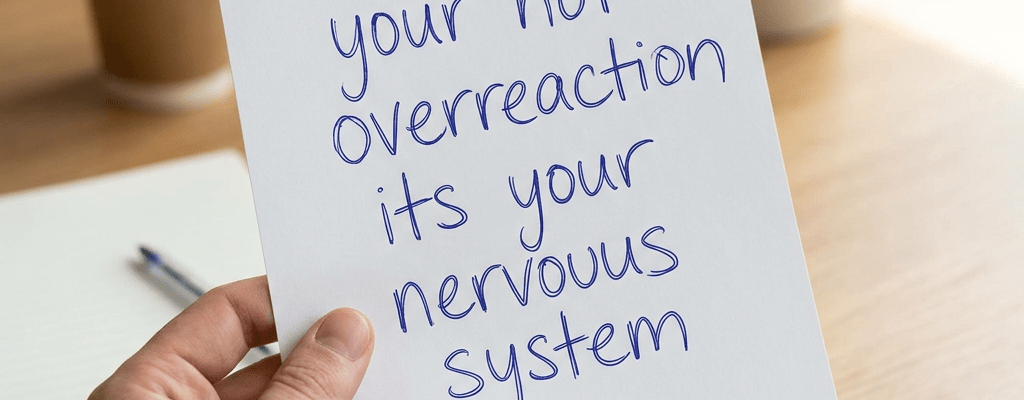
Your nervous system may have learned to protect you by turning the volume down.
What is anhedonia?
Anhedonia is the reduced ability to experience pleasure, interest or enjoyment from things that previously felt rewarding.
It can affect different areas of life, including:
- relationships and connection
- hobbies and interests
- food
- music
- sex and intimacy
- exercise
- socialising
- achievement and motivation
- anticipation of enjoyable experiences
There is an important distinction between not wanting something and wanting it but not being able to feel much from it.
You might know intellectually that something should make you happy, yet emotionally it barely registers.
That disconnect can be frightening.
When survival takes priority over pleasure
Our brains are constantly assessing the environment for safety.
When a person experiences prolonged threat, unpredictability, criticism, intimidation, humiliation or control, the nervous system can remain focused on survival rather than enjoyment.
The brain is not asking:
“What would feel wonderful today?”
It may be asking:
“What could go wrong?”
That is a very different neurological state.
When the stress response becomes chronic, attention can become dominated by threat detection, vigilance and managing the next problem.
Pleasure becomes less important to the survival system.
This doesn’t mean your brain is broken.
It means your brain has been adapting to the environment it believes you are living in.
The neuroscience of pleasure
Pleasure isn’t produced by one single chemical or one area of the brain.
It involves interconnected systems involved in motivation, reward, anticipation, learning, emotion and sensory experience.
The brain’s reward circuitry includes structures such as the ventral tegmental area, nucleus accumbens and prefrontal regions.
Dopamine is particularly important.
But dopamine is often misunderstood.
It isn’t simply the “pleasure chemical.”
Dopamine is strongly involved in motivation, anticipation, learning and the pursuit of rewarding experiences.
In other words, it helps answer:
“Is this worth moving towards?”
Under chronic stress, the brain’s reward and motivation systems can become altered.
This can contribute to reduced motivation, reduced anticipation and a sense that very little is worth the effort.
Anhedonia after emotional abuse
Anhedonia can be particularly complicated after emotional abuse or coercive control.
Imagine living for years in an environment where your emotional state depends upon another person’s behaviour.
You may have learned to monitor:
- their mood
- their voice
- their footsteps
- their messages
- their facial expressions
- their reactions
- what you say
- what you don’t say
- what might cause conflict
Your attention becomes externally focused.
Instead of asking:
“What do I want?”
you may repeatedly ask:
“What will keep things calm?”
Over time, this can disconnect you from your own preferences, desires and sources of pleasure.
You may stop choosing things because you enjoy them.
You choose things because they are safe.
That is a very different way of living.
Hypervigilance and the disappearance of joy
Hypervigilance is the state of being excessively alert to potential danger.
It can be exhausting.
Imagine trying to enjoy dinner while part of your brain is listening for danger.
Imagine sitting on a beach while mentally scanning your phone.
Imagine laughing with friends while simultaneously wondering whether something will happen when you return home.
The body may be physically present in a pleasurable moment while the nervous system remains psychologically elsewhere.
It is difficult to fully experience pleasure when your brain is still looking for danger.
Emotional numbness is not the same as not caring
People experiencing anhedonia sometimes worry that they have become cold, detached or incapable of love.
That conclusion may be unnecessarily harsh.
Emotional numbness can be a protective response.
If feeling deeply has repeatedly been associated with pain, disappointment, conflict or danger, reducing emotional intensity may temporarily feel safer to the nervous system.
This can create a strange experience:
You don’t necessarily stop caring. You stop feeling as much.
And there is an important difference.
The body may need to learn that pleasure is safe again
After prolonged stress, recovery is not simply about telling yourself:
“Be positive.”
The nervous system may need repeated experiences of safety before it becomes easier to relax into pleasure.
That can begin with very small experiences.
A warm shower.
Sunlight on your face.
A favourite piece of music.
Walking somewhere beautiful.
A good cup of coffee.
Laughing with someone you trust.
Touching the leaves of a plant.
Swimming.
Dancing.
Cooking.
Sitting quietly without being watched, questioned or criticised.
These moments may initially feel insignificant.
But they are not insignificant.
They are opportunities for the nervous system to experience:
“Nothing bad is happening right now.”
Don’t wait until you feel motivated
One of the traps of anhedonia is waiting for pleasure to return before doing pleasurable things.
That can create a vicious cycle.
I don’t feel like doing anything → I do less → I experience less reward → I feel even flatter → I withdraw further.
Instead, gentle behavioural activation can help interrupt the cycle.
You don’t have to feel excited before doing something.
Sometimes the action comes first.
The feeling follows later.
Start small.
Don’t ask:
“What would make me incredibly happy?”
Ask:
“What might feel 2% better?”
That is often a much more achievable question.
Rediscovering your preferences
After a long period of control, another important part of recovery can be discovering what you actually like.
Not what someone else approves of.
Not what keeps the peace.
Not what avoids criticism.
Not what you think you are supposed to enjoy.
What do you like?
What colours attract you?
What music makes you want to move?
Where do you feel peaceful?
Who makes you laugh?
What clothes make you feel good?
Where do you want to travel?
What food do you genuinely enjoy?
What would you do if nobody were judging you?
These questions may seem simple.
For someone who has spent years adapting to another person’s expectations, they can be profoundly important.
Pleasure can return gradually
Recovery from anhedonia is not always dramatic.
Sometimes the first sign is incredibly subtle.
You suddenly notice a song.
You laugh without forcing it.
You look forward to seeing someone.
You become interested in something again.
You notice the beauty of a sunset.
You find yourself making plans because you actually want to.
You realise that you are no longer simply getting through the day.
You are beginning to experience it.
Those moments matter.
They can be evidence that your emotional world is becoming accessible again.
From surviving to experiencing
There is a profound difference between being alive and feeling alive.
When someone has spent years managing threat, conflict, control or emotional uncertainty, survival can become the organising principle of everyday life.
Recovery creates another possibility.
Not simply:
“I am safe.”
But eventually:
“I am free to experience my life.”
Freedom is not only the absence of another person’s control.
It can also mean having access to your own emotions, preferences, curiosity, pleasure and desire again.
You don’t have to force happiness.
You don’t have to perform positivity.
And you don’t have to judge yourself because joy hasn’t returned yet.
Sometimes the nervous system needs time.
Sometimes it needs safety.
Sometimes it needs rest.
Sometimes it needs connection.
And sometimes it needs permission to discover that life can be more than survival.
If you recognise yourself in this article
Anhedonia can occur for many reasons, including depression, trauma, chronic stress, medication effects and other psychological or physical conditions. If loss of pleasure is persistent, severe or accompanied by hopelessness or thoughts of self-harm, professional assessment is important.
You are not necessarily broken because you cannot feel what you used to feel.
Sometimes the part of you that went quiet was simply trying to protect you.
And with the right support and enough safety, that part of you may gradually learn that it is safe to come alive again.

