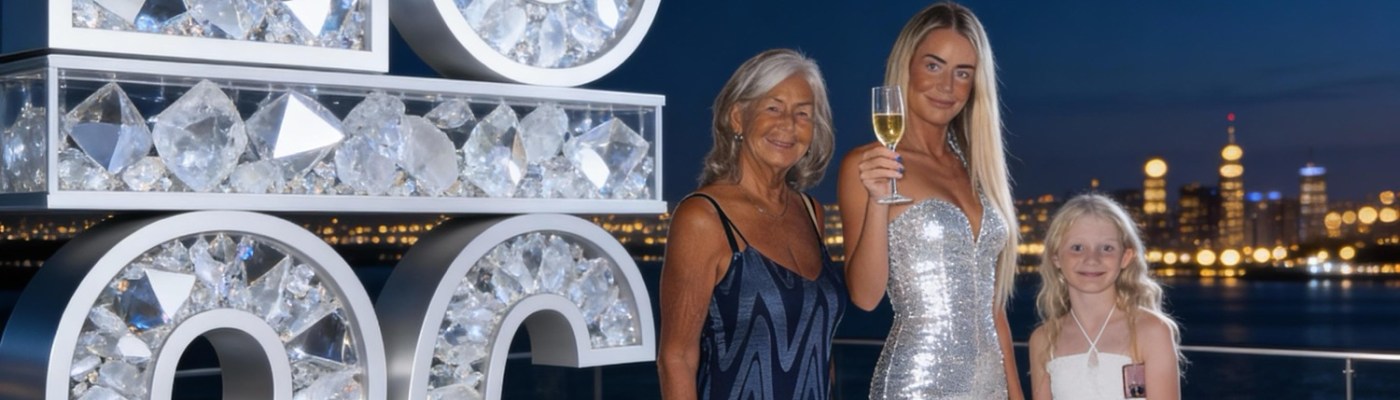
As I’ve been packing to move house, I’ve found myself looking through boxes of old photographs.
It’s remarkable how much a photograph can reveal.
Not just where you were.
But who you were becoming.
At first glance, I was smiling in many of them.
But when I looked more closely, I saw something I hadn’t noticed before.
The sadness was in my eyes.
I can remember exactly when many of those photographs were taken.
I remember what had happened that day.
What was happening behind the scenes.
The smile was there.
But so was the exhaustion.
Before…
The photographs from my teens, twenties and early thirties tell a different story.
I was smartly dressed.
Elegant.
Confident.
I took pride in my appearance.
Not because I was trying to impress anyone, but because that was how I had been brought up.
My mother believed in presenting yourself with self-respect.
After I left school, she sent me to finishing school to refine the confidence, manners and standards she had worked so hard to instil.
Looking after yourself wasn’t vanity.
It was self-respect.
Then Something Changed
As the years passed, another pattern appeared.
The clothes became practical rather than stylish.
Supermarket clothing replaced carefully chosen outfits.
Hair appointments became less frequent.
The little things that once made me feel like me quietly disappeared.
It didn’t happen overnight.
It happened so gradually that I barely noticed.
But other people did.
My mother would gently ask,
“Why don’t you have your hair done anymore?”
“Why don’t you wear the lovely clothes you used to wear?”
Friends and relatives would look at me and say,
“Linda… what are you doing? This isn’t you.”
And they were right.
It wasn’t me.
The Slow Erosion of Identity
One of the least understood effects of a controlling relationship is that it often changes your identity in tiny, almost invisible ways.
Not because someone tells you to stop being yourself every day.
But because your world slowly becomes smaller.
You stop spending money on yourself.
You stop making yourself a priority.
You adapt.
You compromise.
You survive.
Over time, survival begins to replace living.
Neuroscience tells us that chronic stress can narrow our focus. When the brain is preoccupied with coping and avoiding conflict, everyday acts of self-care can begin to feel unimportant or even impossible. It isn’t simply about losing interest in clothes or appearance. It can reflect the way prolonged stress changes our priorities and drains our emotional energy.
Isolation Changes More Than Your Address
Living in the middle of nowhere, away from friends and family, made those changes even harder to recognise.
When you’re isolated, you lose the people who know the real you.
The people who say,
“You don’t seem yourself.”
“Is everything okay?”
Abuse often thrives in isolation.
Not because isolation causes abuse, but because distance can make unhealthy patterns much harder to see and much easier to normalise.
Looking Into My Own Eyes
As I studied those old photographs, I realised something profound.
The woman in those pictures hadn’t disappeared.
She had simply been buried beneath years of adapting to survive.
Today, I see her returning.
Not because of expensive clothes.
Not because of perfect hair.
But because the light has returned to her eyes.
Coming Home to Yourself
Recovery isn’t about becoming someone new.
It’s about rediscovering the person you were before fear, control and self-doubt convinced you to settle for less.
If you’ve ever looked in the mirror—or at an old photograph—and thought,
“I don’t recognise that person anymore,”
please know this:
The real you isn’t gone.
She is waiting to be found again.
Sometimes all she needs is the safety, support and time to come back.
If this article resonates with you, I offer a free 15-minute consultation where we can talk about your experience and explore how trauma-informed therapy can help you reconnect with yourself.
Because healing isn’t just about leaving an unhealthy relationship.
It’s about finding your way back to the person you were always meant to be.


🩷
LikeLike
Thank you so much for your ❤️. It means a great deal. So many women recognise that feeling of looking back at old photographs and realising their eyes were telling a very different story. Thankfully, healing allows the light to return. 💕
LikeLiked by 1 person
Absolutely resonate with this. Thanks for writing and helping me learn about my past. Healing to us and renewed real eyes of true genuine being. 🩷
LikeLike