Neuroscience of the Revenge Loop in the Brain

The urge for revenge is not only emotional — it is also neurological. When someone feels deeply wronged, several brain systems become activated. If the person keeps replaying the event or planning retaliation, these brain areas can form a self-reinforcing revenge loop. Below is a simplified explanation of how this cycle works in the brain. 1. Emotional… Read More Neuroscience of the Revenge Loop in the Brain
The End Game

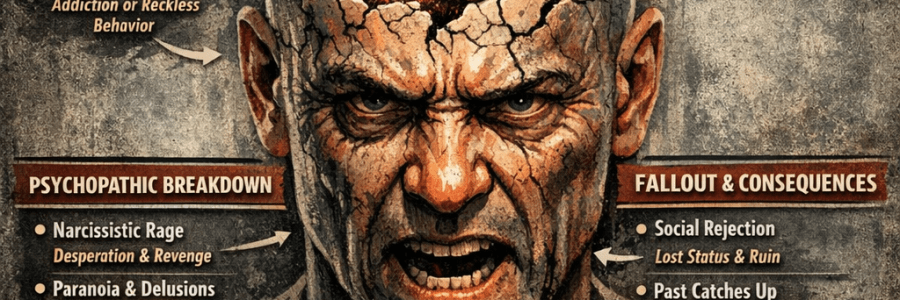
During the marriage, the abuser tries to control your happiness.During the divorce, they try to control your freedom.Afterward—when control fails—their internal system can destabilize. Let’s look at this from a neuroscience perspective, calmly and clearly. 1️⃣ During the Marriage: Control = Regulation For some abusers, control over a partner functions like emotional regulation. When they: Monitor… Read More The End Game

When Manipulators Go Into Meltdown: Understanding the Neuroscience and Psychology

Watching someone escalate their tactics can sometimes feel almost surreal. They seem to spiral, their behavior becomes erratic, and it’s tempting to think: they must be going into a meltdown. Neuroscience and psychology explain why this happens. 1️⃣ The Brain Under Stress When manipulative individuals encounter resistance or fail to control a situation, their nervous… Read More When Manipulators Go Into Meltdown: Understanding the Neuroscience and Psychology

The Extreme Measures People Take to Control and Force You Out of Your Own Home

Few experiences are as destabilizing as feeling threatened in your own home. Whether it’s through legal maneuvers, financial pressure, or psychological tactics, some people will go to extreme lengths to assert control — even over property that is legally shared or personally yours. Understanding why this happens requires both a psychological and neuroscientific perspective. 1️⃣… Read More The Extreme Measures People Take to Control and Force You Out of Your Own Home

Inner Conflict

The fear of being yourself and worrying about acceptance is deeply rooted in both neuroscience and psychology. Let’s break it down clearly: 1️⃣ The Brain’s Threat Response Amygdala Activation: Your amygdala lights up when you imagine being judged or rejected. The brain interprets social exposure as a threat, similar to physical danger. Neuroscience Insight: Even imagining disapproval triggers stress… Read More Inner Conflict

You can run but you cant hide

From a neuroscience and psychology perspective, your past behaviors, patterns, and emotional responses are encoded in the brain and the nervous system — they can’t simply be hidden or erased. Here’s why: 1. The Brain Remembers Patterns Hippocampus: Stores episodic memories — your past actions, relationships, and consequences. Amygdala: Encodes emotional salience — fear, shame, guilt, anger. Even… Read More You can run but you cant hide

Understanding Neuroscience & Neuroplasticity

1. What is Neuroscience? Neuroscience is the scientific study of the brain and nervous system — how neurons communicate, how brain regions control behavior, and how cognition, emotion, and perception emerge. It combines biology, psychology, chemistry, and even computational science to understand how the brain functions in health and disease. Key focus areas include: Neural circuits and communication… Read More Understanding Neuroscience & Neuroplasticity

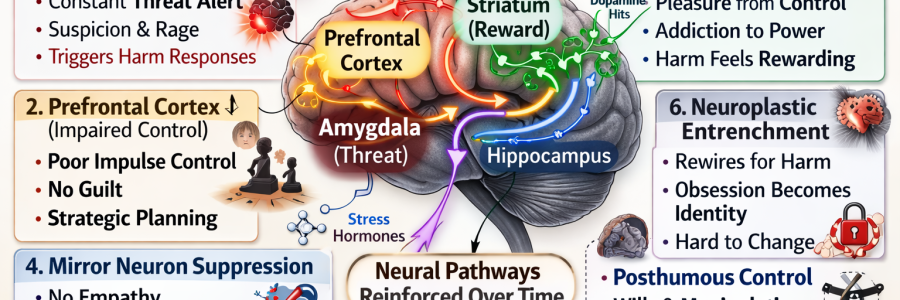
Neuroscience of a Lifelong Obsession with Harm

1. Hyperactive Threat Circuits Amygdala: The brain’s alarm system becomes constantly on high alert, interpreting others’ actions as threats or targets for manipulation. Result: Every interaction is filtered through a lens of suspicion, fear, or opportunity to control. Even minor slights trigger intense emotional responses. 2. Prefrontal Cortex Dysfunction Normally, the prefrontal cortex regulates impulses, considers consequences, and enables empathy.… Read More Neuroscience of a Lifelong Obsession with Harm

Brain Structure & Neurobiology

Prefrontal Cortex (PFC) Controls planning, impulse regulation, goal-setting, and self-discipline. Underactivity or delayed development can lead to poor self-care, lack of ambition, and impulsive behaviors, like greed or selfishness. Anterior Cingulate Cortex (ACC) Involved in empathy, error detection, and social awareness. Weak or underactive ACC may result in low empathy, poor moral judgment, and abusive or mean behavior. Amygdala… Read More Brain Structure & Neurobiology