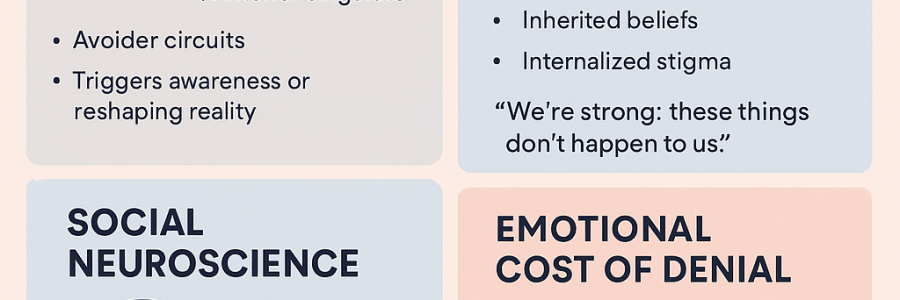
Co-Dependent Individuals: Neuroscience and Psychology

Co-dependency refers to a pattern where an individual consistently prioritizes others’ needs over their own, often to the point of emotional, psychological, or even physical detriment. It’s commonly observed in relationships with emotionally unavailable, abusive, or high-conflict partners. 1. Brain Mechanisms in Co-Dependency A. Reward System Dysregulation Helping or “fixing” others releases dopamine, reinforcing self-sacrificing patterns.… Read More Co-Dependent Individuals: Neuroscience and Psychology
Neuroscience-Informed Guide to Trauma-Bond Resistance

1. Understanding the Neurobiology of Trauma Bonds Trauma bonds form when intermittent reinforcement (alternating kindness and abuse) hijacks the brain’s reward and stress systems: Dopamine system (nucleus accumbens): activates during rewarding interactions; intermittent rewards spike craving for the relationship. Oxytocin system: promotes bonding and trust; even abusive partners trigger attachment circuits. Amygdala and hypothalamic-pituitary-adrenal (HPA) axis: high… Read More Neuroscience-Informed Guide to Trauma-Bond Resistance

How Trauma Disrupts the Ability to Identify What Is Healthy

IntroductionIndividuals with a history of abuse frequently report difficulty determining what is “right” or “healthy” in relationships. This is not a matter of poor judgment or weakness; it is the predictable neurobiological and psychological result of prolonged trauma exposure. Abuse alters threat-processing systems, attachment circuits, and self-referential networks in the brain, which collectively distort the… Read More How Trauma Disrupts the Ability to Identify What Is Healthy

Intergenerational Transmission of Anxiety and Social Dysfunction:

A Research-Heavy Neuroscience & Psychology Overview** Modern science overwhelmingly supports the reality that anxiety and social functioning problems can be inherited— not only genetically, but through epigenetic modification, neurodevelopmental programming, and learned behavioral patterns across generations. This phenomenon is known as intergenerational transmission of trauma, epigenetic inheritance, and transgenerational stress programming. Below is a comprehensive explanation. 1. Epigenetic Transmission of Stress… Read More Intergenerational Transmission of Anxiety and Social Dysfunction:

Children Inheriting Anxiety and Social Difficulties

Neuroscience & Psychology Confirm This Is Real** For decades people believed anxiety was “personality” or a child being “sensitive.”But neuroscience and epigenetics show something deeper: 👉 Children can inherit anxiety and social difficulties — not just emotionally, but biologically.👉 Trauma, fear, and stress experienced by parents and grandparents can change how a child’s brain develops. This… Read More Children Inheriting Anxiety and Social Difficulties

Misattribution of Arousal: A Neuroscience Perspective

1. The Body Responds — Same Physiology for Fear and ExcitementWhen your body experiences intense situations — like standing on a high suspension bridge, skydiving, or even public speaking — your autonomic nervous system (ANS) kicks in: Sympathetic nervous system: triggers “fight or flight” Heart rate increases, breathing quickens Adrenaline and noradrenaline surge Sweating, pupil dilation, muscle tension occur… Read More Misattribution of Arousal: A Neuroscience Perspective

Reclaim Your Space — A Neuroscience & Psychological Perspective

When you remove the remnants of an abusive relationship and take control of your living space, you are doing much more than tidying up. You are engaging in a profound act of neurobiological and psychological self-reclamation. The space you inhabit directly interacts with your brain, body, and nervous system — influencing how safe, calm, and empowered… Read More Reclaim Your Space — A Neuroscience & Psychological Perspective