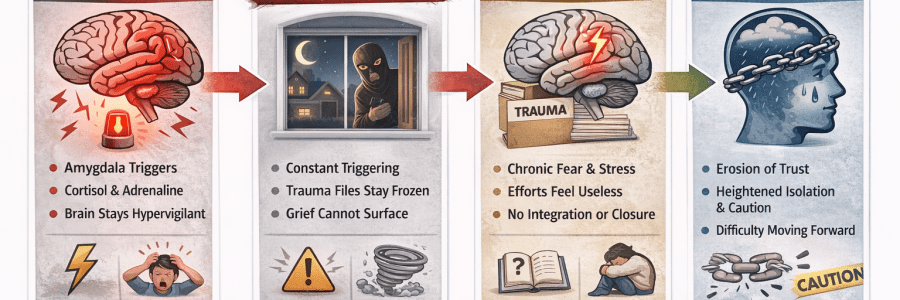
Aftermath & Long-Term Impact

In inheritance or high-stakes family conflicts, people often follow a predictable escalation pattern. Understanding it helps you anticipate moves, protect yourself, and even de-escalate tension. 1. Initial Anxiety & Awareness 2. Strategic Maneuvering 3. Escalation & Pressure 4. Open Conflict 5. Aftermath & Long-Term Impact How to Anticipate or Manage These Behaviors Inheritance conflicts are… Read More Aftermath & Long-Term Impact

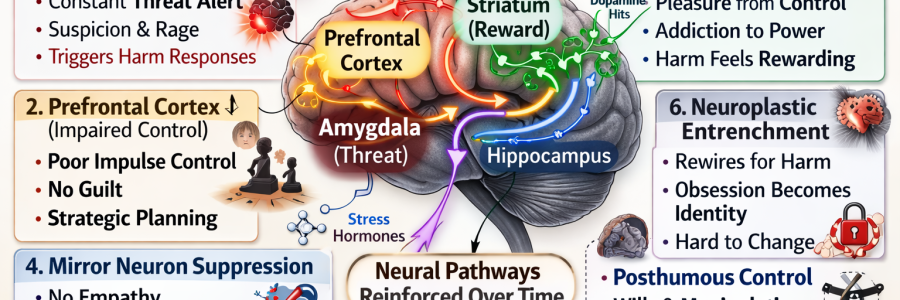
Brain Structure & Neurobiology

Prefrontal Cortex (PFC) Anterior Cingulate Cortex (ACC) Amygdala Reward System (Ventral Striatum / Nucleus Accumbens) 2️⃣ Psychology & Personality Factors Attachment & Early Environment Learned Behavior & Modeling Personality Traits 3️⃣ Epigenetics ✅ Key Takeaways In short: it’s a mix of biology, environment, early life experiences, and personality traits. The brain literally learns these patterns through repeated exposure and reinforcement.

 Social Learning & Mirror Neurons

The neuroscience of learned greed, manipulation, and dishonesty—basically, how teaching someone to take advantage of others can create a cycle where those behaviors get reflected back to you. Let’s break this down carefully: 1. Social Learning & Mirror Neurons 2. Reward System & Dopamine 3. Prefrontal Cortex & Moral Control 4. Empathy & Social Awareness 5. Karma-Like Reciprocity in the Brain… Read More  Social Learning & Mirror Neurons

Genetic and Heritable Factors

he neuroscience behind why a “Me, Me, Me” personality—self-centeredness or narcissistic traits—can appear to “run in the family.” Let’s break it down carefully: 1. Genetic and Heritable Factors 2. Brain Networks & Neurobiology 3. Environmental & Epigenetic Influences 4. The Neuroscience of “Running in the Family” ✅ Key Takeaway A “Me, Me, Me” pattern in families is usually:

What Happens When Antipsychotic Medication Is Stopped Suddenly?

Stopping antipsychotic medication abruptly is medically risky.It can cause serious physical, psychological, and neurological effects. This is called antipsychotic withdrawal syndrome and rebound psychosis risk. 🧠 Why Sudden Stopping Is Dangerous Antipsychotic medications change brain chemistry over time, especially dopamine regulation. When stopped suddenly:👉 The brain cannot instantly rebalance👉 Dopamine activity rebounds sharply👉 This can cause severe symptom relapse or worsening 🚨 Possible… Read More What Happens When Antipsychotic Medication Is Stopped Suddenly?

Anxiety vs Paranoia vs Delusions vs Psychosis

(And why doctors ask about war zones / military service) 1️⃣ Anxiety Core emotion: Fear, worry, anticipation Anxiety is a heightened fear response to perceived threat — usually based on real-life stress or danger. Key features: Reality testing: ✅ IntactThe person knows their fear may be irrational but struggles to control it. Example:“I know I’m probably safe, but I can’t stop feeling… Read More Anxiety vs Paranoia vs Delusions vs Psychosis

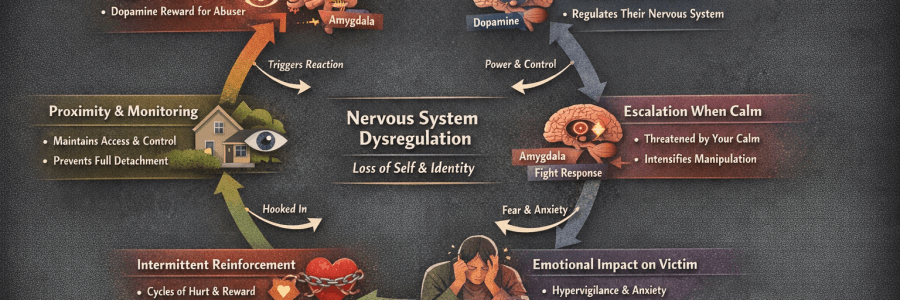
🧠 Physical & Emotional Abuse Combined Escalation Timeline

Here’s a comprehensive combined escalation timeline that merges physical and emotional abuse into a single, trauma-informed progression. This is based on psychology, neuroscience, and real-world patterns, showing how abuse builds over time, often starting subtly and escalating dangerously. 🟢 Phase 1 — Idealization / Charm (Hooking Stage) Timeframe: Days → Weeks Emotional Abuse: Physical Abuse: Neuroscience Impact: How You Feel: ⚠️ Warning: Intensity over… Read More 🧠 Physical & Emotional Abuse Combined Escalation Timeline

🧠 Physical Abuse Patterns & Escalation Timeline

Here’s a comprehensive, trauma-informed guide to physical abuse patterns and escalation, based on psychology, neuroscience, and real-world behavioral research. This shows how physical abuse often progresses, the warning signs, and strategies for recognizing danger early. This is meant to increase awareness and safety, not create fear. Abuse generally follows predictable stages, though timing varies. 🟢 Phase 1 — Subtle / Coercive Control… Read More 🧠 Physical Abuse Patterns & Escalation Timeline