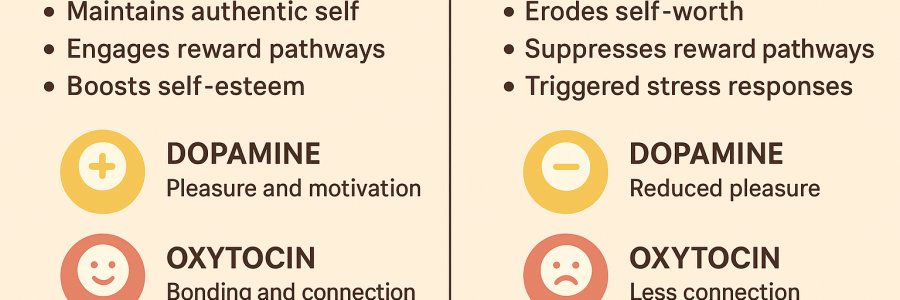
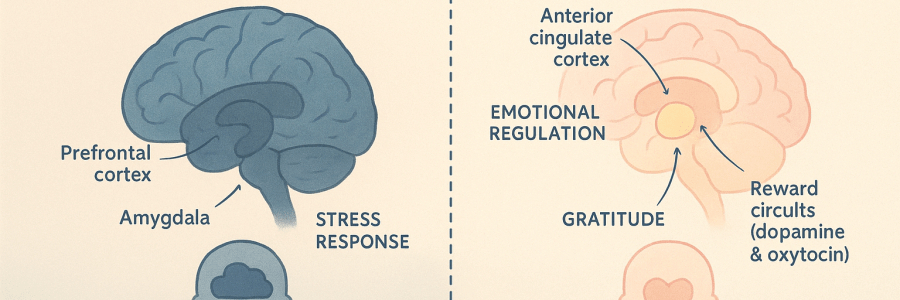
Neuroscience + Real-Life Signs of Self-Abandonment in Relationships

True compatibility = alignment, not control.When being with someone requires you to compromise your values, silence your dreams, or hide your authentic self, it’s not love — it’s self-abandonment. Neuroscience shows this has real consequences. What Happens in Your Brain Real-Life Signs You’re Self-Abandoning How to Reclaim Alignment Bottom line: Relationships built on alignment activate reward… Read More Neuroscience + Real-Life Signs of Self-Abandonment in Relationships

True Compatibility: Alignment Over Control

Many people enter relationships believing that love requires compromise. While compromise is essential for practical aspects of partnership, true compatibility is not about bending yourself to fit someone else’s world — it’s about alignment between your values, goals, and authentic self. The Psychology of Self-Abandonment Self-abandonment occurs when you suppress or compromise your core identity… Read More True Compatibility: Alignment Over Control

The Power of Acceptance: Letting Your Partner Be Themselves

One of the deepest lessons in love is learning to let someone be who they are. We often enter relationships with hope that our partner will change — that certain habits, opinions, or patterns will shift to align with our own vision of a “perfect” partnership. But neuroscience and psychology show us that trying to change… Read More The Power of Acceptance: Letting Your Partner Be Themselves

Love Has No Age: The Neuroscience of Living in the Moment

Yesterday, someone told me, “We’re too old for relationships.”Later that same day, another voice said the opposite — “It depends on where you are in your healing, and what feels right for you.” And that’s the truth: it always depends on where your heart and mind are in their journey. From a psychological view, healing reshapes the… Read More Love Has No Age: The Neuroscience of Living in the Moment

Where a Closed Heart and Mind Lead

A closed heart and a closed mind may look strong on the outside — confident, certain, unshakable.But inside, they are often frozen. When we shut down curiosity and stop letting love in, the brain slowly shifts into protection mode.The amygdala — our internal alarm — stays active, scanning for threat instead of connection.The prefrontal cortex, where empathy and reflection… Read More Where a Closed Heart and Mind Lead

Nothing Is Coincidence: The People We Meet Are Part of Our Healing

There are no coincidences in the people who cross our paths.Every soul we meet — the kind ones, the difficult ones, the fleeting ones — carries a message written somewhere in our destiny. Some arrive to teach us — to show us where we still need to grow, to mirror the parts of ourselves we’ve ignored.Some arrive… Read More Nothing Is Coincidence: The People We Meet Are Part of Our Healing

Living in Truth: The Neuroscience of Honesty and Peace

When you begin new friendships or relationships, honesty and transparency are not just moral ideals — they are neurobiological necessities for genuine connection. From a neuroscience perspective, honesty regulates the brain’s stress systems. When you hide parts of yourself or pretend to be someone you’re not, your amygdala (the brain’s threat detector) stays slightly activated. This constant low-level… Read More Living in Truth: The Neuroscience of Honesty and Peace

Finding My Way: The Neuroscience of Freedom and Connection

Right now, I’m finding my way — and it feels like waking up to life again. I’m meeting so many interesting, beautiful, kind people, each conversation lighting up something new inside me. After years of restriction, obligation, or other people’s control, I’m finally making my own choices — where I go, who I see, what… Read More Finding My Way: The Neuroscience of Freedom and Connection