What Is Trauma‑Informed Care?
At its core, trauma‑informed care (TIC) means understanding how trauma affects a person’s brain, body, behaviour, and relationships — and using that understanding to shape how support is offered. Instead of asking: “What’s wrong with you?”A trauma‑informed approach asks:“What happened to you, and how can we help you feel safe?” This shift changes how people are seen,… Read More What Is Trauma‑Informed Care?

Memory & Trauma Processing

Alcohol can have a profound and often counterproductive impact on trauma recovery, both neurologically and psychologically. Here’s a detailed breakdown: 1. Nervous System Impact Trauma leaves the nervous system hypervigilant. Alcohol: Initially may feel calming or numbing. This is why many people self-medicate with alcohol. GABA modulation reduces inhibition → risky behaviors, impulsivity. Withdrawal and hangovers activate stress… Read More Memory & Trauma Processing

What “messing up” in trauma really is

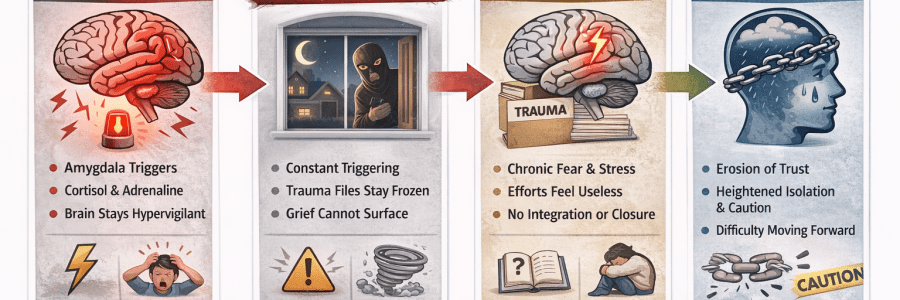
When you’re traumatised, your nervous system is not choosing behaviour — it’s protecting you. So what looks like “wrecking the relationship” is often: reacting instead of responding pulling away suddenly or clinging too tightly misreading neutral signals as rejection needing reassurance but not knowing how to ask safely shutting down or becoming overwhelmed testing closeness to… Read More What “messing up” in trauma really is

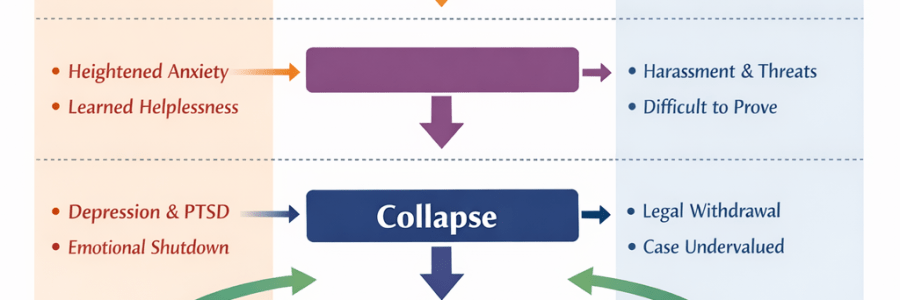
Abuse → Denial → Escalation → Collapse: Conceptual Map

Step 1: Abuse Types: Emotional, psychological, financial, or physical harm. Chronic stress → sustained activation of amygdala and HPA axis → elevated cortisol. Hypervigilance: constant scanning for threats. Memory fragmentation: trauma memories stored in implicit memory. Dysregulated vagus nerve: affecting social engagement and calming capacity. Legal Effects: Initial reports may be ignored or minimized; protective measures may be requested. Step 2:… Read More Abuse → Denial → Escalation → Collapse: Conceptual Map

1. Why abusers mistake silence for submission

Abusers are trained by cause–effect feedback. Earlier in the relationship: anger → fear pressure → compliance withdrawal → pursuit punishment → appeasement So when silence appears, their brain runs an old rule: “Silence means it’s working.” But post-flip silence is not fear-based.It is attachment shutdown. The misread happens because: Abusers monitor reaction, not internal state They rely on emotional supply (fear,… Read More 1. Why abusers mistake silence for submission

Safety Signals Are Undermined

When family members join in the abuse — sending threatening emails, insults, or manipulative messages — it creates a compound trauma effect. This goes far beyond emotional pain: it directly affects the nervous system, memory processing, and psychological recovery. Here’s a neuroscience- and psychology-informed breakdown. 1️⃣ Safety Signals Are Undermined Normal function: Family is usually the “safe base” for emotional… Read More Safety Signals Are Undermined

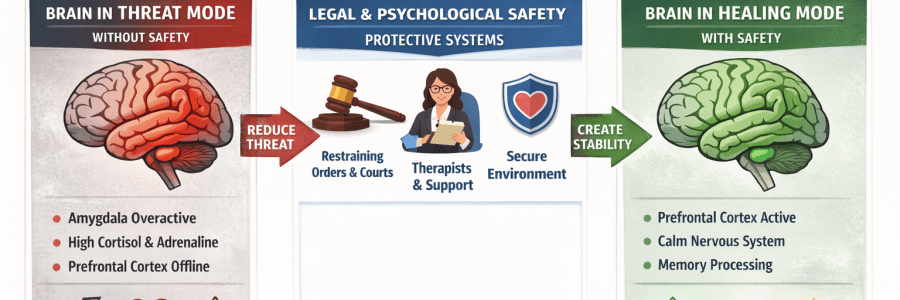
Safety is the soil of healing

When someone continuously breaks a restraining order, it’s not just a legal violation — it’s a direct assault on the nervous system, and it profoundly affects trauma recovery. I’ll break it down using neuroscience and psychology, step by step. 1️⃣ SAFETY SIGNALS ARE DESTROYED Neuroscience Trauma triggers hypervigilance: amygdala constantly scans for threat A restraining order is a clear… Read More Safety is the soil of healing

Why Attention Drops When Survivors Begin to Heal

Trauma Recovery, Post-Abuse Dynamics & the Nervous System For people who have lived through long-term abuse, the shift you’re noticing is not just social — it’s neurobiological and relational. When you were in survival mode, your nervous system, identity, and relationships were organized around threat, appeasement, and endurance. As you heal, that entire structure changes. And not everyone… Read More Why Attention Drops When Survivors Begin to Heal

Next Chapter: A Step-by-Step Guide

I am safe. I have spoken out. My healing is progressing. Now it’s time to focus on my life, my growth, and my well-being. Step 1: Maintain Trauma-Informed Support Continue regular sessions with a psychologist or trauma-informed therapist. Explore unresolved feelings and suppressed memories. Consider peer support or survivor groups for validation and connection. Step 2:… Read More Next Chapter: A Step-by-Step Guide

Minimization and Denial by Family Members

Common psychological phenomenon in families of abuse survivors, and it has both neuroscientific and social-psychological dimensions. Here’s a clear breakdown: 1. Minimization and Denial by Family Members Minimization: Family members may downplay the risk to avoid acknowledging the severity of the abuse. Denial: They may unconsciously refuse to accept that the abuser is capable of serious harm because it conflicts with… Read More Minimization and Denial by Family Members