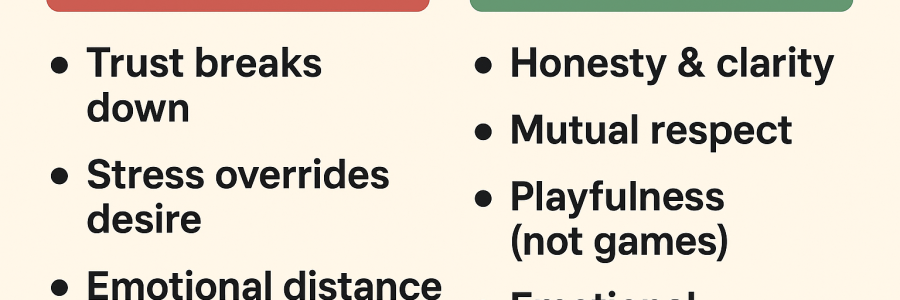
ENTITLEMENT vs HEALTHY AUTHORITY (Clinical Comparison)

CORE SELF-STRUCTURE Entitlement Fragile or unstable self-worth Identity requires external validation Power is borrowed from others’ compliance Healthy Authority Integrated, stable self-worth Identity is internally referenced Power is self-contained NERVOUS SYSTEM REGULATION Entitlement Poor internal regulation Uses control, dominance, or compliance to feel safe Boundaries trigger threat responses Healthy Authority Strong internal regulation (ventral vagal)… Read More ENTITLEMENT vs HEALTHY AUTHORITY (Clinical Comparison)

Trauma Bonding vs Healthy Attraction

(How it feels in the body, mind, and nervous system) 🧠 Nervous System Trauma Bonding Feels intense, urgent, consuming Nervous system is activated (anxious, hyperfocused) Calm only comes from them Absence feels like withdrawal Healthy Attraction Feels steady, warm, curious Nervous system stays regulated Calm exists with or without them Absence is tolerable Key question:Do they regulate me —… Read More Trauma Bonding vs Healthy Attraction

Strong, intelligent women are not targeted despite their strength.They are often targeted because of it.

Here’s why, clearly and without myth. 1. Strength Looks Like a Resource to a Predator Abusive personalities don’t look for “weakness” in the way people imagine. They scan for: Competence Emotional depth Stability Social credibility Problem-solving ability Capacity to carry responsibility To them, this signals: “This person can absorb pressure, adapt, and keep functioning.” That’s… Read More Strong, intelligent women are not targeted despite their strength.They are often targeted because of it.

The Stages Before Leaving (What Actually Happens)

1. Idealisation & Bond Formation What it looks like Intense connection, charm, attentiveness Feeling “seen” or chosen Fast emotional intimacy What’s happening internally Dopamine + oxytocin surge (bonding hormones) Sense of safety and meaning attaches to this person Key trap “This feels special — I’ve never had this before.” 2. First Boundary Breaches (Minimised) What it looks like… Read More The Stages Before Leaving (What Actually Happens)

Why some personalities trigger trauma bonds (and others don’t)

Trauma bonds form when attachment + threat + intermittent relief get wired together.Some personalities reliably create that wiring. 1. The Hot–Cold / Inconsistent personality 🔥❄️ Traits Intense connection early Sudden withdrawal Mixed signals Unpredictable availability Why it bondsYour nervous system learns: Connection is unstable — I must work for it. Uncertainty spikes dopamine.Withdrawal spikes cortisol.Relief feels euphoric. This is textbook intermittent reinforcement —… Read More Why some personalities trigger trauma bonds (and others don’t)

The overlap: why trauma bonds and healthy attachment both create loops

At the surface, both can look like: intrusive thoughts longing difficulty letting go replaying memories feeling “pulled back” despite logic That’s because both activate attachment circuitry and unfinished emotional processing. But what’s driving the loop is very different. Trauma bonding + Zeigarnik loops 🔥 (the sticky kind) What creates it Trauma bonds form through: intermittent reinforcement (warm → cold… Read More The overlap: why trauma bonds and healthy attachment both create loops

Self-Assessment: Do I Stay — or Do I Leave?

This questionnaire is not about making a decision today.It’s about clarity.Answer each question with Yes / Sometimes / No. Safety First Do I feel emotionally safe in this relationship? Am I ever afraid of their reactions — anger, withdrawal, punishment, retaliation? Has my sense of safety decreased over time? Do I feel more at peace when they… Read More Self-Assessment: Do I Stay — or Do I Leave?

Self-Assessment: Am I in a Healthy or Abusive Relationship?

Read each statement and answer honestly with Yes / Sometimes / No.There are no right or wrong answers — only information. Emotional Safety Do I feel emotionally safe expressing my thoughts, feelings, or needs? When I’m upset, am I listened to rather than dismissed, mocked, or blamed? Do disagreements stay respectful, without intimidation or cruelty? Do… Read More Self-Assessment: Am I in a Healthy or Abusive Relationship?

“What the hell did you ever see in him?”

It’s been another full, nourishing week with my bestie and family — the kind filled with long, unhurried conversations that stretch late into the evening. We talked about school, teenagers, work, growing up, and the strange passage of time. About responsibilities that multiply, roles that shift, and the quiet weight of experience. And yet, threaded… Read More “What the hell did you ever see in him?”

Financial Exploitation Escalation 

STEP 1: Subtle Dependence Small favors or expenses covered by survivor Abuser asks occasionally for help Nervous system: mild trust mixed with slight vigilance Red flag: evasiveness or resentment when asked to reciprocate Protective action: slow down contribution, observe behavior ↓ STEP 2: Regular Exploitation Survivor covers routine bills, groceries, or travel Abuser contributes minimally… Read More Financial Exploitation Escalation