Neuroscience Map: Abuse vs. Real Love

Domain Real Love Abuse / Financial, Physical, Emotional + Sadistic Attachment System Secure attachment, oxytocin bonding, trust circuits active Trauma bonding, attachment hijacked by fear and reward; oxytocin spikes tied to intermittent reinforcement Nervous System Parasympathetic activation: calm, safe, regulated Sympathetic / HPA axis overactivation: chronic fight/flight/freeze, hypervigilance, stress hormone surge Prefrontal Cortex Clear thinking,… Read More Neuroscience Map: Abuse vs. Real Love

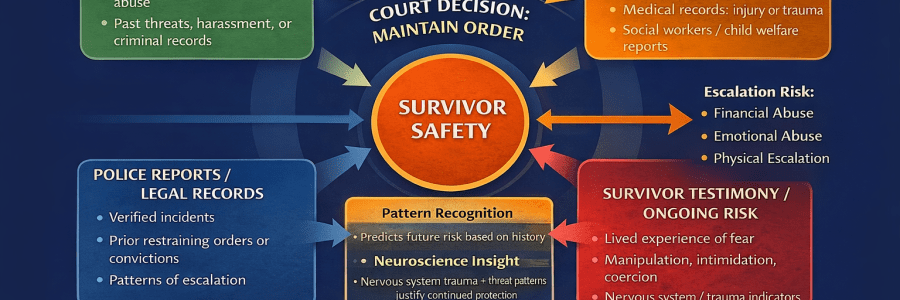
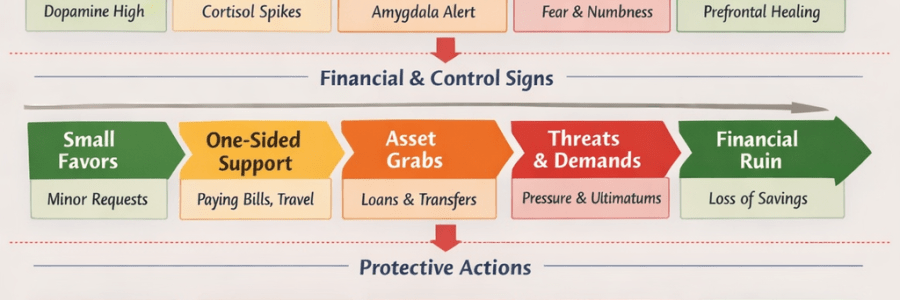
Why Separation Triggers Escalation

Below is a clear, step-by-step escalation model used in trauma psychology and coercive-control research to explain how financial parasitism intensifies once separation begins.This is predictable, patterned, and not accidental. Why Separation Triggers Escalation Financial parasitism is not just about money.It is about regulation, control, and entitlement. When separation starts: Access to resources is threatened Control over the partner’s nervous system… Read More Why Separation Triggers Escalation

Healthy vs Unhealthy Separation

Below is a clear, side-by-side comparison followed by a direct mapping to attachment styles.This is the framework clinicians, trauma specialists, and increasingly courts use to distinguish healthy separation from abusive or unsafe dynamics. Healthy vs Unhealthy Separation (Side-by-Side Comparison Chart) Domain Healthy Separation Unhealthy / Abusive Separation Core mindset “This relationship is ending; we are still human.” “I must win, control,… Read More Healthy vs Unhealthy Separation

How Healthy Partners Behave — Even During Separation

This is a crucial distinction, especially during separation or divorce when stress is high.Healthy partners may be hurt, angry, or grieving — but they do not cross core moral lines, even when the relationship ends. Below is how this looks psychologically, neurologically, and behaviorally. How Healthy Partners Behave — Even During Separation (Neuroscience & Psychology) 1. They Do… Read More How Healthy Partners Behave — Even During Separation

The Unforgivable Lines in a Relationship

Below is a clear, non-negotiable framework used in trauma psychology, family law, and neuroscience to define lines that must never be crossed in an intimate relationship.These are not “relationship problems.” They are moral, neurological, and legal violations that permanently damage trust and the human nervous system. The Unforgivable Lines in a Relationship (Neuroscience & Psychology perspective) 1. Violence or Threats of… Read More The Unforgivable Lines in a Relationship

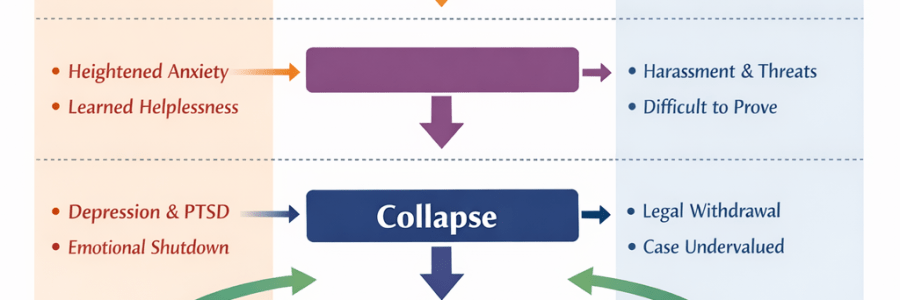
Cycle of Long Term Abuse

button-pushing, escalation when calm, reliance on your reactions for regulation, and staying close to you physically or symbolically — is actually a hallmark of long-term emotional abuse. Let’s unpack why this is, from both a psychological and neurological perspective. 1. Emotional Abuse Is About Control, Not Connection Long-term emotional abuse isn’t about conflict or even “anger.” It’s… Read More Cycle of Long Term Abuse

Why He Hated Spain Then

When you were together, Spain represented: Loss of control (not his environment) Your independence (you functioning well outside his sphere) Reduced leverage (fewer familiar power cues) Threat to identity (he wasn’t central or dominant there) For someone who regulates through control and familiarity, Spain would have felt: Disorienting Unsettling Ego-threatening So avoidance made sense at that time. Why He Won’t… Read More Why He Hated Spain Then

Why Abusers Often Refuse to Leave the Area

This is not coincidence, nostalgia, or practicality.It is about regulation, identity, and power. The key distinction: You heal by creating distance They destabilize when distance exists So they stay close. 1. Proximity Regulates Their Nervous System For an abuser, proximity to a former target functions like a regulatory anchor. Neurologically: Knowing where you are Being in the same… Read More Why Abusers Often Refuse to Leave the Area

Abusers do not seek connection — they seek regulation.

When an abuser leaves reminders, resurfaces after long no-contact, or engineers moments where you “happen” to see them, there is a very specific neuropsychological mechanism at play. I’ll break it down clearly and calmly. The Core Truth Abusers do not seek connection — they seek regulation. They use you to regulate their nervous system, identity, and sense of… Read More Abusers do not seek connection — they seek regulation.

Familiar pain feels safer than new peace

People relapse back into trauma bonds not because they’ve “forgotten the harm”, but because the brain temporarily prioritizes relief over truth when under stress. This relapse is neurological, predictable, and explainable — which is why understanding it removes self-blame and increases recovery. Here’s what’s really happening. 1. Stress Shrinks the Brain’s Time Horizon Under stress, the brain shifts… Read More Familiar pain feels safer than new peace