Calm truth

There was never anyone else.I returned from holiday with my family — my children and grandchildren. Nothing more, nothing hidden. The idea of a “mystery man” was a story used to discredit me. In reality, he had another partner while using my hard-earned money and restricting my access to my own finances. For decades, I… Read More Calm truth

Why you should NOT pass details to their family

1. Families are not neutral containers Psychology shows that families are emotionally invested systems, not objective recipients of information. Common outcomes: Neuroscience: This means facts are rarely processed rationally. 2. You become the messenger — and the target Passing information to family shifts your role from: Psychologically, this exposes you to: Your nervous system absorbs stress that does not… Read More Why you should NOT pass details to their family

You are not refusing truth — you are refusing harm

✅ DO — Protect yourself while acting responsibly 🧠 Nervous system first 📩 Communication 📁 Information handling ⚖️ Responsibility 🌱 Aftercare 🚫 DON’T — Avoid what harms recovery ❌ Engagement ❌ Emotional load ❌ Cognitive traps ❌ Role confusion ❌ Self-betrayal thoughts to notice (not obey) These are trauma-conditioned empathy reflexes, not obligations. 🧩 One-sentence response… Read More You are not refusing truth — you are refusing harm

Disturbing information

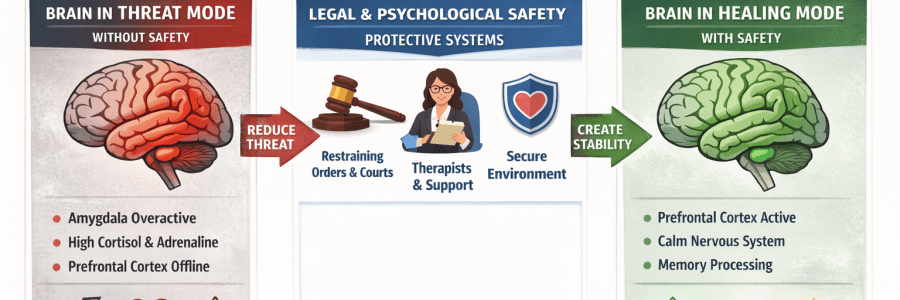
Here is a clear, trauma-informed, neuroscience-aligned way to react when someone you barely know contacts you with a disclosure about your ex — something you didn’t want to know, but that should be reported. This approach protects your nervous system, your legal position, and the integrity of the information. 1. Regulate first — before responding Do nothing immediately. Neuroscience: What to do… Read More Disturbing information

“Does this information increase my safety or only my stress?”

harmful disclosure doesn’t look dramatic at first. Neuroscience shows it often erodes recovery quietly, through stress accumulation rather than acute distress. Here are the clear, evidence-based signs that disclosures are starting to harm your recovery. 1. Your nervous system stays activated after contact Key sign: the reaction doesn’t settle. Neuroscience: You may notice: If your body remains alert long after… Read More “Does this information increase my safety or only my stress?”

Why Attention Drops When Survivors Begin to Heal

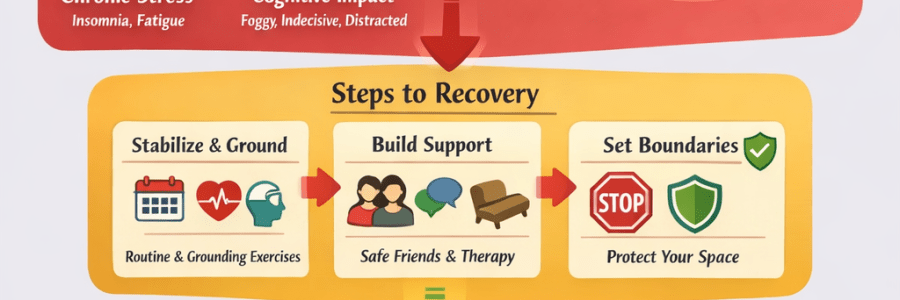
Trauma Recovery, Post-Abuse Dynamics & the Nervous System For people who have lived through long-term abuse, the shift you’re noticing is not just social — it’s neurobiological and relational. When you were in survival mode, your nervous system, identity, and relationships were organized around threat, appeasement, and endurance. As you heal, that entire structure changes. And not everyone… Read More Why Attention Drops When Survivors Begin to Heal

Why People Engage More With Struggle Than With Joy

A Neuroscience & Psychology Perspective Many people notice a puzzling pattern on social media and in real life:When you’re struggling, sharing pain, or “not doing well,” engagement pours in.When you’re healing, happy, confident, or visibly thriving—attention drops off. This is not accidental, and it is not about your worth. 1. The Brain Is Wired to… Read More Why People Engage More With Struggle Than With Joy

Repetition Compulsion in Psychodynamic Therapy

Definition:Repetition compulsion is a concept introduced by Sigmund Freud in psychoanalytic theory. It refers to the tendency of individuals to repeat behaviors, situations, or relationships that mirror unresolved conflicts or traumatic experiences from the past, often unconsciously. How It Manifests Example:A person who grew up with inconsistent parental care may unconsciously seek partners who are emotionally unavailable,… Read More Repetition Compulsion in Psychodynamic Therapy

When Families Know About Abuse

One of the reasons many survivors don’t speak out sooner is simple:they already know they won’t be supported. In some families, the abuse isn’t a secret.It has been seen before.Hints have been dropped.Incidents have been witnessed, minimised, or quietly explained away. Instead of intervening, the family: This silence isn’t neutral.It’s a choice. Why This Keeps… Read More When Families Know About Abuse