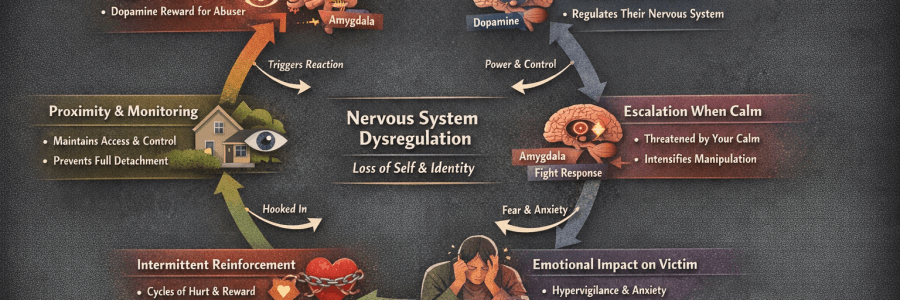
Abuse is not a “two versions of reality”

Abuse is not a “two versions of reality” situation in any meaningful moral sense.Whatever cognitive or emotional narratives people build afterwards, abuse is defined by behaviour and its impact, not by interpretation. ⚖️ The important distinction 1. Abuse is behaviour-based, not perception-based In psychology and law, abuse is identified through patterns of actions, such as: Those things… Read More Abuse is not a “two versions of reality”

Different Truths

This is one of the most interesting findings in psychology: two people can live through the same relationship and walk away with completely different “truths” about it. Not because one is necessarily lying—but because the brain doesn’t store relationships as facts. It stores them as interpreted emotional experiences. 🧠 Why two people build opposite narratives 1. Different… Read More Different Truths

Self-regulation after closeness

The distinction matters a lot because the behaviour can look identical on the surface, but the internal state and relationship outcome are very different. Here’s how psychology typically separates them: 1) Healthy “needing space” This is self-regulation after closeness, not rejection. Internal state Nervous system pattern Prefrontal CortexThe thinking brain stays online, so the person can still hold… Read More Self-regulation after closeness

 Post-intimacy nervous system shift

When someone withdraws after intense sex, psychology usually treats it less as “self-destruction” and more as a post-intimacy nervous system shift. It can look sudden, but there are several well-studied mechanisms behind it. 1. Nervous system “drop” after high arousal Sex—especially intense or emotionally charged sex—activates strong arousal systems in the brain (dopamine, adrenaline, oxytocin). After… Read More  Post-intimacy nervous system shift

Self-destruct button

In relationships, the “self-destruct button” usually shows up as a very specific pattern: things are going well, then suddenly something inside flips and you either pull away, create conflict, or emotionally shut down. In neuroscience and psychology, this isn’t random—it’s a predictable stress response shaped by learning, attachment, and threat processing. What’s happening in the brain… Read More Self-destruct button

The neuroscience of self-destruction

AmygdalaYour amygdala is your brain’s alarm system. If something feels emotionally threatening (rejection, intimacy, success, failure), it can trigger fight, flight, freeze, or fawn — even when there’s no actual danger. Example: things are going well in a relationship → suddenly you pick a fight or pull away. Prefrontal CortexThis is your “wise adult” brain — logic,… Read More The neuroscience of self-destruction

When People Sabotage Their Own Relationships: A Neuroscience and Psychology Perspective

One of the most painful things people experience is watching themselves — or someone they love — damage a relationship they deeply wanted. They may say: This is often called self-sabotage, but psychologically it is rarely about consciously wanting to destroy something. It is usually about protection. 🧠 The brain prefers familiar over healthy Your nervous system… Read More When People Sabotage Their Own Relationships: A Neuroscience and Psychology Perspective

Understanding Why It Took So Long: What 18 Months of Therapy Can Reveal

Many people come to therapy asking a simple question: “Why did I stay so long?”“Why did I not see it sooner?”“Why did I doubt myself?” These questions often carry shame, confusion, or frustration. But over time, therapy rarely delivers a dramatic single answer. Instead, it reveals something quieter — and more accurate. Understanding begins to… Read More Understanding Why It Took So Long: What 18 Months of Therapy Can Reveal

😳 “You Weren’t Expecting That, Were You?”

The Photo That Changed the Entire Conversation There are moments in life that permanently alter group dynamics. This was one of them. It started innocently enough: “Can we see a photo of him?” A simple request. Harmless. Curiosity wrapped in politeness. And for a brief second, I considered refusing on ethical grounds, emotional safety grounds,… Read More 😳 “You Weren’t Expecting That, Were You?”