A Warrior’s Heart Stays Whole – Resilience is a beauty that never fades

There’s a quiet myth in the way we talk about strength—that it looks unbreakable, untouched, invincible. But a warrior’s heart is not one that has never been wounded. It is one that has been cracked open, tested, stretched beyond what seemed survivable—and still chooses to remain whole. Wholeness is not the absence of pain. It… Read More A Warrior’s Heart Stays Whole – Resilience is a beauty that never fades

On Staying the Course: When Delay Stops Being a Distraction

There comes a point in any long, high-friction process where something quietly shifts. Not in the situation itself — but in perspective. What once felt urgent, reactive, and emotionally charged begins to look more structured. Less personal. More mechanical. A sequence rather than a story. The Cost of Constant Delay In extended negotiation or legal… Read More On Staying the Course: When Delay Stops Being a Distraction

What Happens Over Time

There is a thread that runs through all of this work—one that connects perception, survival, healing, and ultimately, self-trust. At the beginning, there is confusion. The experience of false accusations, projection, and emotional distortion. Psychology helps us name some of it—projection, cognitive dissonance, attachment patterns—but naming it does not immediately make it easier to live… Read More What Happens Over Time

A Busy Night on the website

Most viewed Posts & pages Views About Linda C J Turner43 The Mindset of Someone Who Aims to Destroy You39 Understanding the Abuser’s Mentality: A Neuroscience and Psychological Perspective29 What Causes Paranoia? A Psychological and Neuroscience Perspective21 The Psychology Behind Vindictiveness and Revenge21 Living a Lie: The Psychology and Neuroscience Behind People Who Pretend to… Read More A Busy Night on the website

“Small Person Syndrome” — Neuroscience & Psychology Explained

(What drives the need for dominance, status, and putting others down) 1. Core Driver: Fragile Self-Worth At the root of this behaviour is deep insecurity and unstable self-esteem. Neurologically, this is linked to: Underdevelopment or dysregulation in the prefrontal cortex (self-reflection, emotional regulation, impulse control) Overactivation of the amygdala (threat detection, fear response) Their brain is constantly scanning for: “Am I… Read More “Small Person Syndrome” — Neuroscience & Psychology Explained

Trauma recovery often feels like time travel.

When you live for years in survival mode — emotional suppression, hyper-vigilance, constant adaptation — your nervous system is focused only on one thing: getting through. You don’t live.You endure. Psychologically, this creates a version of you built for survival, not for authenticity.You silence your needs.You shrink your emotions.You disconnect from parts of yourself just to… Read More Trauma recovery often feels like time travel.

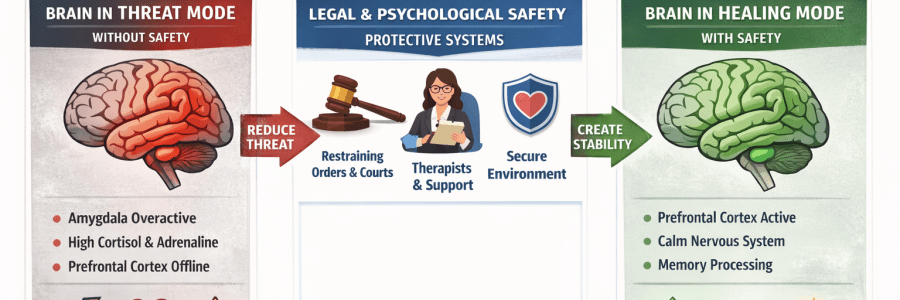
Neuroscience & Therapeutic Map: Boundaries, Safety, and Recovery

1. Enforcing One Boundary Rewires Safety Faster Than Insight Key idea:Action speaks louder than thought. The brain needs proof, not reasoning. Mechanism: Prefrontal cortex enforces “I am in control here.” Amygdala receives reliable signals of safety: when a boundary is respected, threat circuits downregulate. Hippocampus updates memory: “Limits = effective, predictable, protective.” Clinical/Legal translation: Documented boundary enforcement… Read More Neuroscience & Therapeutic Map: Boundaries, Safety, and Recovery

🌱🧠 What Recovery Looks Like After Intimidation Ends

This is the part people rarely explain — but it matters most.Recovery after intimidation is real, predictable, and neurological. It doesn’t happen all at once, and it doesn’t mean “forgetting.” It means your nervous system relearns safety. Here’s what recovery actually looks like, stage by stage. 🌱🧠 What Recovery Looks Like After Intimidation Ends Phase 1: Threat Removal… Read More 🌱🧠 What Recovery Looks Like After Intimidation Ends

🧠 ANGER vs GRIEF IN TRAUMA RECOVERY

(Brain → function → outcome) 🔥 ANGER Purpose: protection and containment 🧠 Brain state Amygdala activated (threat response) Sympathetic nervous system dominant Cortisol and adrenaline elevated Prefrontal cortex narrowed but not offline 🧭 Function after trauma Creates boundaries Restores agency Prevents collapse Protects against shame Keeps pain organised and externalised Anger says: “This should not… Read More 🧠 ANGER vs GRIEF IN TRAUMA RECOVERY