Your Brain & Heart Recovery Plan (After Years of Emotional Uncertainty)

Phase 1: Awareness – “This Was Conditioning, Not Love” Goal: Break the emotional spell What happened to you wasn’t just a relationship—it was conditioning. Your brain got hooked on intermittent reinforcement (inconsistent attention = addictive loop) You were trained to wait, analyze, and tolerate confusion Your nervous system learned: “Love = uncertainty” 👉 Reframe (daily):“Consistency is safe. Confusion is not chemistry.” This… Read More Your Brain & Heart Recovery Plan (After Years of Emotional Uncertainty)

The Healing Power of Connection: How Time with Friends and Family Supports Emotional Recovery

Recovering from trauma or difficult life experiences is rarely linear. Emotional ups and downs, confusion, and uncertainty are normal, but what often helps most is the people you surround yourself with. Spending time with supportive friends and family isn’t just comforting—it can actively regulate your emotions, reinforce healthy coping strategies, and complement professional therapy. Why Connection Matters… Read More The Healing Power of Connection: How Time with Friends and Family Supports Emotional Recovery

Healing Changes the Body: What Neuroscience & Psychology Say About Recovery Results

Tomorrow I receive the results of my routine hospital tests after returning to private medical care. And naturally, a question arises: Will my physical health now reflect the emotional healing I’ve been doing? From a neuroscience and psychology perspective, the answer is:👉 Very possibly — yes. 🧠 Trauma Lives in the Body — So Does Healing… Read More Healing Changes the Body: What Neuroscience & Psychology Say About Recovery Results

When Healing Shows: How Trauma Recovery Transforms Mind, Brain & Body

Two years ago, under extreme psychological stress and PTSD from an abusive marriage, my eyesight measured just 70% without glasses.Eighteen months after leaving that environment, my vision is now 90% without glasses. The optician also said something unexpected:“You look lighter. Brighter.” And that moment says everything about trauma, healing, and the incredible power of the human… Read More When Healing Shows: How Trauma Recovery Transforms Mind, Brain & Body

Choosing EMDR after strangulation and psychological abuse is not recovery — it is reclamation.

Strangulation is one of the most dangerous and psychologically devastating forms of assault.It directly impacts the brain’s fear system, memory processing, emotional regulation, and sense of safety. But survival rewires the brain for endurance.Healing rewires it for freedom. EMDR allows trauma to be reprocessed so it no longer controls the nervous system, emotions, identity, or self-worth. This… Read More Choosing EMDR after strangulation and psychological abuse is not recovery — it is reclamation.

Trauma recovery often feels like time travel.

When you live for years in survival mode — emotional suppression, hyper-vigilance, constant adaptation — your nervous system is focused only on one thing: getting through. You don’t live.You endure. Psychologically, this creates a version of you built for survival, not for authenticity.You silence your needs.You shrink your emotions.You disconnect from parts of yourself just to… Read More Trauma recovery often feels like time travel.

Neuroscience & Therapeutic Map: Boundaries, Safety, and Recovery

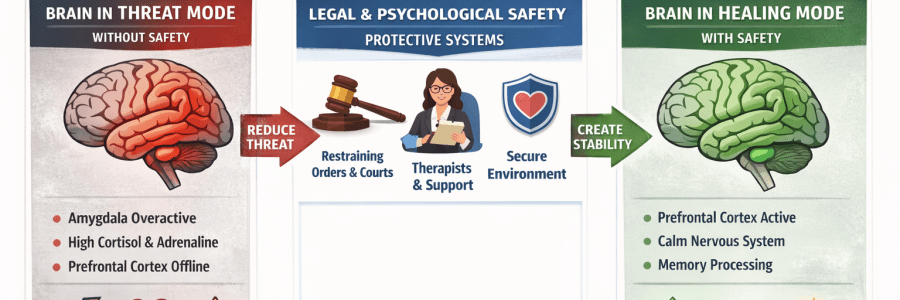
1. Enforcing One Boundary Rewires Safety Faster Than Insight Key idea:Action speaks louder than thought. The brain needs proof, not reasoning. Mechanism: Prefrontal cortex enforces “I am in control here.” Amygdala receives reliable signals of safety: when a boundary is respected, threat circuits downregulate. Hippocampus updates memory: “Limits = effective, predictable, protective.” Clinical/Legal translation: Documented boundary enforcement… Read More Neuroscience & Therapeutic Map: Boundaries, Safety, and Recovery

🌱🧠 What Recovery Looks Like After Intimidation Ends

This is the part people rarely explain — but it matters most.Recovery after intimidation is real, predictable, and neurological. It doesn’t happen all at once, and it doesn’t mean “forgetting.” It means your nervous system relearns safety. Here’s what recovery actually looks like, stage by stage. 🌱🧠 What Recovery Looks Like After Intimidation Ends Phase 1: Threat Removal… Read More 🌱🧠 What Recovery Looks Like After Intimidation Ends

🧠 ANGER vs GRIEF IN TRAUMA RECOVERY

(Brain → function → outcome) 🔥 ANGER Purpose: protection and containment 🧠 Brain state Amygdala activated (threat response) Sympathetic nervous system dominant Cortisol and adrenaline elevated Prefrontal cortex narrowed but not offline 🧭 Function after trauma Creates boundaries Restores agency Prevents collapse Protects against shame Keeps pain organised and externalised Anger says: “This should not… Read More 🧠 ANGER vs GRIEF IN TRAUMA RECOVERY