Why Disclosure Is Important (and Protective)

You absolutely should inform your lawyer, the judge (via your lawyer), and your psychologist if you believe the family lawyers on your ex’s side have been manipulating matters. This isn’t about accusation; it’s about protective disclosure and record‑keeping. Here’s how and why to do it safely and effectively. Why Disclosure Is Important (and Protective) 1. To Your Lawyer Your… Read More Why Disclosure Is Important (and Protective)

Why Trusting a Family Solicitor Can Be Risky

1. Conflict of Interest A solicitor who is a family member or closely aligned with the family may have dual loyalties. Their advice may unconsciously or deliberately favor other relatives or the family estate over your interests. 2. Financial Vulnerability Handling wills, trusts, or shared assets through a conflicted advisor increases the chance that your inheritance, rights, or… Read More Why Trusting a Family Solicitor Can Be Risky

Public Advisory: Protect Yourself from Conflicted or Untrustworthy Legal Advice

When dealing with family finances, inheritances, or shared assets, it’s important to be aware that not all legal or financial advisors may act impartially, particularly if they have close relationships with family members. To protect yourself: Use a solicitor or financial advisor who is not connected to family members or the parties involved. Request all advice and… Read More Public Advisory: Protect Yourself from Conflicted or Untrustworthy Legal Advice

Free from Threat

Safety is both internal and external, and it can look very different depending on context. Here’s a structured set of examples for survivors of abuse, framed in psychological and nervous-system terms: 1. Physical Safety External environment is secure, predictable, and free from threat. Examples: Living in a home where the abuser cannot enter or monitor you. Locked… Read More Free from Threat

Road to Safety: Step-by-Step Framework

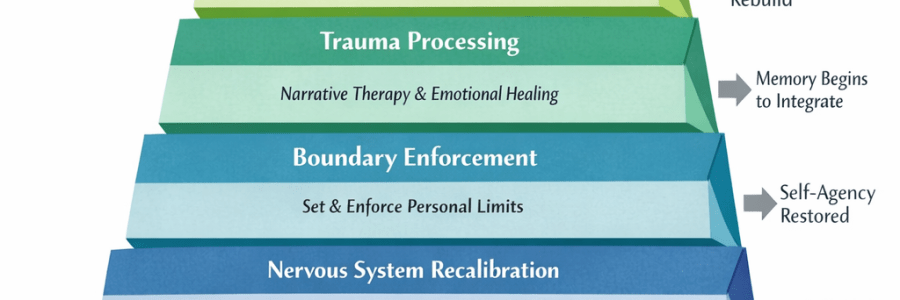
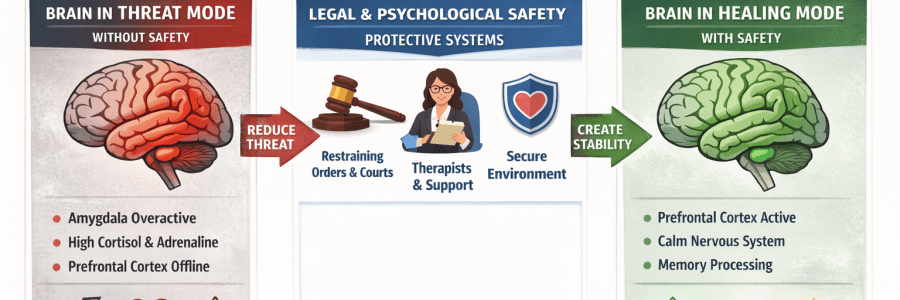
Layer 1: External Safety Goal: Remove immediate threatActions: Physical separation (home, distance) Legal protection (restraining orders, custody agreements) Digital security (blocking, privacy controls) Supportive network of trusted allies Nervous System: Amygdala downregulation starts once the environment is reliably safe. Layer 2: Nervous System Recalibration Goal: Teach the body that danger is not constantActions: Mindfulness, grounding, breathwork Somatic therapies… Read More Road to Safety: Step-by-Step Framework

Establish External Safety First

Recovering safety after decades of abuse is absolutely possible, but it’s a gradual, nervous-system-centered process, not something that happens overnight. Safety is both internal (how your body and mind respond) and external (your environment, relationships, and boundaries). Here’s a comprehensive framework: 1. Establish External Safety First Before the nervous system can relax, you need to remove ongoing threat. Steps include: Physical separation: Living… Read More Establish External Safety First

Neuroscience & Therapeutic Map: Boundaries, Safety, and Recovery

1. Enforcing One Boundary Rewires Safety Faster Than Insight Key idea:Action speaks louder than thought. The brain needs proof, not reasoning. Mechanism: Prefrontal cortex enforces “I am in control here.” Amygdala receives reliable signals of safety: when a boundary is respected, threat circuits downregulate. Hippocampus updates memory: “Limits = effective, predictable, protective.” Clinical/Legal translation: Documented boundary enforcement… Read More Neuroscience & Therapeutic Map: Boundaries, Safety, and Recovery

How Repeated Boundary Breaches Rewire the Brain

(From Safety → Survival → Shutdown) 1. Initial Boundary Breach Event:A limit is crossed (emotional, physical, psychological, financial, or time-based). Brain response: Amygdala activates → “Something isn’t safe.” Stress hormones (cortisol, adrenaline) release. Prefrontal cortex still online → you explain, reason, clarify. 🧠 At this stage, the brain expects repair. 2. Boundary Is Ignored or Punished Event:The… Read More How Repeated Boundary Breaches Rewire the Brain

What a Boundary Breach Actually Is

A boundary breach is any behavior that overrides your autonomy, consent, or internal signals — especially after you’ve communicated a limit (or when it should be obvious). It’s not about intent.It’s about impact. Your nervous system reacts with stress because it detects loss of control. 1. Communication Boundary Breaches Message: “You don’t get to decide when or how I access you.”… Read More What a Boundary Breach Actually Is

Three phases of a nervous system exiting captivity.

PHASE 1: DETACHMENT (While still inside, or immediately after leaving) Primary function: Survival efficiencyDominant system: Autonomic nervous system (freeze → controlled shutdown) What’s happening internally The brain stops seeking resolution or repair Hope collapses quietly, not dramatically Attachment circuits disengage to conserve energy Emotional responses flatten to reduce pain and risk This is when people say: “I don’t… Read More Three phases of a nervous system exiting captivity.