Why Aging Often Accelerates Cruelty

Aging removes the buffers that once kept cruelty contained. 🧠 Neurological factors Reduced prefrontal flexibility Lower dopamine baseline Less emotional novelty available Increased fear of loss (status, health, control) Cruelty becomes a compensatory strategy. 🔁 Behavioural consequences As aging progresses: patience decreases tolerance for autonomy in others shrinks control behaviours intensify bitterness and rigidity increase If… Read More Why Aging Often Accelerates Cruelty
How Survivors’ Safety Rises Faster Than Abusers Decline

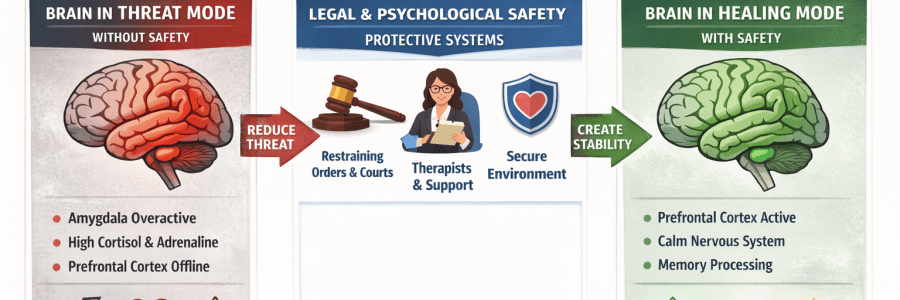
This asymmetry is biological, not moral. 🧠 Survivor nervous system Once danger is removed: threat input drops immediately cortisol begins to fall within weeks prefrontal cortex re-engages learning and integration resume Safety is additive.Each boundary enforced strengthens regulation. ➡️ Recovery accelerates because the nervous system is designed to heal when threat stops. 🧠 Abuser nervous system Cruelty-based… Read More How Survivors’ Safety Rises Faster Than Abusers Decline

How Long-Term Cruelty Erodes the Abuser’s Own Wellbeing

Cruelty damages the person using it, even if they never admit it. 1️⃣ Emotional Range Narrows Over time: joy diminishes curiosity fades intimacy feels unsafe or boring 🧠 Empathy suppression spreads to all emotions, not just compassion. ➡️ Life feels flatter, emptier. 2️⃣ Stress Physiology Becomes Chronic Cruelty keeps the nervous system: hypervigilant adversarial threat-oriented 🧠 This… Read More How Long-Term Cruelty Erodes the Abuser’s Own Wellbeing

Why Some People Replace Partners Instead of Changing

This is not emotional shallowness — it’s neural efficiency. 🧠 The brain’s shortcut Change requires: tolerating shame relinquishing reward rebuilding empathy circuits sustained discomfort Replacement offers: instant regulation renewed dopamine restored control a clean narrative reset 🧠 The brain chooses: “New supply is easier than neural rewiring.” 🔄 What replacement actually does Resets the cruelty loop… Read More Why Some People Replace Partners Instead of Changing

When Escalation Turns Dangerous

Cruelty becomes dangerous when regulation fails and desperation replaces control. 🔴 Key neurological warning points Escalation crosses into danger when you see three shifts together: 1️⃣ Loss of Predictability Cruel behaviour becomes erratic, not patterned Reactions no longer “work” to calm the person Outbursts are disproportionate or poorly timed 🧠 This signals collapsing self-regulation. 2️⃣ Increased Risk-Taking Threats… Read More When Escalation Turns Dangerous

Cruelty can become addictive, and it tends to escalate over time.

Here’s why, in plain but accurate terms: 🧠 Why Cruelty Becomes Addictive Cruelty isn’t usually about “enjoying pain” at the start.It begins as a way to regulate the nervous system. Control reduces anxiety Dominance creates relief Another person’s reaction brings calm or focus That relief triggers dopamine (the brain’s learning/reward chemical). The brain learns: “This behaviour works.” That’s… Read More Cruelty can become addictive, and it tends to escalate over time.

Silence Removes the Regulation Source

Abusive dynamics work because the abuser uses another person to: regulate anxiety discharge tension stabilise identity confirm power When you go silent: there is no emotional input no reaction no feedback loop 🧠 ResultThe nervous system loses its external regulator. ➡️ Dysregulation begins internally. 2️⃣ The Brain Encounters Reward Collapse Cruelty and control rely on dopamine prediction: “If… Read More Silence Removes the Regulation Source

How One Enforced Boundary Disrupts the Entire Cruelty Loop

Cruelty depends on access.A single boundary works because it removes fuel, not because it teaches insight. 1️⃣ Boundary Enforcement = Circuit Interruption When a survivor enforces a boundary (not explains it, not negotiates it): No response No emotional feedback No repair attempt No re-entry point 🧠 Neurological effect Dopamine prediction fails The brain expected reward → receives none The cruelty→relief… Read More How One Enforced Boundary Disrupts the Entire Cruelty Loop

How Cruelty Escalates Neurologically Over Time

Think of cruelty not as a personality switch, but as a learning loop inside the brain. Stage 1: Initial Threat → Control Response Brain state: Stress + insecurity threatened shamed powerless dysregulated The nervous system searches for regulation stop anxiety regain dominance silence discomfort 🧠 Neural activity Amygdala (threat) is high Prefrontal cortex (reflection) is reduced Control briefly restores calm… Read More How Cruelty Escalates Neurologically Over Time

Are People Born Cruel — or Is Cruelty Learned?

People are not born cruel.Cruelty is learned, reinforced, and practiced over time. From a neuroscience perspective: Infants are born with capacity for empathy Empathy circuits (mirror neurons, anterior insula, ACC) strengthen with attuned caregiving neglected overridden by fear rewarded for dominance, humiliation, or control Cruelty becomes conditioned behavior, not an innate trait. How Cruelty Becomes Reinforced in the Brain When… Read More Are People Born Cruel — or Is Cruelty Learned?