🚩 Common Signs of Gaslighting

Gaslighting is one of the most subtle but destructive forms of emotional manipulation in relationships. It erodes your sense of reality, making you question your memory, perception, and even sanity. Here’s a clear breakdown so you can recognize it quickly: 🔍 What Gaslighting Is Definition: A manipulative tactic where one partner distorts facts, denies events, or… Read More 🚩 Common Signs of Gaslighting

❤️ Genuine Partner vs. 💰 Fortune Hunter

A Red-Flag Comparison Category Genuine Partner ❤️ Fortune Hunter 💰 Motives Seeks love, companionship, and shared growth Seeks money, status, lifestyle upgrade Finances Open about own situation, contributes what he can (even if modest) Avoids talking about money, subtly expects you to pay Attention Values you as a whole person Over-focuses on your wealth, status,… Read More ❤️ Genuine Partner vs. 💰 Fortune Hunter

🧠 Psychological Motives, Insecurities & Patterns

1. Motives Financial Security → He views relationships as a survival or lifestyle upgrade strategy. Instead of building his own stability, he looks for someone who already has it. Status & Access → Being with a wealthy older woman gives him access to circles, experiences, and luxuries he couldn’t achieve alone. Maternal Dynamic → Some seek nurturing figures—an older… Read More 🧠 Psychological Motives, Insecurities & Patterns

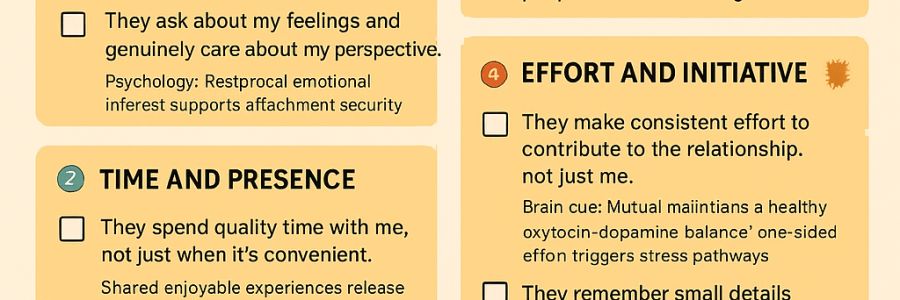
“Are My Needs Being Met?” Relationship Checklist

Instructions: For each statement, check ✅ if it’s true in your relationship. Fewer checks may indicate your needs aren’t being fully met. 1. Emotional Attention  My partner listens attentively when I speak, without immediately turning the focus back to themselves.Neuroscience note: Active listening triggers oxytocin release, creating trust and emotional bonding.  They ask about my feelings and… Read More “Are My Needs Being Met?” Relationship Checklist

Choosing Joy: Why It’s Better to Be Alone Than With the Wrong Person

A Psychological & Neuroscience Perspective Time is the one thing we can never get back. Who we spend it with—and how we spend it—shapes our mental health, emotional wellbeing, and even our brain chemistry. Too often, people stay in relationships where their needs and joys are ignored, hoping that companionship alone will fill the void.… Read More Choosing Joy: Why It’s Better to Be Alone Than With the Wrong Person

Stop Settling for Breadcrumbs: Why Equal Investment Matters in Relationships

A Psychological & Neuroscience Perspective Many people spend years—even decades—doing things on their own, waiting for a partner to notice or reciprocate. A small compliment, a half-hearted gesture, or a rare evening together may feel like a lifeline. But in truth, these are just breadcrumbs—tiny scraps of attention that keep you hoping, while never truly feeding… Read More Stop Settling for Breadcrumbs: Why Equal Investment Matters in Relationships

Genuine Care vs. Transactional Investment

A Psychological & Neuroscience Perspective At the surface, both scenarios look like “time spent with another person.” But deep in the brain, the motives and neurochemical patterns are very different. The difference shapes how the relationship feels, how stable it is, and whether it nourishes or drains you. 1. Investing Time Because You Genuinely Care Psychology: Rooted in intrinsic motivation—you… Read More Genuine Care vs. Transactional Investment

What It Means When a Partner Constantly Looks at Other Women and Makes Sexual Comments

1. The Psychological Message Lack of respect: Objectifying others in front of you sends the message that your feelings and dignity are not a priority. Low impulse control: This behavior is often linked to reward-seeking and impulsivity, similar to addiction-like patterns. Pathological narcissism or immaturity: Repeated sexual commentary can reflect a need for ego-boosting, validation, or dominance,… Read More What It Means When a Partner Constantly Looks at Other Women and Makes Sexual Comments

Missing Someone vs. Avoiding Someone: The Brain Science

1. When You Truly Miss Someone If you’ve been away and genuinely care, your brain naturally craves reconnection. Oxytocin (bonding hormone) rises when you think of them, driving closeness and touch. Dopamine (reward hormone) makes you excited about the reunion. Attachment psychology: Securely attached people restore connection after distance, because closeness regulates emotions and lowers stress. 👉… Read More Missing Someone vs. Avoiding Someone: The Brain Science