Rejected Appeals

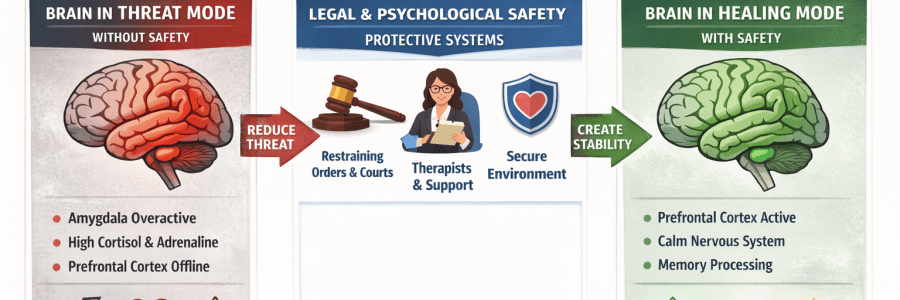
1. Why Courts Deny Appeals to Drop Restraining Orders Courts rarely remove restraining orders lightly because the safety of the protected person is paramount. Before considering removal, they typically review: History of abuse or harassment: Prior incidents, documented threats, or violence. Police reports: Evidence of criminal activity or domestic incidents. Psychologist or psychiatrist reports: Evaluations of risk, mental health concerns,… Read More Rejected Appeals

Why Now You Know It Was Never Love

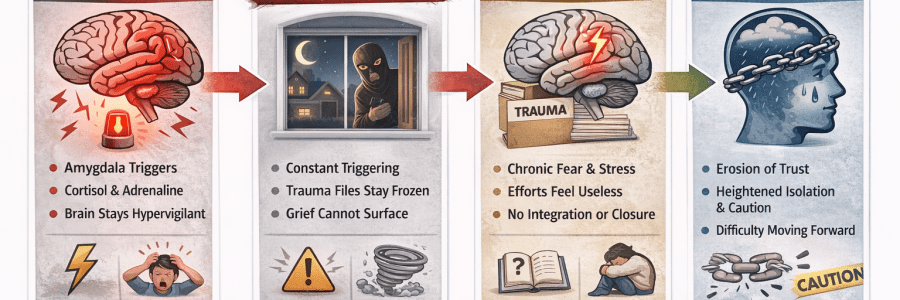
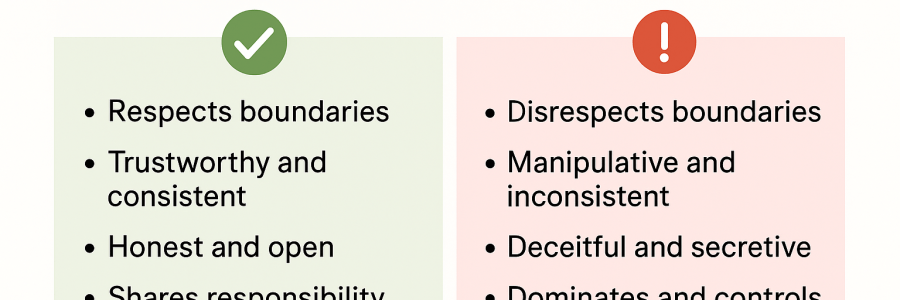
1. Love vs Abuse: Neurobiology Real love activates: Oxytocin & dopamine in balanced patterns (bonding + reward) Ventral striatum & prefrontal cortex for trust and long-term planning Safety circuits: parasympathetic system can rest, nervous system regulated Abuse activates: Amygdala hyperactivation → chronic fear, hypervigilance HPA axis → chronic stress hormone release Limbic hijacking → threat circuitry overrides rational thought Reward… Read More Why Now You Know It Was Never Love

Why Separation Triggers Escalation

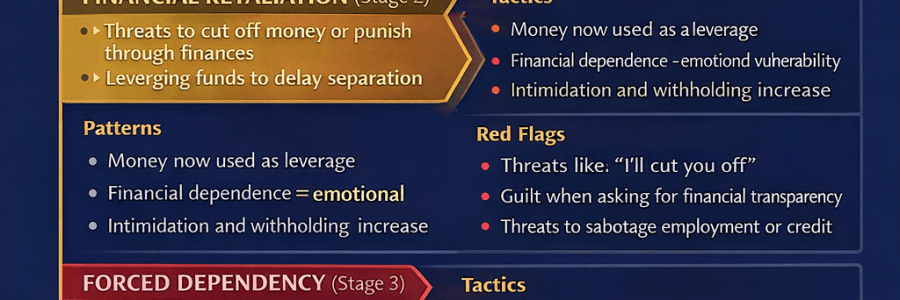
Below is a clear, step-by-step escalation model used in trauma psychology and coercive-control research to explain how financial parasitism intensifies once separation begins.This is predictable, patterned, and not accidental. Why Separation Triggers Escalation Financial parasitism is not just about money.It is about regulation, control, and entitlement. When separation starts: Access to resources is threatened Control over the partner’s nervous system… Read More Why Separation Triggers Escalation

Cycle of Long Term Abuse

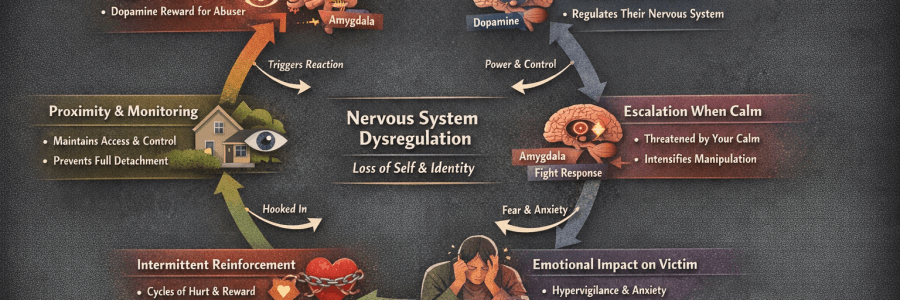
button-pushing, escalation when calm, reliance on your reactions for regulation, and staying close to you physically or symbolically — is actually a hallmark of long-term emotional abuse. Let’s unpack why this is, from both a psychological and neurological perspective. 1. Emotional Abuse Is About Control, Not Connection Long-term emotional abuse isn’t about conflict or even “anger.” It’s… Read More Cycle of Long Term Abuse

Why Abusers Often Refuse to Leave the Area

This is not coincidence, nostalgia, or practicality.It is about regulation, identity, and power. The key distinction: You heal by creating distance They destabilize when distance exists So they stay close. 1. Proximity Regulates Their Nervous System For an abuser, proximity to a former target functions like a regulatory anchor. Neurologically: Knowing where you are Being in the same… Read More Why Abusers Often Refuse to Leave the Area

Familiar pain feels safer than new peace

People relapse back into trauma bonds not because they’ve “forgotten the harm”, but because the brain temporarily prioritizes relief over truth when under stress. This relapse is neurological, predictable, and explainable — which is why understanding it removes self-blame and increases recovery. Here’s what’s really happening. 1. Stress Shrinks the Brain’s Time Horizon Under stress, the brain shifts… Read More Familiar pain feels safer than new peace

“I know this is bad for me — why can’t I let go?”

This is where endings become especially difficult — because trauma bonds and long-term relationships don’t just live in memory or emotion. They live in deep survival circuitry. Let’s connect the neuroscience clearly. Trauma Bonds: When the Brain Links Love to Survival A trauma bond forms when attachment is mixed with: Intermittent reward (affection → withdrawal → repair) Fear, unpredictability, or… Read More “I know this is bad for me — why can’t I let go?”

Calm truth

There was never anyone else.I returned from holiday with my family — my children and grandchildren. Nothing more, nothing hidden. The idea of a “mystery man” was a story used to discredit me. In reality, he had another partner while using my hard-earned money and restricting my access to my own finances. For decades, I… Read More Calm truth

Practical and safe approach

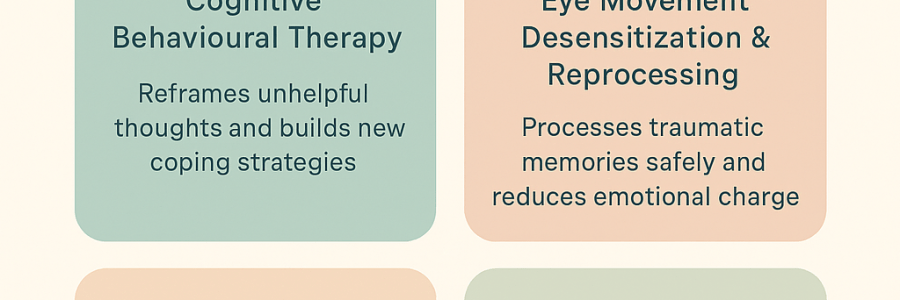
Passing the information to your psychologist and discussing it is generally a very safe and effective choice, from both psychology and neuroscience perspectives, because it allows you to process the material without carrying it alone, and it protects your nervous system. Here’s the reasoning: 1. Psychologists are trained containers for trauma Unlike family or acquaintances, psychologists provide… Read More Practical and safe approach

Why you should NOT pass details to their family

1. Families are not neutral containers Psychology shows that families are emotionally invested systems, not objective recipients of information. Common outcomes: Denial Minimisation Defensive loyalty Blame-shifting Retaliation (direct or indirect) Neuroscience: Family identity activates threat and loyalty circuits in the brain. The prefrontal cortex (reasoning) is often overridden by ingroup protection. This means facts are rarely processed rationally. 2. You become… Read More Why you should NOT pass details to their family