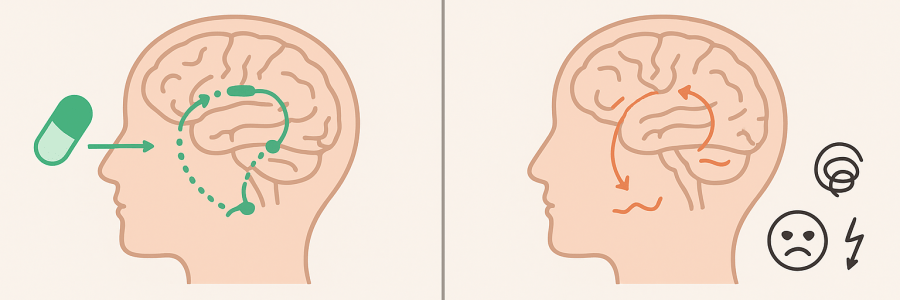
Behavioral Choice Pathways: Neuroscience of Deliberate Actions

Here’s a neuroscience-informed explanation of behavioral choice pathways, specifically in the context of abusive or manipulative behavior. This framework emphasizes that abuse is a deliberate, neurologically reinforced choice rather than a symptom or accident. 1. Key Brain Circuits Involved Brain Region Function in Behavioral Choice Implication for Abuse Prefrontal Cortex (PFC) Executive function, planning, decision-making, inhibition Enables abuser… Read More Behavioral Choice Pathways: Neuroscience of Deliberate Actions

Medication, Behavior, and Abuse: Choice and Responsibility

Here’s a neuroscience-informed explanation addressing the relationship between medication, behavioral regulation, and abusive behavior, framed in terms of choice and accountability. 1. Abuse is a Choice, Not a Symptom 2. Role of Medications 3. Choosing Not to Take Medication 4. Psychological and Legal Implications Scenario Neuroscience Insight Accountability Abuse while on medication Reward circuits still drive pleasure from… Read More Medication, Behavior, and Abuse: Choice and Responsibility

Abuse: Choice vs Misconception of Mental Illness

Here’s a clear, neuroscience- and psychology-informed explanation distinguishing abuse as a deliberate choiceversus the common misconception that abuse is caused by mental illness, stress, or emotional instability. This is suitable for educational, clinical, or legal contexts. Abuse: Choice vs Misconception of Mental Illness Aspect Abuse as a Deliberate Choice Misconception: Caused by Mental Illness / Stress / Instability… Read More Abuse: Choice vs Misconception of Mental Illness

Abuse as a Deliberate Behavioral Pattern: A Neuroscience and Psychology Perspective

Introduction Abuse is often misunderstood in popular discourse as the result of stress, mental illness, or poor emotional regulation. Neuroscience and psychology research increasingly clarify that abuse is a conscious, deliberate behavior aimed at power and control rather than an accident or symptom. Understanding the underlying mechanisms helps survivors, professionals, and the legal system recognize patterns, predict… Read More Abuse as a Deliberate Behavioral Pattern: A Neuroscience and Psychology Perspective

Co-Dependent Individuals: Neuroscience and Psychology

Co-dependency refers to a pattern where an individual consistently prioritizes others’ needs over their own, often to the point of emotional, psychological, or even physical detriment. It’s commonly observed in relationships with emotionally unavailable, abusive, or high-conflict partners. 1. Brain Mechanisms in Co-Dependency A. Reward System Dysregulation B. Emotional Regulation C. Attachment Circuitry D. Stress Response… Read More Co-Dependent Individuals: Neuroscience and Psychology

Why Healthy Relationships Matter

Surrounding yourself with healthy, supportive, and inspiring people is one of the most powerful ways to protect your emotional well-being, reinforce positive habits, and create resilience against toxic or dark-trait individuals. Here’s a breakdown of why and how to do it effectively: 1. Why Healthy Relationships Matter Neuroscience Perspective Psychology Perspective 2. Characteristics of ‘Healthy, Beautiful’ People… Read More Why Healthy Relationships Matter

Neuroscience-Informed Trauma Bond Resistance: Overview

Key Concepts / Mechanisms Practical Implications Neurobiology of Trauma Bonds Explains how the brain forms strong attachments even in harmful relationships. – Dopamine system (nucleus accumbens): reward spikes during intermittent affection.– Oxytocin system: strengthens bonding, trust, and attachment.– Amygdala & HPA axis:hyperarousal, fear, and stress responses.– Prefrontal cortex suppression:rational decision-making is reduced during emotional manipulation. – Recognize neurochemical dependence.– Understand physiological… Read More Neuroscience-Informed Trauma Bond Resistance: Overview

Neuroscience-Informed Guide to Trauma-Bond Resistance

1. Understanding the Neurobiology of Trauma Bonds Trauma bonds form when intermittent reinforcement (alternating kindness and abuse) hijacks the brain’s reward and stress systems: Result: Even when abused, your brain craves connection, creating a powerful attachment. 2. Key Psychological Mechanisms 3. Strategies to Build Resistance (Neuroplastic Approach) A. Strengthen Prefrontal Cortex Engagement Activates rational decision-making, reduces impulsive reactivity.… Read More Neuroscience-Informed Guide to Trauma-Bond Resistance

Behavioral Indicators

Avoiding or protecting yourself from individuals with dark-triad traits (Machiavellianism, psychopathy, narcissism) or related traits like sadism involves a combination of psychological awareness, boundary-setting, and behavioral strategies. Here’s a thorough, neuroscience-informed guide: 1. Recognize Early Red Flags Behavioral Indicators Psychological Indicators Tip: Keep a mental or written note of repeated patterns rather than dismissing them as one-off incidents. 2.… Read More Behavioral Indicators