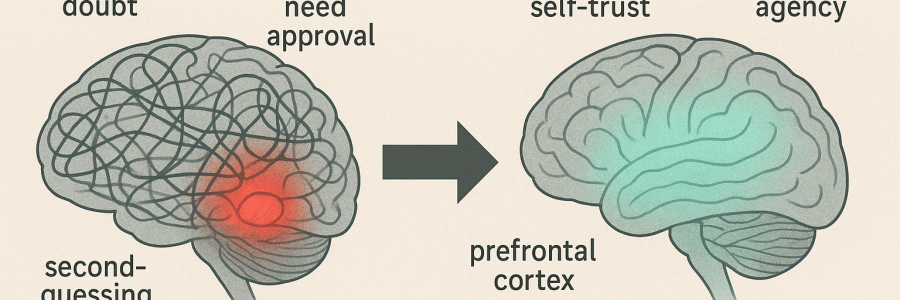
When Fear of Abandonment Meets Upward Comparison: Why Some Men Become Hyper-Jealous — A Psychological & Neuroscience View

There’s a difference between ordinary worry (“I miss you when you’re gone”) and the kind of constant, corrosive anxiety that turns a partner into a threat. When that anxiety meets an environment of constant comparison — social media, beauty ideals, social reward for attractiveness — the result can be a destructive pattern: surveillance, accusations, controlling… Read More When Fear of Abandonment Meets Upward Comparison: Why Some Men Become Hyper-Jealous — A Psychological & Neuroscience View
Ego Self vs. Higher Self: Understanding the Difference

The Ego Self The ego self is the part of us most people are familiar with—it’s the “I” that interacts with the world. In psychological terms, the ego helps us form an identity and navigate daily life. Neuroscience points to areas like the default mode network in the brain (active when we think about ourselves and our place in… Read More Ego Self vs. Higher Self: Understanding the Difference

The Repetition of Harm: When Manipulation Masquerades as “Guidance”

One of the most powerful tools of manipulation is repetition. Over and over, you hear the same phrases, criticisms, or warnings, until your brain begins to absorb them as truth. At first, they might sound like advice, even concern. But in reality, they are acts of control designed to erode confidence, isolate you from support, and… Read More The Repetition of Harm: When Manipulation Masquerades as “Guidance”

The Repetition of Control: How Manipulation Masquerades as “Care”

One of the most insidious features of long-term manipulation is its disguise. It rarely announces itself as cruelty or domination. Instead, it cloaks itself in the language of concern: “I’m only reminding you because you got it wrong before.” “I’m telling you this for your own good.” To an outside ear, these phrases may sound protective. But when… Read More The Repetition of Control: How Manipulation Masquerades as “Care”

Relearning Autonomy After Manipulation: The Strange Freedom of Making Your Own Choices

For anyone who has lived under the shadow of control, manipulation, or coercion, the moment of stepping into true autonomy can feel less like liberation and more like vertigo. Suddenly the air feels different—you’re not being told what to do, but instead left with the unnerving task of making your own decisions. At first, this… Read More Relearning Autonomy After Manipulation: The Strange Freedom of Making Your Own Choices

Forgiving Yourself and Staying Soft: A Neuroscientific and Psychological Perspective

Forgiveness is often seen as something we extend to others, but self-forgiveness is a profound act of healing, especially after trauma, mistakes, or deep personal regrets. It is not about excusing harm or minimizing wrongdoing; it is about acknowledging your humanity, integrating your experiences, and cultivating resilience without hardening your heart. 1. The Neuroscience of Self-Forgiveness… Read More Forgiving Yourself and Staying Soft: A Neuroscientific and Psychological Perspective

Reclaiming Your Mind: The Neuroscience and Psychology of Moving Forward After Abuse

Life can deal unimaginable blows, and when those blows come from someone you trusted deeply—especially over decades—the psychological and emotional impact can feel overwhelming. Yesterday, you marked a profound milestone: deciding, in your mind and heart, that your abuser is no longer a presence in your life. From now on, your thoughts will focus on… Read More Reclaiming Your Mind: The Neuroscience and Psychology of Moving Forward After Abuse

Ignored or Dismissed: The Brain’s Role in Denial

When a family member ignores or dismisses your experience, it’s not always a conscious act of cruelty—often, it’s tied to how the brain processes threatening information. Threat response and emotional avoidance: The amygdala, the brain’s emotional threat center, can trigger avoidance when someone is confronted with information that challenges their perception of a loved one. To… Read More Ignored or Dismissed: The Brain’s Role in Denial